


Behind the The Art of Banksy with Michel Boersma
‘Art should comfort the disturbed and disturb the comfortable’—Banksy
Walking into the Aotea Centre on the very chilly evening of the 7th of July, to attend the opening of ‘The Art of Banksy’, I toyed with the idea of maybe returning home to my wooly slippers, my comfortable dressing gown, a lovely cup of tea. Art exhibitions aren’t usually ‘my thing’. Give me a book launch any day of the week. Art galleries are unchartered territories for me.
Years ago, in my dappled youth, I had been invited to an art exhibition, which I attended excitedly, for a local artist-buddy. The result: I consequently made a few guests (several being the family of the artist) uncomfortable with my loud, shaking, deep voice (imagine the sound of an opera singer drowning), my accidental ‘disregard’ of spacial awareness, and my ‘hands-on’ approach to appreciating the art. I was excited, and I have flappy fingers, who could blame me? Having flash-backs of the security at that exhibition watching me like a hawk made me perturbed in attending this opening. But when you get invited by the curator to see authenticated and original Banksy art pieces, you go.
Art, in itself, is subjective, and curious and deserves to be spoken to. At times, I felt that Banksy would’ve appreciated a hint of raucousness from me, but alas I abstained. As much as I could, I guess, when looking at his politically-charged, thought-provoking and very-often controversial art pieces.
A few well-known artists have captured the world’s imagination, provoked such intense debate, or maintained such a shroud of mystery as Banksy. Emerging from the streets of Bristol in the early 1990s, Banksy’s work has transformed from gritty underground graffiti to some of the most talked-about and sought-after art in the contemporary world.
As the guests shuffled themselves slowly through the dimly-lit Hunua Rooms on the first floor of the Aotea Center (with me awkwardly trying to get out of everyone’s way), I couldn’t help but feel like I was rebelling alongside the artist.
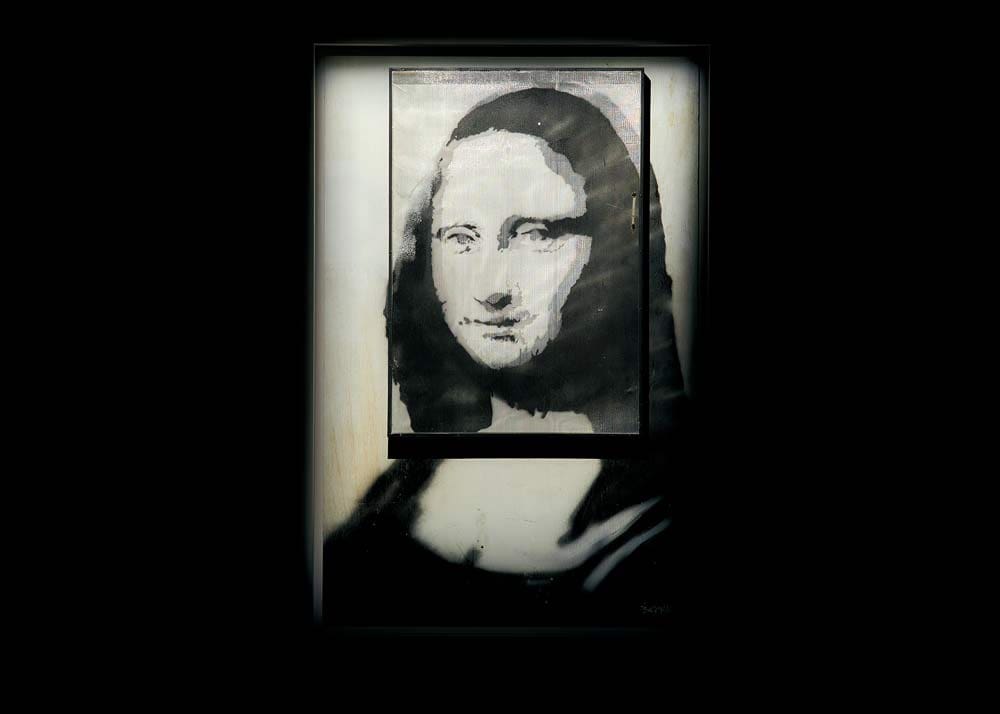
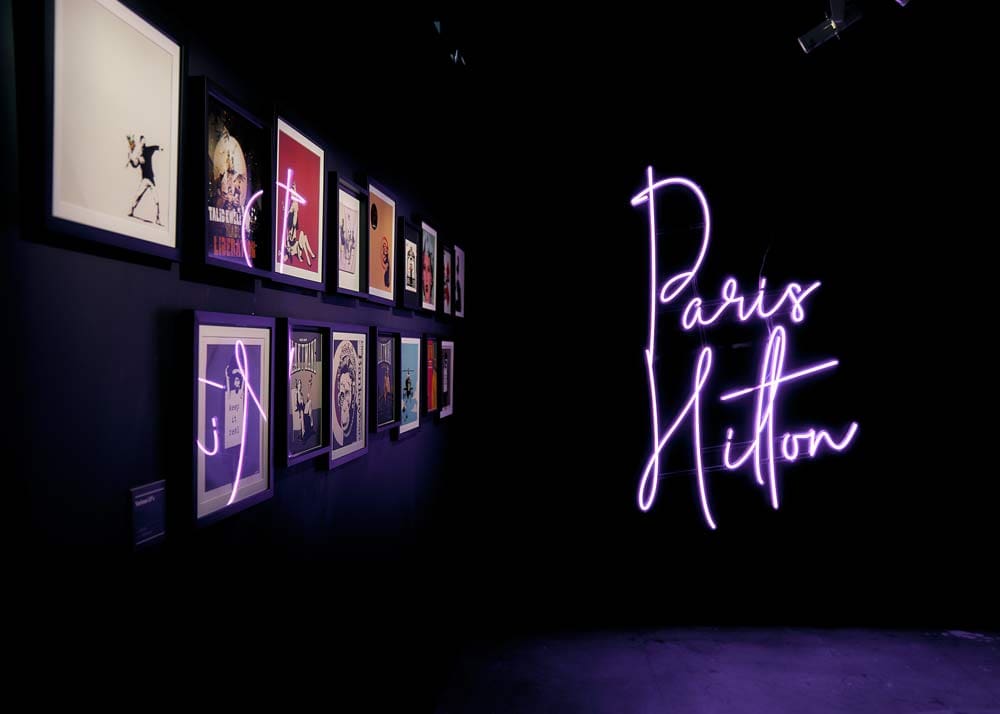
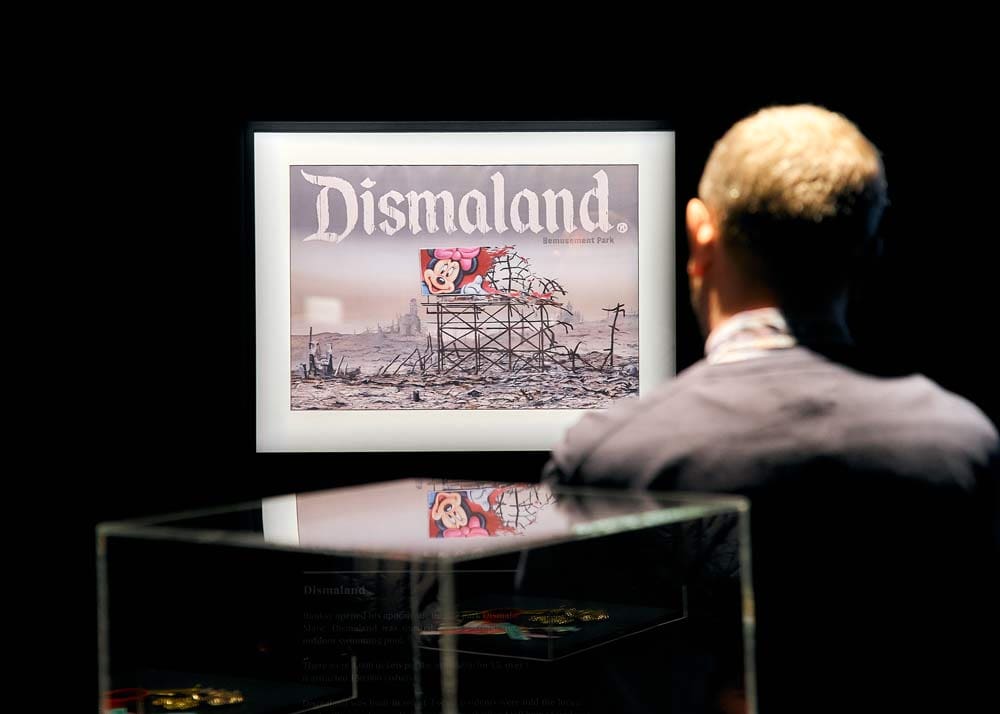
The detail and care taken to design the 909 sqm temporary space is outstanding. It is dark and moody, gritty and oftentimes even off-putting, blending hints of social commentary with humor. The pieces on display are instantly recognizable—having appeared everywhere from London alleys and the West Bank wall to major galleries and auction houses.
Bringing in over 1.5 million visitors across 19 cities across the world, ‘The Art of Banksy’ is truly not one you want to miss. A girl letting go of a heart-shaped balloon, Queen Victoria sitting on someone’s face in the anti-royalist Monkey Queen, Paris Hilton’s calligraphed name in bright neon lights, or a protester throwing a bouquet of flowers instead of a Molotov cocktail. These are not just images; they are statements from the artist. In a time where branding often overshadows content, and social media blurs the line between activism and performance, Banksy’s voice barks, rebellious and urgent.
Auckland Live, alongside GTP, presents ‘The Art of Banksy’ from the 8th of July to the 3rd of August in the Hunua Rooms of Aotea Centre. I got to sit down with curator and producer, Michel Boersma, a week before opening the exhibition in Auckland to talk to him about ‘The Art of Banksy’, working alongside Ben Eine, and the impact that Banksy’s art has had on the world.

You brought The ‘Art of Banksy’ to Wellington for a very successful run last year. Why back so soon, and why up to Auckland?
We originally went to Auckland in 2018 with a smaller version. We’ve been doing ‘The Art of Banksy’ for a while; touring it for the last nine years. Auckland will be the 19th city we’ve done. It’s like a soup—it grows and grows. We work with private collectors, a lot of them buy art directly from Banksy. When we did the exhibition in 2018, we had 65 pieces. Now, we have 160 pieces! In 2018, we thought we had a big exhibition. No, no, no…what we have now is big!
We’ve been able to change a bit more of the curation, where we get to tell ‘behind the scenes’ stories. Together with Ben Eine (the printer of Banksy), who is a big artist himself, we have six audio-visual components where Ben is telling all the anecdotes and naughtiness they got up to behind the scenes and stunts. He tells how iconic images were created. Over the years we were able to create more layers to the exhibition. When we opened in London, where we ran for two years in three different locations, I was approached by former girlfriends of Banksy. Banksy had created artworks for them, like the original ‘Flower Thrower’, which was actually a Valentine’s Day gift created seven years before you and I ever saw it in exhibition.
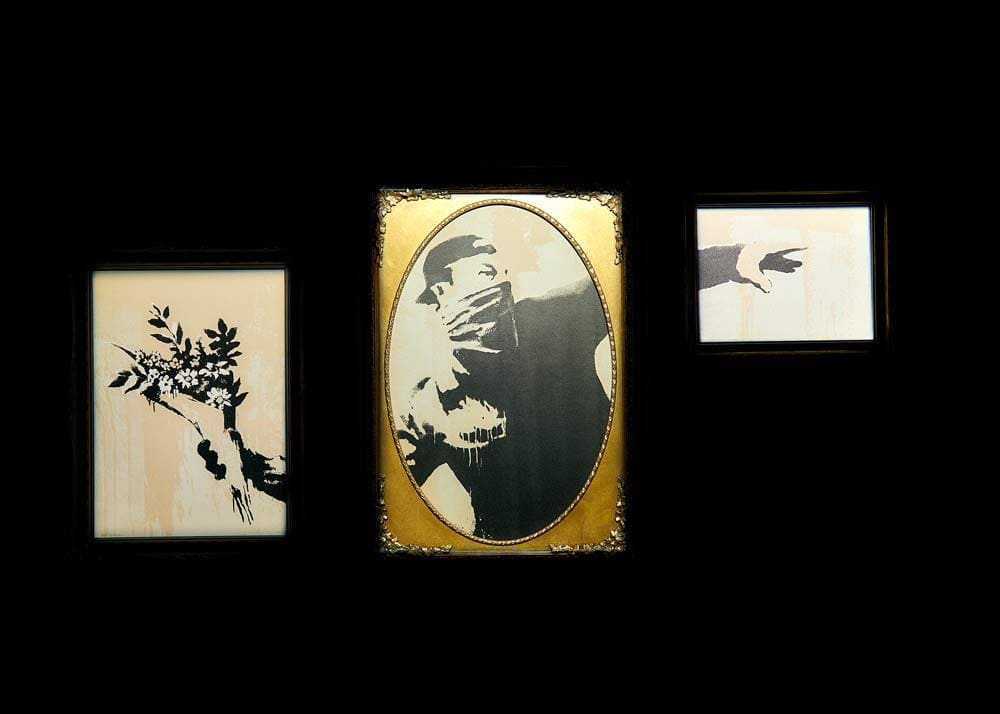
The first time in Auckland was a major success—record-breaking, even. There was a gap in our touring and I was wracking my brain in where to go next. We’re quite selective on where to go. And there are a lot of Banksy exhibitions around. Most of them don’t have authenticated works—they’re replicas, which I know Banksy hates with a vengeance. They copy his art, and they copy our name and branding. Like ‘The Art of Banksy’ exhibition in Australia recently wasn’t us and only had 10 prints (all replicas). They were a ‘tribute show’. We have completely authenticated art. No copies or replicas.
I had started talking to Auckland Live, because the love we received from New Zealand last year was amazing. We’re using the same location as last time [we were in Auckland], but we’re squeezing in 100 more works. We’ve pre-hung everything in preparation, but I’m still pretty nervous about arriving. I’ll still be thinking: oh, f**k, how are we going to do this?
I know this is quite a broad question, and you must get asked this 10,000,000,000 times, but why Banksy? What was the draw-in for you?
I don’t come from the fine art world. I’m actually a theatre-producer and I own an entertainment company. When I got involved with Banksy nine years ago, as a producer, I realized that there’s a reason he has such a broad appeal. I like to tell stories and take an audience on a journey. You know the people who say they don’t ‘get’ art, and don’t go to galleries…I bet they do like Banksy, and will go to a gallery for him. They’ll pick up the newspaper when Banksy is on the front cover with a new work and they will talk about it. I like when we work with schools and school children, because Banksy is a point of entry into the arts. The images are instantly recognizable! People don’t have to stand there for 10 minutes and over analyze the pieces and think they’re very wise and clever because they gave an in depth reading on an Banksy piece. For me, it’s more so a question of: do you like it? Does it speak to you? Banksy doesn’t explain what the image is, because it’s always so clear. The pieces usually have a lot of humour.
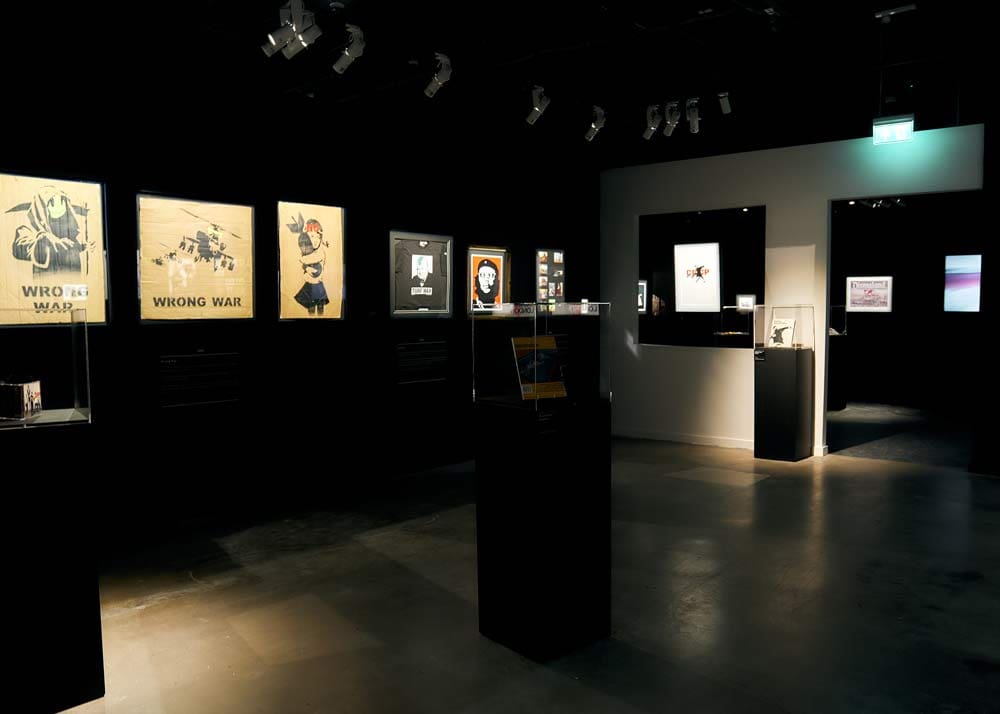
To get audiences to come to a museum-grade exhibition and do it in a way that is entertaining to the eye and the brain is an achievement for me. I’m welcoming people in to experience this as if I’m doing a theatre show. Our lighting, for example, has always been commented on as being outstanding—those sort of details, where it becomes a visual feast. I love walking around the exhibition (and no one knows who I am, so it’s perfect!) and get to hear people engage with it and talk about the stories.
With ‘The Art of Banksy’, we’ve been able to fill in the blanks a little bit more. We have hand-drawn sketches of ‘Flying Balloon Girl’, or ‘Girl with Balloon, Flying’, which is in Israel. Ben Eine and Banksy went to Israel for a reconnaissance. On the back of the piece of paper where Banksy had sketched, you see the marks from the concrete slabs of the West Bank wall, and also a sketch of Ben Eine that Banksy did when they were waiting at the airport. Eine was very sunburnt, and you can actually see the shading detail of the burns in the sketch. That adds a layer to the enigma of Banksy. It’s so multifaceted.
I wish I got a dollar every time someone asked me who Banksy is—I’d make a very good living. But I always say: ‘you don’t wanna know…’ Of course, over the years, he has been outed. The journalist who successfully outed him, and he knows she outed him, is extremely frustrated because nobody was picking it up. People really don’t want to know who this ‘shadow-boy’ is. Because if people know who he is, they’ll soon realize that it’s just a normal guy who wakes up in the morning, does food shopping, and washes his car on a Sunday. Suddenly this whole ‘Banksy’ thing is different in the public gossip. So we all sit there like little monkeys with our hands over our ears going: ‘we don’t wanna know, we don’t wanna know, we don’t wanna know…’ We like the fairy tale too much.
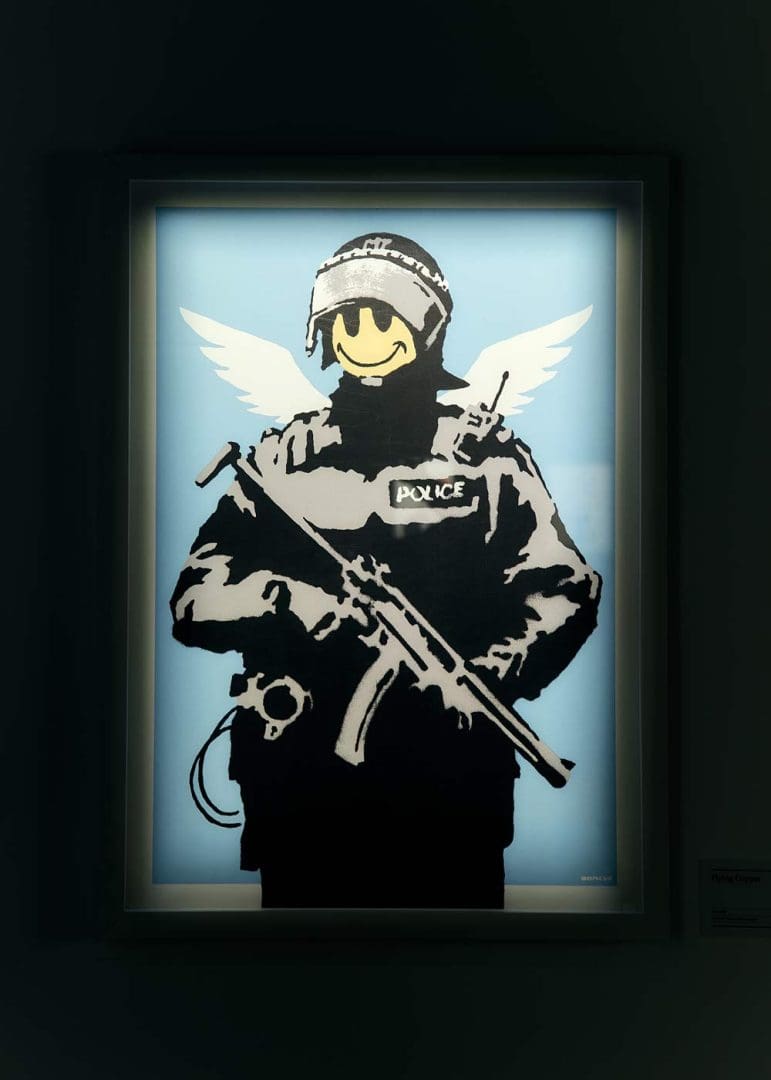
When you get to ‘The Art of Banksy’, and the work we did with Ben Eine, you get to all the naughty stuff…or the ex-girlfriend’s story…The stuff we found out about the ‘Flower Thrower’ piece (the one he did for a Valentine’s Day gift) is mind-blowing. Or there was an ex-girlfriend who worked with us—she was with Banksy for four years—who had a collection of birthday cards from him for each year. Remember, this was from the early days. Within those four years, and looking at these four cards, he becomes Banksy. Imagine what it was like for me, opening this little box, and it had the cards which had never been seen outside of her family. Inside these hand-drawn cards, you see a teenage doodler becoming Banksy. First card, he signed with his real name. Second, he signed ‘The Bankster’, or something like that. Third, something else. Then, the last year they’re together, he’s Banksy. He signed it with the immediately recognizable Banksy signature.
Over the many years doing this, there have been extremely frustrating moments, but then moments I can dine out on. Banksy hates exhibitions, but he went to our exhibition in London. His closest mates went too and loved it.
If you’re Bruce Springsteen, and 75, you can sing all your biggest hits, and new songs, until your dying day. But when you’re Banksy, you can not do that. ‘The Art of Banksy’ is the best tour that he can’t do. If he does an exhibition, he’ll have to have a new art piece, and recreate his old work. Like in 2023 in Glasgow when he did his last exhibition with stencils on display, he had actually made new art on the stencils.
When we opened in London, on Regent Street, press were like: ‘does Banksy know about this?!’
‘Yeah, he knows about it…’ I replied.
‘Are you in contact?!’ they asked.
‘Yeah, we’re in contact…’
‘Does he like it?!’ they asked.
‘It depends on what day you ask him…’
I know he likes us better than the rest, because the rest are f**king fake.
‘Oh, so he doesn’t like it?!’ they said.
I told them Banksy could open a new exhibition in the building next door, and that audience would be completely different to the one we attract. The audience that goes to his exhibition would say that they had been to ‘THE Banksy exhibition’ and it’d be a tick off their bucket list, more ego than art. We attract the people who actually love, or are mystified, by him. They want to interact with the ‘Girl with Balloons’. In ‘The Art of Banksy’, the ‘Girl with Balloons’ is in its separate room and there are four of them. People don’t realize that that piece comes in red, blue, purple and—the holy grail of them—the gold one. When you go into the space, the lights are only on them as if they’re floating. These Banksy prints become the moment. Like when you’re walking into the Louvre and you are standing in front of the Mona Lisa.
When the mates of Banksy went to see the show in Covent Garden, before we opened, one of them spent two and a half hours in the exhibition. Every text he read, and every audio bit he listened to. He turned to me and said: ‘do you realize how mind-blowing this is?’
I realized then that all these mates of his, that had shared in creating Banksy’s works with him, had never seen their childhoods, or earlier years, laid out in front of them.
It’s a very interesting world.

What was the key component in curating ‘The Art of Banksy’?
It organically grew. I wanted to tell the story. When we were in Auckland in 2018 it was the first time we had a timeline. It was one wall with dates. It wasn’t my idea. Someone else was curating it then. We didn’t have the space, and quite literally it was boring.
The start of this year’s ‘The Art of Banksy’ will begin with his career; an ephemera in art. We take pivotal moments in his timeline and we show it. For example, we show how he got to using stencils. We actually have stencils that Banksy used. We show all the big moments with actual works there. That connects the audience more. That was a big step.
I noticed how we weren’t in actual galleries, but pop-up type situations. We’ve been in an ammunition factory in Toronto, a tent in Sydney, a supermarket in Tel Aviv. The layout is always different. I always enjoy making the layout. You notice that even though the art is the same, the story becomes different. I noticed when we did our show in Regent Street in London, that it was about money. I told Judith, my manager. I was like, ‘do you notice something different?’ We were in the middle of Regent Street. King Charles was our landlord. I literally had a rental agreement with the King! I actually took a picture of the agreement. The curation was suddenly about the duality of Banksy. It’s how the exhibition sits in the world. It’s funny how the focus will change in Auckland too. I look forward to setting up, being able to walk around before we open and be like, ‘okay, so now this time “The Art of Banksy” is…’ It’s a living thing. We start from scratch every time. We’re working on the next stop right now and we can play with it. It’s very nice.
Do you have a favorite piece in the exhibition?
There’s this one tiny piece, and I love hanging it. It has its own wall. It’s a test print of ‘Bird with Grenade’ and it’s pink. It has a Disney-like quality to it. I love the story of the original ‘Flower Thrower’. That’s the only thing we’ll have scanned at the back because we couldn’t show both sides. There’s a personal message from him to his former girlfriend. But…it’s not the original message. She had sent the work to Banksy’s office, for a certificate of authentication, and after nine months she still didn’t have to back. She pissed him off, basically, or vice versa. He had taken a grinder to the original message and had grinded it off. You can see the scratches on the back. And there, the new message: ‘To Leonie Laws, from your admirer, B.’
There’s one we haven’t got in the exhibition, another small piece. Do you know The Snowman, by Raymond Briggs? ‘I’m walking in the air?’ Banksy used that image. And it’s a very naughty snowman. Google it. It’s one snowman doing something to another snowman. I have a little giggle.