
Avatar: Fire And Ash
It’s been three years since Avatar: The Way of Water broke box office records and now we’re picking up the story again right where it left off. Avatar: Fire and Ash starts with the Sully family still living amongst the Metkayina Clan in the picturesque reefs of Pandora, but is learning to adjust to life without Neteyam who was killed in a brutal skirmish with the humans in the last film.
In discussing his character, Worthington says, “’Fire and Ash’ is almost a direct kind of step from the end of the second movie; it’s literally where we see them starting to tear. Jake goes back to his essence, which is just being a grunt, because that makes sense for him to go back to war, to do what he has been trained to do…he thinks that will get him through the pain.”
“The film also looks at Jake and Lo’ak’s relationship as they figure out their place within each other’s worlds,” continues Worthington. “It’s not necessarily about a father and a son…it’s about a mirror. Jake and Lo’ak are a reflection of each other, and like I am with my own son in my own real life, I’m trying to make him a better version of myself, which is what Jake is trying to do with Lo’ak. He’s also seeing the worst of himself in Lo’ak, and that’s an interesting kind of concept and dynamic to work with.”
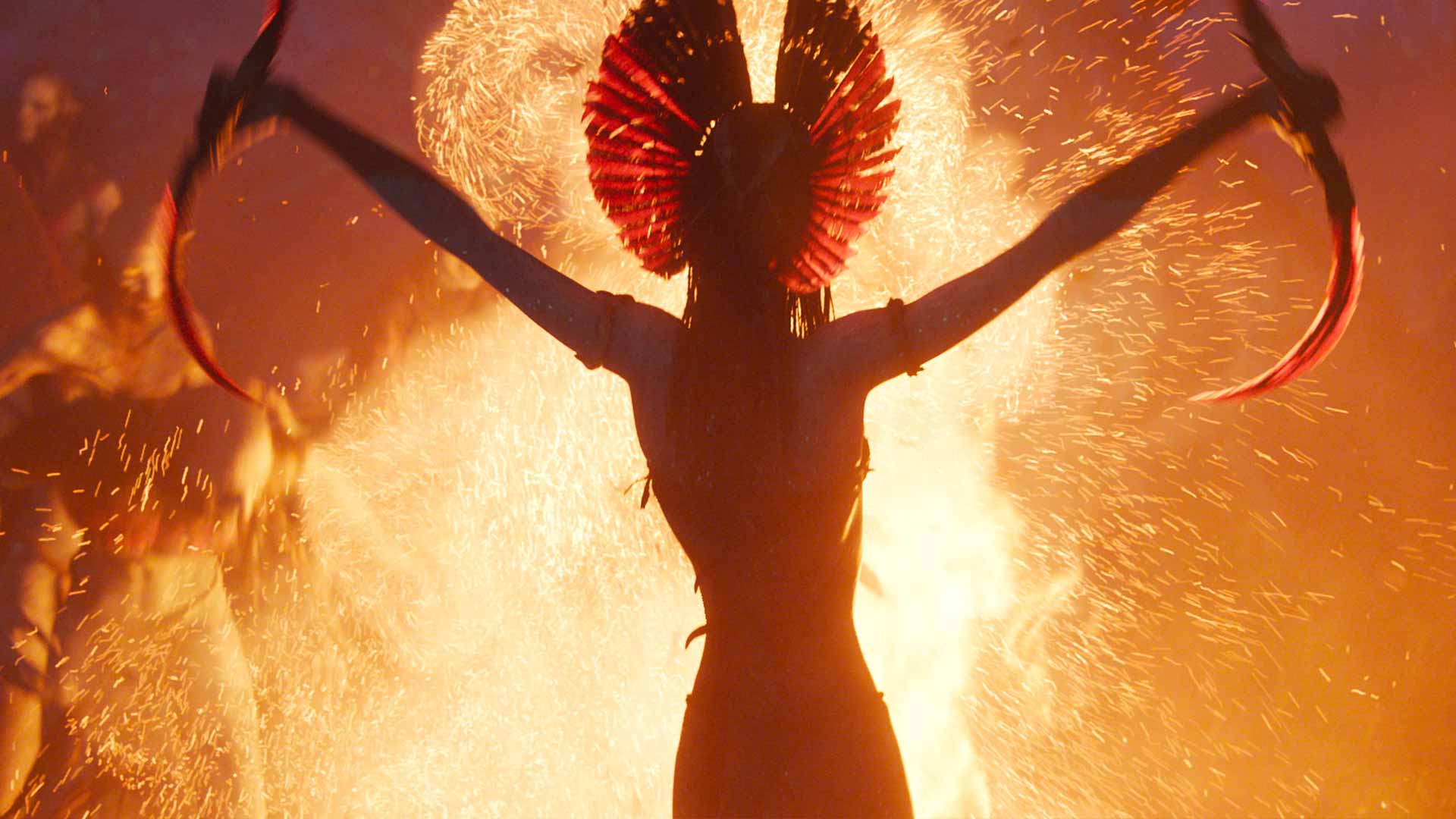
Spider, the human kid with the family faces his own trials with the water people, and this ultimately causes the family to up-stakes and leave for bluer pastures. This causes them to cross paths with the ash-people. Guess what their whole thing is.
According to director/co-writer/producer James Cameron, “This is a movie about a family processing what it means to be in a war, for kids to be in a war, for parents to let their kids go and trust them enough that they’re going to make the right decisions. This is an important theme in the movie. And for Jake, having just lost a child, his protectiveness takes the form of being an almost tyrannical father.”
The screenplay for “Avatar: Fire and Ash” is once again written by director/producer James Cameron & Rick Jaffa & Amanda Silver who are also responsible for the “Planet of the Apes” trilogy and “Jurassic World,” among numerous other titles.
One sad note is the loss of producer Jon Landau, Cameron’s right hand man for thirty years since producing Titanic. His name will appear posthumously on the credits for the next couple films. His son, Jamie Landau, naturally had more access to the scripts, and so began to pick up more of a leadership role coaching the mo-cap performance troupe. “So, when the live-action portion of the production, the biggest bulk of it (in 2020) was done, Jim asked me to stay on in New Zealand and help supervise on our virtual camera stage,” Landau says, “And that was really the start for me.”
All the films so far have been shot predominantly in New Zealand. More than 1,500 crew members in New Zealand were involved in the production of this film. “On ‘Avatar,’ we thought of New Zealand as our second home, but it might actually be our first home now,” says Producer Rae Sanchini. “Jim is now officially a New Zealand citizen. Filming there has been absolutely fantastic. The crews have been great, and the people are lovely to deal with. Wētā, our primary visual effects house, is, of course, based there, so it makes all the communication between Jim, who lives in Wellington, and the supervisors at Wētā much more fluid and immediate. And Stone Street Studios, where we film live action, is practically in the heart of Wellington.”
“’Avatar’ movies are not made by computers,” says Cameron. “’Avatar’ films are made by an incredibly talented team of people – especially our actors – who physically perform every scene.”
“I worked with my cast on ‘The Way of Water’ and ‘Fire and Ash’ for almost 18 months. Every expression, every movement, every emotional beat comes from their real performances.”
I’m definitely seeing this one at iMax, because I like to support New Zealand industry, of course.