

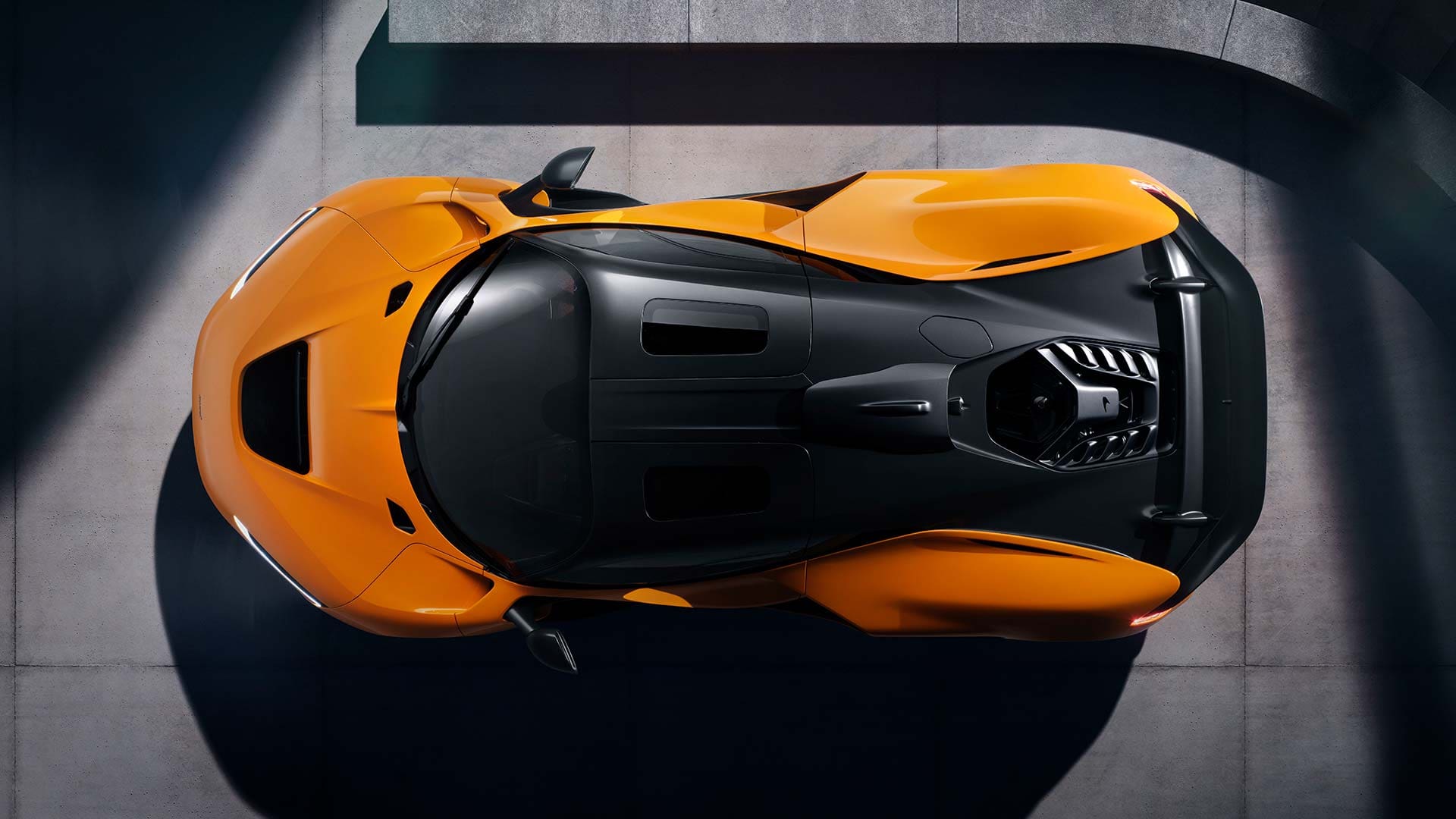
The McLaren W1, It’s The One
The pinnacle of automotive performance is an ever moving target and with McLaren’s racing heritage, the challenge is fundamental to the brand. Following the legendary F1 and the paradigm-shifting hybrid P1, the company faced the huge task of writing the next chapter.
The result is the W1, a vehicle conceived not merely to be fast, but to be what McLaren calls “a real supercar.” Through an in-depth discussion, Heather Fitch – product manager for the W1 since its first imagining – reveals the core principles and groundbreaking technologies that define this new apex machine. ‘1’ is a special designation in McLaren parlance, only the most extraordinary cars receive it. Maybe it’s a nod to McLaren’s current status as Formula 1 constructors champion, or maybe it’s just a great number.
“The W1 has been inspired by two of the greatest supercars ever made, the F1 and the P1,” Heather continues. “The F1 was designed to be the best supercar in the world, resetting benchmarks of performance and engagement. The P1 was the world’s first hybrid supercar, changing perceptions of hybrid powertrains. The W1 takes inspiration from these two cars and moves the game on further.”

This ambition is built upon four foundational pillars: Performance Everywhere, Epic Power, Pure Connection, and Authentic Theatre. These principles, distilled from the essence of its predecessors, guided every engineering and design decision, resulting in a car featuring over “12 world-first technologies and more than 45 McLaren firsts”.
The first pillar, “Performance Everywhere,” is about creating the ultimate breadth of ability on both road and track. This begins with what is described as “our most advanced aerodynamic package we’ve ever put on a McLaren to date.” Central to this is the active rear wing, which works in tandem with a full-width active front splitter. “When you’re in extreme braking scenarios, what it does is it balances the car, giving it incredible stability in cornering, and that’s where we get our real advantage from in terms of lap time performance and drivability,” the project lead explains. The system is transformative. In its road configuration, the car generates a substantial 200 kilograms of downforce. Press the race mode button, however, and the car lowers as the wing extends, multiplying the aerodynamic load to an extraordinary 1000 kilograms. This active aero system is so substantial it defines the car’s physical form. The wing extends back a massive 300mm to connect its leading edge with the trailing edge of the car’s massive underbody diffuser delivering ground effect as well. “It makes it a long tail,” she confirms. “You’re extending the body to maximise the performance.”

The doors were dictated by aerodynamics. The W1 features ‘Anhedral’ doors, hinged on the roof rather than the A-pillar. I can’t explain them, you have to see a video. “We needed to ensure we were getting all of that airflow straight to the back to feed the engine, which meant we needed a really clear air path down the body side,” she elaborates. “It meant we had to clear out space in this corner, which meant the hinge had to go.” The result is a stunning visual display that serves a critical performance function.
This aerodynamic mastery is paired with McLaren’s dedication to ‘lightweighting’. The W1 boasts a power-to-weight ratio of 670 kW per tonne, the best ever for a McLaren road car. “There are so many benefits that you get from lightweighting, obviously in performance, but also drivability and cornering capability. You can really feel how agile it is.”

At the core of the W1 is an all-new high-performance hybrid powertrain generating a colossal 938 kW. The all new V8 engine produces 683 kW on its own and revs to a wild 9200 rpm. The electric system contributes a further 255 kW. “It’s unique to us and designed specially for this package,” she notes. “It also allows us to feed in the torque at a particular point that we want to in the system to give us that high performance.” This system provides instantaneous torque fill, sharpening throttle response and supplementing the V8. All up it delivers 1340Nm, a mind bending figure. Output is good for a top speed of 350 Km/h and mass is 1,399 kg dry. The combination of extreme power, low mass, and potent aerodynamics delivers staggering acceleration. The W1 sprints from 0 to 200 km/h in just 5.8 seconds, a figure that bests even the straight-line-focused McLaren Speedtail. The car’s dual personality is the key. “When the wing is in, it’s incredibly low drag, which allows us to have that really slippery surface for good top speed. When it extends, we’re basically into a McLaren Senna, using that big wing for downforce.”
The “Pure Connection” pillar ensures the W1 is an engaging and usable vehicle for the road, not just a formidable track machine. “Customers are using this on the roads, they’re living with this as part of their lives day-to-day. For us, it’s a huge focus to make sure this was just enjoyable.” To achieve this, McLaren prioritised a pure, unfiltered driving experience. The car is exclusively rear-wheel drive, and both the steering and braking systems are hydraulic, providing a direct, tactile connection to the road. “There’s no regenerative braking on the braking systems. It’s pure McLaren brake feel, which we prioritize to make sure that you feel like you’re driving a car and it’s really connected.”
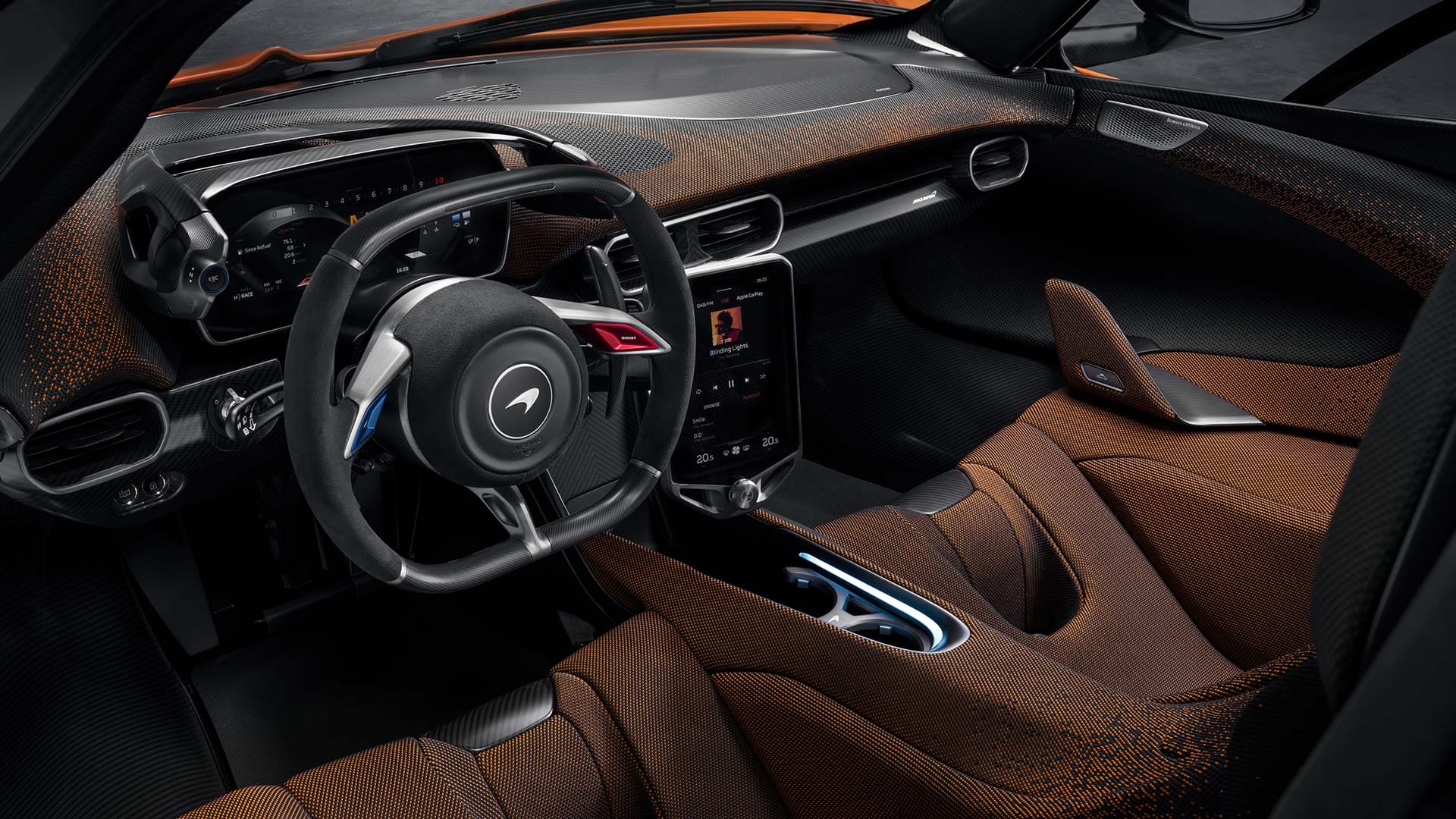
Practicality was also a key consideration. Luggage space is incorporated behind the seats, ingress and egress is facilitated by the unique doors, and visibility is maintained through the narrow A-pillars of the carbon fibre monocoque. The interior itself is minimalist, with a steering wheel that places powertrain and handling controls at the driver’s fingertips.
The final pillar is ‘Authentic Theatre’: a supercar must look and feel special. The W1’s design language is one of duality, with smooth, flowing lines. The orange bodywork sections show a subtle, sleek part of its character, and the darker contrast panels have more angular, sharper surfaces.” Inside, this philosophy continues with innovations like McLaren Innervate, a new knitted textile that represents a leap forward in material science. “It’s a textile, lightweight, and knitted to fit, so there’s no waste. What’s great about it is we can integrate components, so speakers and lighting play through the mesh.” This means designers can delete the speaker grille and the functional components that hold those items together. The driver is positioned in a seat that is integrated into the body, with the pedal box and steering wheel adjusting to them, ensuring a perfect ergonomic fit for a wide range of body types. This level of detail extends to the extensive personalisation program offered by McLaren Special Operations (MSO), allowing each of the 399 owners to create a unique vehicle.
The McLaren W1 is a lot more than a collection of impressive statistics, it’s a stunning achievement, yet one that I may never drive due to all 399 having sold already. I was however able to experience the MSO Design room at the Technology Center. The theatre-style space shows off the car, rotating in all its glory – along with sumptuous seating and the most delicious biscuits I’ve ever eaten. Customers work with designers to create their perfect performance automobile expression. Some have an exact idea of what they want, maybe they always buy orange McLarens. Others tailor every single part to their unique specifications. Design choices are broad yet there’s one thing that stays the same: the car itself is a wonder of physics and engineering, and that’s why people buy them.

La Grande Année 2014
Vinification in barrels: expertise preserved by Champagne Bollinger

La Grande Année Rosé 2014
La Grande Année, a champagne craftmanship