
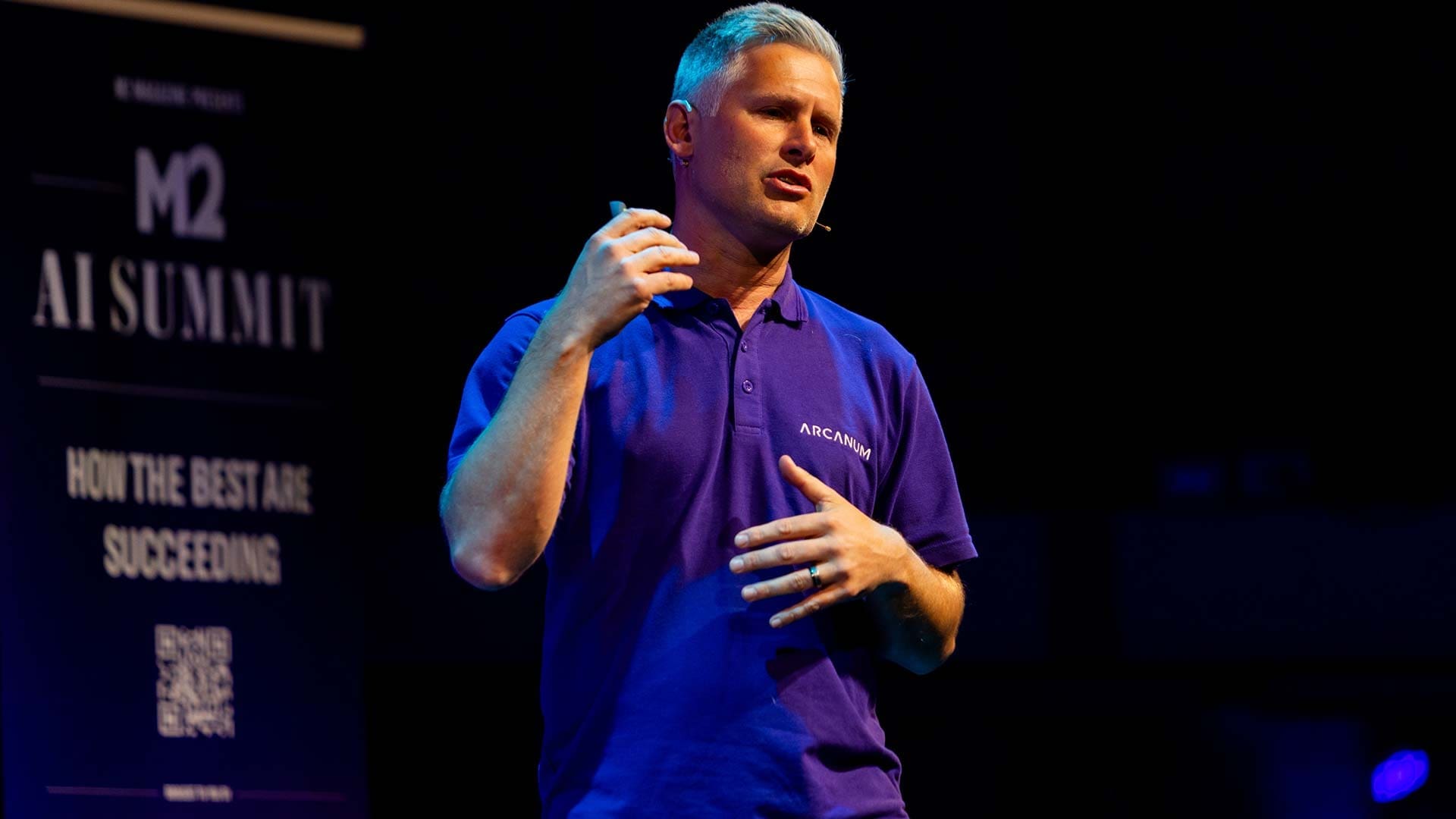
Customer Retention & Growth At Scale – Asa Cox, CEO & Founder, Arcanum.ai
Under his leadership, Arcanum has delivered AI-powered solutions that fast-track retention, streamline workflows, and drive real business impact across diverse industries. Asa leads strategic development of Numa, a practical AI platform that helps SMEs grow profitably by turning business data into actionable insights and automation.
Asa Cox doesn’t talk about AI like a futurist, he talks about it like a guy who’s spent years in the mud trying to make it actually work for real-world businesses. As founder of Arcanum, he’s been building AI products with New Zealand and global customers for years, and his Christchurch keynote is strikingly down-to-earth. His obsession now is simple: how do non-enterprise companies – the mid-market, councils, franchises, family businesses – use AI to grow revenue, retain customers and give people their time back, without a CTO on staff or a seven-figure budget?
For most of their history, he says, those organisations have been out of luck. The best tech was expensive, complex and aimed squarely at corporates. The irony is that today AI is finally accessible to everyone, but the people who could benefit the most often don’t know where to start. That’s why Arcanum built their AI Adoption Canvas – originally, in classic engineer fashion, called the “Pimp It” framework until marketing vetoed it. It’s basically a map for non-technical leaders who are sick of inspirational talks and just want to move from “we should do something with AI” to “this is our first, second and third move.”
The metaphor he leans on is AI as an e-bike. You still have to pedal. You still choose the route. But you suddenly have a motor that helps you climb hills faster and keep up with riders who used to disappear into the distance. That’s empowering, but only if you’re prepared. If you’ve never learned the road rules, don’t own a helmet and have no idea what to do when you get a puncture, the e-bike isn’t a productivity boost, it’s a risk. In business terms, the “helmet and puncture kit” are things like basic process hygiene, clean-ish data, realistic expectations and, especially, cybersecurity. If you want to race, you need to know what you’ll do when something breaks.
From there he gets very concrete. One of his favourite examples is a global business-coaching network whose advisors spend their lives in long, meandering meetings. There’s a ton of prep before each board or strategy session, rich discussion during it, and then a depressing amount of admin afterwards: writing up notes, pulling out action items, turning it all into coherent stories clients can actually use. Coaches are great at human conversation, he says, but they don’t always follow a particular path all the time and they definitely don’t enjoy typing it all up.
Arcanum’s approach wasn’t to replace the coaches, it was to study their rhythm. What do these meetings always circle back to? What prompts and questions get used over and over again? What does a good summary or action plan look like in this firm’s house style? Once they’d captured that, they used AI to listen to the conversations, structure them and draft outputs that matched each coach’s voice. The tool became an invisible researcher and note-taker in the background, freeing coaches to do more of the high-value human work – challenging, encouraging, asking better questions – and less of the low-value typing.
A Wellington AV and events company came at it from a different angle but with the same problem: they were stuck on the quote treadmill. Tender after tender, RFP after RFP, copying and pasting similar information into slightly different formats just to stay in the race. There’s no glamour in that kind of grind, just hours of unpaid labour trying to win the right to do paid labour. By capturing the patterns in their best proposals and feeding that into an AI workflow, they were able to get first-cut quotes out much faster, with humans focusing on the genuinely bespoke bits instead of retyping their own boilerplate.
Then there’s the Australian tutoring business drowning in marking. Highly skilled teachers were spending vast chunks of their week hand-marking exams for thousands of kids. It was important work but brutal on time and energy. Here, AI sat in the middle as a tireless assistant: doing the first pass on marking and structuring feedback, so teachers could spend more time actually teaching, coaching and talking to students and parents. Again, the pattern is the same – AI eats the repetitive complexity so humans can lean into interactions that need nuance and care.
Not every story is a slam-dunk. Asa talks about a council client that dreamed of straight-through processing – forms in, decisions out, no human touch. On paper, the process looked beautifully linear. In reality, it was anything but. Multiple systems that didn’t talk to each other. Shadow spreadsheets. Exceptions everywhere. Nervous IT. Politics. The elegant workflow diagram on the wall had very little to do with how work actually got done. The sexy ambition had to be parked. The first real win? Stopping a team from spending three hours a day hammering Ctrl-F through giant PDF bundles and still not finding what they needed. That tiny, low-risk use case saved more time, and built more trust, than any grand “AI transformation” slide.
At the other end of the spectrum sits the catering-equipment company whose CEO, as Asa tells it with clear affection, didn’t yet know copy-and-paste or drag-and-drop. Digital basics were a stretch, but ambition wasn’t; he was fired up about what AI could do for his business. The lesson Asa draws isn’t to laugh at the gap, but to pace yourself. Ambition is great. You might have a few team members who want to go straight to building agents and rewriting the business model. But if the fundamentals aren’t there, you’ll burn trust and budget and end up sour on AI before you’ve even started.
Underneath all of this is a bigger narrative shift. For a long time, calculators in classrooms were “cheating”. Now nobody thinks twice about them; they’re just part of how we do maths. The same thing is happening with AI. Yes, at its core, a model like GPT is just fancy maths – turning words into numbers, doing a lot of algebra very quickly, and turning them back. But if you treat it as a smart colleague you can brief, not a magic box, it can help you find patterns in your own data, translate complex offerings into plain English and tell stories your customers actually want to share.
The Spotify Wrapped example is never far away in his mind. Spotify didn’t become culturally sticky because they had streams; everyone had streams. They became part of people’s identity because they turned listening data into a fun, highly personal story people wanted to screenshot and send to their friends. Every business, Asa argues, has the raw material for similar stories lying dormant in their systems. AI can be the researcher that digs it up, the writer that shapes it, and the amplifier that helps it reach the right people – provided you build on a foundation of security and trust.
He closes on a very human note. Consumers generate oceans of data. Companies generate oceans of data. The question isn’t how do we squeeze more efficiency out of it so much as how do we turn it into genuinely magical experiences in a safe and respectful way – and what does that free us up to do as humans? AI should be about giving us back time for the conversations, creativity and care that machines can’t replicate. It’s also a once-in-a-generation chance, he says, to reconsider what your business is: who you serve, how you create value, and what you do that nobody else can. Assume your current position isn’t guaranteed, ask yourself what a “new how” powered by AI might look like – and then, crucially, just get on with it.
Action points:
Work through an AI adoption canvas with your team
Get specific about where AI can actually help: which processes are slow, error-prone, repetitive or admin-heavy, and what “good” looks like in each of them.
Pick a “Goldilocks” use case, not a moonshot
Start with something painful and visible – quoting, minutes, document search, marking – that’s big enough to matter but small enough that failure won’t sink you.
Map the real process before you automate it
Talk to the people doing the work. Capture the workaround spreadsheets, exceptions, approvals and systems no one put on the official flowchart. Build for that reality.
Feed AI rich, local context
Give it your templates, examples of “good” outputs, and historical data. Generic prompts into a generic tool will only get you generic results.
Let AI eat the drudge, not the relationship
Aim it at tasks like Ctrl-F searches, first-pass marking, structuring notes and drafting boilerplate so humans can spend more time selling, coaching, teaching and solving.
Treat AI as researcher, translator and amplifier
Use it to mine your data for insight, explain complex products simply, and surface personalised, high-trust experiences – your own version of Spotify Wrapped.
Invest in basic digital and cyber hygiene
Make sure your people understand passwords, phishing, permissions and data handling so AI becomes “just software” they can use safely, not a scary black box.
Shift the narrative from scarcity to possibility
Challenge “AI is cheating” or “this will take our jobs” scripts. Instead, frame AI as an e-bike: still your legs, still your journey – just with extra power to go further, faster.