
What We Did to Grow Productivity With AI
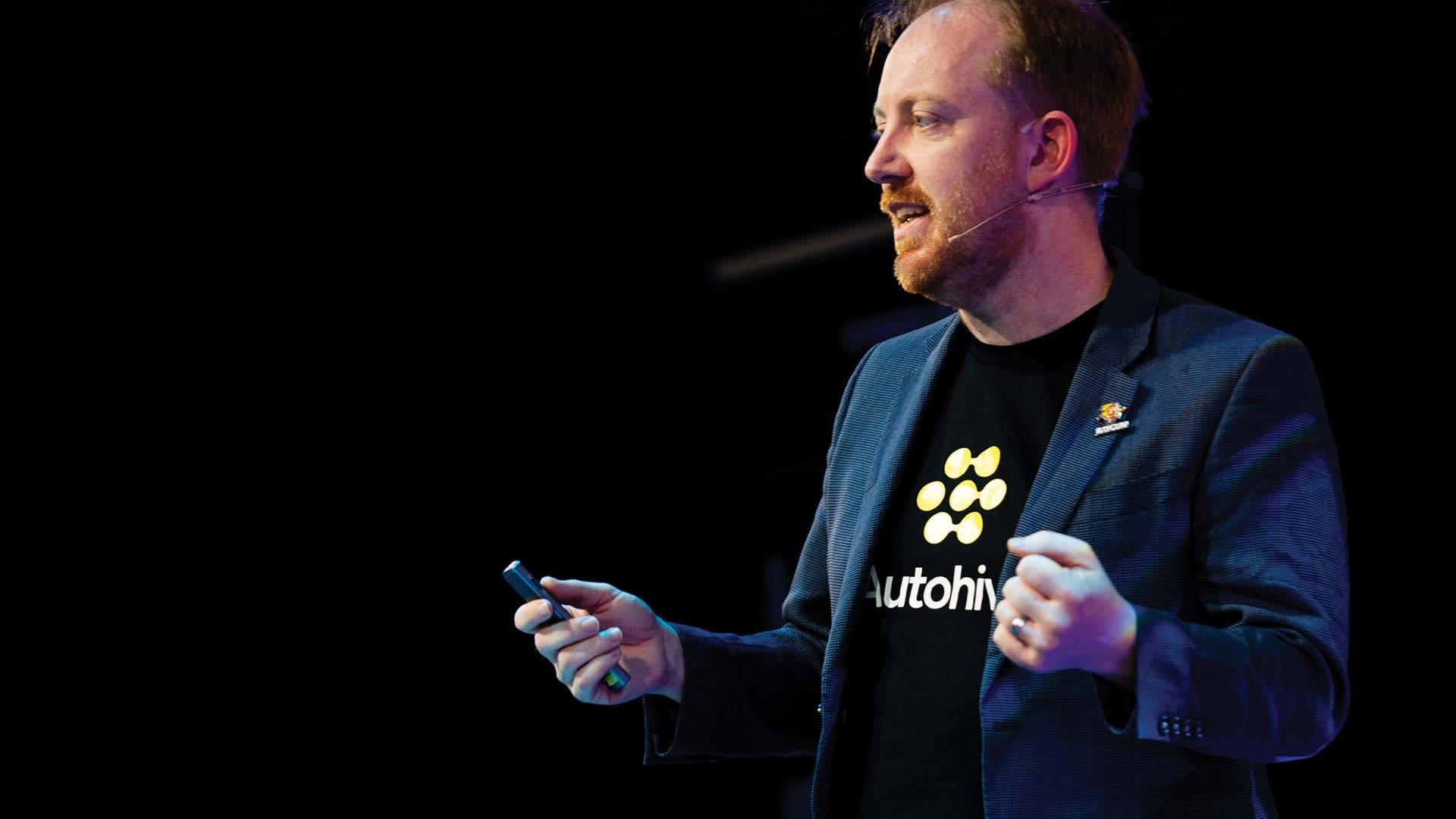
John-Daniel Trask, CEO, Autohive & Raygun
CEO and founder of Autohive and the co-founder and CEO of Raygun, a global application monitoring company serving customers in over 120 countries including Domino’s, HBO, and Virgin Atlantic. With more than 18 years of experience building globally competitive Wellington-based technology companies, JD has been at the forefront of AI adoption.
John-Daniel (JD) Trask comes into the AI conversation with serious scar tissue from building and running real software companies, not just talking about them. He co-founded developer tools company Mindscape in 2007 and went on to launch Raygun, a Wellington-built application monitoring platform now used in more than 120 countries by brands like Domino’s, HBO and Virgin Atlantic. Raygun gives engineering teams live visibility into errors, performance and real user experience, so they can see exactly what is breaking and who it is hurting before customers leave.
Autohive is the next chapter in that story. Spun out of the Raygun world, it is a no-code platform that lets everyday teams build and run AI agents that work together, plug into familiar tools and automate workflows across support, marketing, finance and operations. Trask describes agentic AI as potentially “a bigger revolution than the internet” and talks about Autohive as the missing dashboard for running a modern AI-native company, where agents quietly execute chunks of the business while humans orchestrate and oversee.
His M2 AI Summit Christchurch keynote, “What We Did To Grow Productivity With AI”, is essentially the field report from that journey. It starts in late 2022 when ChatGPT arrived and the Raygun team recognised it as “another internet moment”. This time, unlike the early days of the web, JD had capital, customers and a mature SaaS platform behind him. Early in 2023 he told his team they would not automatically backfill leavers and that he wanted the company to become deeply AI-native instead. The question was not whether the technology would be important. It was whether they would be early and bold, or late and timid.
The boldest move came in May 2023, when Raygun effectively shut down normal work for a week. Aside from essential customer service, everyone stopped and focused entirely on AI. Every staff member, from finance to design, took the same engineering onboarding test that Raygun uses for developer hires, but this time with access to large language models. People who had never written code in their lives were suddenly able to complete technical tasks. For JD this was the moment the penny dropped. The ceiling on what non-technical staff could do had just lifted dramatically, provided they had the right tools and support.
From there, his focus shifted to tokens and output. In interviews he has been blunt that “business needs to get used to spending money” on AI and that token consumption is a reasonable proxy for productive work. At Raygun and Autohive they track LLM spend per person and the internal narrative is not “save money” but “spend more, wisely”. He tells the story of a lead engineer now working with seven coding agents at once, shipping three to five bug fixes and one to two new features every day. A year earlier, he estimates, that level of throughput would have needed a small team and a week of effort. The shift he pushes from the stage is simple: scale your company by the token, not by headcount.
The next phase in his M2 story is agents. By 2024 Raygun had moved beyond individual prompts and experiments into building agents that ran key parts of the marketing machine. They built internal agents to manage Google Ads, evaluate SEO, audit inbound trials and help generate and refine blog content. The analogy he uses is that if ChatGPT is like the email era of the internet, agents are the web era – the point where you start to get full digital rails, not just messages. The lesson for the Christchurch audience was that it is one thing to have staff occasionally drop into ChatGPT. It is another to embed agents that are always on, always watching, always nudging the business along.
Autohive was born from trying to scale that internal success. JD and his team realised that for most businesses there was no clean on-ramp to agentic AI, especially for non-technical teams. Legacy workflow tools had bolted on AI in awkward ways and the “builder” products on the market still assumed you had engineers on staff. Autohive’s design flips that. It provides a simple interface where people can discover and clone agent templates, configure them in plain language, connect them to tools like HubSpot, Gmail, Google Calendar, Github, Adwords and internal APIs, and then drop them into collaborative chats where human colleagues can @-mention agents like any other teammate.
Underneath the product demos sits a harder message about why most AI initiatives fail. On the M2 presentations site his session is framed around the finding that roughly 90 percent of AI initiatives do not deliver on their promise. JD’s argument is that this is not primarily a model problem. It is a people and capital allocation problem. Businesses cling to “wait and see”, push AI exploration into people’s lunch breaks, and then quietly assume it does not work when nobody has time to experiment properly. They treat tokens as a cost line to minimise instead of the new lever for output. They also aim too high too soon, dreaming up science-fiction-grade “EA for every employee” agents when the underlying models and governance simply are not there yet.
His prescription is more pragmatic. Start with one task that takes you an hour or more every week and that you “bloody hate”, and build an agent that does only that piece. Then extend it in small increments. He uses his own inbox as an example. The first version of his email agent simply summarised the day’s messages. Then it learned to auto-archive some of them. Then it started forwarding anything with invoices to accounts. None of this required boiling the ocean. It was a series of tiny, composable wins that gradually removed toil from his day. For JD this is the real investment curve: sustained, compounding automation of small pain points, not a single big-bang project that magically transforms the business.
Action points:
Treat tokens as a new form of capital
Stop thinking about AI usage as a cost to minimise and start thinking of token spend as fuel for output. Track usage per person and look for a healthy correlation between tokens consumed and valuable work shipped.
Ring-fence time for AI experimentation
Do your own version of Raygun’s “AI week”, even if it is only a day or a series of afternoons. Pause non-critical work and give people explicit permission to explore, test and document AI use cases instead of trying to fit it around the edges.
Start with one hated task per person
Ask each team member to nominate a recurring task that takes an hour or more and drains their energy. Build or adopt a simple agent to handle just that task, then iterate. Aim for a stack of small wins rather than a single moonshot.
Focus the first wave of agents internally
Reduce risk by pointing early agents at internal workflows such as reporting, inbox triage, marketing analysis, trial audits or reconciliations, before you let them touch customers directly.
Give non-technical champions the steering wheel
Look for people in finance, HR, ops or support who are already playing with AI. Give them tools like Autohive or equivalent, plus time and recognition, and make them visible champions of agentic workflows inside your business.
Measure productivity in real output, not hype
Borrow JD’s concrete yardstick: count features shipped, bugs fixed, campaigns launched or tickets resolved per person before and after you introduce agents. Use that data to decide where to invest more, rather than relying on vague “efficiency” stories.
Design an “agent dashboard” mindset
Whether you use Autohive or another platform, think about how you will see, manage and govern agents at a glance. Treat them like a distributed team: each with a job description, tools, metrics and an owner who is accountable for behaviour and outcomes.
Celebrate the early movers inside your company
Make a point of championing the people who prototype agents and reduce toil. Share their stories at all-hands meetings and frame them as the ones actively working to ensure your business still exists, and thrives, in an AI-driven future.