Asking About 3i/atlas Tells Us More About Ourselves
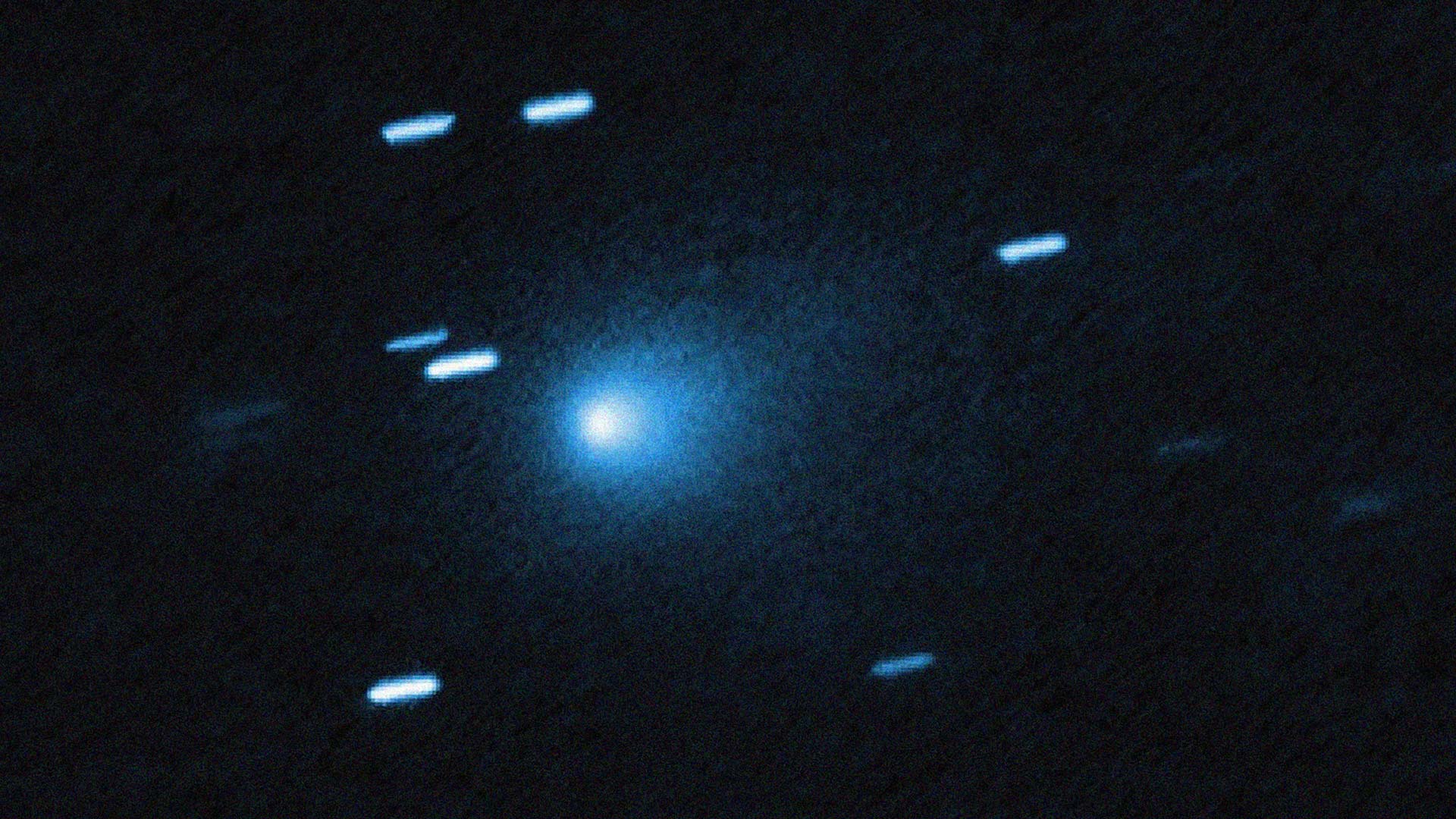
Image Above: Hubble captured this image of the interstellar comet 3I/ATLAS on July 21, 2025, when the comet was 277 million miles from Earth. Hubble shows that the comet has a teardrop-shaped cocoon of dust coming off its solid, icy nucleus.
Comet – or was it alien spacecraft?! – 3I/ATLAS barged its way uninvited through OUR solar system recently. An interstellar object with an orbit suspiciously within ideal observation range of our neighbouring planets plus a sneaky perihelion away from prying Terrestrial eyes; exactly where we couldn’t see it – behind the Sun.
Big Space News?
It should have been colossal astronomical news, on a par with the discovery of a new planet. Yet none of the big global space agencies; NASA, ESA or even the CNSA (China National Space Administration) found it worth discussing in depth.
Huh? Once upon a time these agencies would’ve seized this opportunity to roll out every boffin and telescope they had, at the very least to justify their government grants. Instead: bare mumblings.
The Residue of Oumuamua
A very different story to when the similar ‘interstellar object’ Oumuamua popped into our solar system back in 2017. That was the trigger for a firestorm of media speculation with Harvard astrophysicist and self-appointed cosmic conspiracy theorist Avi Loeb at the very tip of the spear. He argued that Oumuamua’s anomalies – its bizarre shape, lack of a visible tail and non-gravitational acceleration were unarguable proof Oumuamua was an alien spacecraft. He reckoned it had to be an alien probe or some form of broken piece of larger tech.
And then he accused the scientific community of being too quick to dismiss these possibilities…
The Truth Is Out There
Oh boy! In doing so he instantly morphed into the iconic character Fox Mulder from the 90s TV show The X Files who spent close to ten seasons accusing the world’s government-funded space agencies of covering up successful alien contact attempts.
Cue incessant media attention, pop culture postulating and even public dirty laundry airing by a multitude of scientists from across the spectrum. Then, despite all the sheer brilliance of all these arguments and theories, Oumuamua simply carried on its orbit and went back out into space again leaving everyone involved glancing about sheepishly.
Once Burned
NASA, ESA and CNSA may be really good at spotting distant gas-fired stars billions of light years away – but they’re also not bad at spotting potential PR fireball disasters right here at home too. They figured the Oumuamua debacle may have been good for selling books for mavericks like Avi Loeb but all this public squabbling and disunity wasn’t doing much for either their individual credibility or that of their discipline as a whole. Thus, when interstellar object 3I/Atlas rocked up with remarkably similar attributes to Oumuamua, they kept their observations – and opinions – to themselves.
Of course, Professor Loeb wasn’t a signatory to this secret agreement and immediately dusted off his 2017 claims, doing a quick find and replace switching out ‘Oumuamua’ for ‘3I/Atlas’. Yet, this time he received no eager concurrences nor hot denials from any astronomical society. Remembering the ‘alien-claim fatigue’ from Oumuamua, the agencies and researchers were far more cautious about wading in again with 3I/Atlas for fear of fuelling another runaway narrative.
Science’s Pantheon of Pop Culture Experts
Yet Loeb’s claims didn’t vanish completely into any interstellar void however as his theories – whether right or wrong – are mana from heaven for the PR arm of the scientific world. Today, science doesn’t just compete with ignorance – it competes with entertainment so the line between hypothesis and headline barely exists. So, to debate these headlines publicly in a new era of ‘Spectacle Science’ are a collection of scientific megastars. Aside from Loeb himself, there are three other Scilebrities who have high visibility online either on their own social media accounts, TV shows or appearing as guest experts in others.
Science, as with any other subject or discipline, regularly requires new input in order to stimulate interest and, as we are not all the same in our interests/beliefs, it has done well to put forward four different high-profile faces to represent them – each selling a different flavour of ‘truth’:
The Fab Four
If science is the new religion, then its prophets have gone multimedia. But the big influencers don’t wear lab coats anymore; they wear lapel mics. Each one flogging a different narrative that resonates with our differing personalities. So, depending on who your favourite TV character (or, if you’re of a certain age, whichever Beatle you are) was, there’s bound to be a Science guru for you!:
Avi Loeb
The Maverick (Fox Mulder / John)
A heretic who is almost certainly wrong – yet you kinda want him to be right. Loeb – like Graham Hancock – scratches our itch that there’s got to be some kind of cosmic conspiracy theory out there. It’s all a governmental cover up! More detective than scientist, he tells us what we want to believe.
Neil deGrasse Tyson
The Authority (Captain Picard / Paul)

Everyone chill! The adults are all over this. You’re not being told everything because the brainiest people in the world are still double-checking their findings. You’ll get the results in due course – once I’ve recorded a bunch of videos explaining it all of course.
Michio Kaku
The Philosopher-Showman (Mr. Miyagi / George)
Eastern poetry crashes into Western theatre. The caricature of a ‘genius professor’ as he can only talk in quatrains and smirks like he already has the Ultimate Answer but is still mulling over releasing it to the Great Unwashed. When we’re ready to handle it of course. Kaku idolises complexity and believes curiosity ought to be treated as a discipline.
Brian Cox
The Romantic (Ted Lasso / Ringo)

Don’t worry, everything will turn out fine! Freaky new things we don’t understand are just scary because we haven’t sat down and had a cup of tea together yet. You’ll see, once we get to know the little green aliens and/or time travelling black holes, we’ll all get on famously. Being insignificant fleas on a donkey’s butt isn’t so bad really…
As you might expect; the other three of the Fab Four didn’t automatically fall into line with Loeb’s claims. Tyson was very dismissive, calling the alien-probe hypothesis ‘clickbait’. Kaku was similarly off-hand, calling Loeb’s claims ‘premature panic-inducing speculation’ arguing instead for 3I/Atlas being a 7 billion year old collection of ‘space junk’. Cox however was less dismissive, willing to discuss Loeb’s individual points objectively and reserving his criticisms for Loeb’s style rather than his theories.
Science Isn’t Law Anymore
The Fab Four might disagree on the specifics but they all agree on the foundation points: the world is mysterious, but not unknowable.
They almost have to toe that line today as our attitude to science has changed. A generation ago, science was the last word; you could close any argument with ‘the data says so.’ Claim that today and you’d be laughed out of town. Our relationship with science has drifted from trust to transaction with every new development: COVID, climate, quantum computing, AI – each new discovery seems to widen the gap between understanding and belief.
Particularly with regard to wacky old quantum mechanics where even the field experts openly admit they don’t really know what’s really going on. Despite all our advances, our smarter computers, bigger and more awesome tech – we seem to understand less! With the universe behaving like a magician explaining a trick by performing a bigger one. The more we see, the less we understand.
The Object Leaves, the Questions Stay
Over the centuries we’ve gone from believing the Sun revolved around us, to believing the universe owes us an explanation. We may not think we’re the centre anymore, but we still act like we deserve front-row seats to every mystery. When we don’t get that, we assume conspiracy or incompetence.
Now that 3I/Atlas has gone on its merry way to wherever it’s headed, we’re left reflecting. Again.
Maybe it was nothing more than a hunk of ancient ice and rock with no more intention than passage rights through our hood. But its real trajectory was through us – cutting across our media, our belief systems, our desire for meaning. The object is gone – leaving us staring at our own images in the telescope’s mirror.