

How a Christchurch Engineer Built a World-Class EV Charger the World Suddenly Needs
For more than a decade, Ed Harvey has been building towards a moment exactly like this one.
He devoted himself to building a company on the conviction that New Zealand’s dependence on imported fuel was a vulnerability waiting to be exposed and that electric vehicles, charged at home on the country’s own renewable grid, were the answer. Not just the answer to the energy woes we currently find ourselves in, but also a key part of the solution to the climate crisis.
“It hasn’t always been easy,” Ed admits. “Some of the blowback, hate, and misinformation has made the journey pretty challenging at times. For a lot of people who’ve been anti-EV though, they are actually just completely misinformed. It’s not really their fault.”
Then conflict in the Middle East sent fuel prices through the roof, petrol blew past $3 a litre, and suddenly everyone wanted to talk to the 35-year-old engineer from Christchurch. ”The main feeling is a sense of frustration that we’re not moving fast enough to protect our energy security and economy. I hope this is finally the wake-up call for those who can make the switch.”
The wake-up call has been loud. The Strait of Hormuz, through which roughly a fifth of the world’s oil supply passes, was effectively closed following strikes on Iran and retaliatory attacks across the Gulf. Oil prices have surged. LNG prices have spiked even harder. And New Zealand, which imports every last drop of its refined fuel from overseas, is feeling every cent of it at the pump.
The response was immediate. EV registrations in New Zealand more than tripled in March — from 841 in February to 2,992 — the strongest result since the Clean Car Discount was scrapped at the end of 2023. Dealers are reporting cars being sold off the boat before they arrive in the country. Bank lending for EVs has roughly doubled. And Evnex, Ed’s Christchurch-based smart charger company, has seen a 225% percent increase in sales this March compared to the same month last year.
And there is a good reason for this. Evnex’s own data — drawn from its network of almost 10,000 chargers across New Zealand — shows that charging an EV at home costs about $380 a year, or roughly $7.30 a week: a little more than the price of a decent coffee. Meanwhile, an average petrol car runs closer to $2,744 annually.

“Most people know EVs are cheaper to run,” Ed says. “But very few realise quite how massive the gap is. When you break it down, powering your EV for a year costs what a petrol driver spends in under two months. That’s a massive difference.”
New Zealand has no oil refinery, instead it imports 100 percent of its refined fuel. The country spends between $7 and $8 billion a year on that imported fuel, and every dollar is exposed to whatever happens to be going wrong on the other side of the world, and to whatever whim enters Trump’s mind.
Ed has been making this argument for years. “Every time there’s a crisis overseas, New Zealand families pay for it at the pump. We saw it with Ukraine. We’re seeing it now with Iran. We’ll see it again. The question is whether we keep accepting that vulnerability or start building something different.”
It’s a compelling case, and one that extends well beyond pump prices. The government’s plan to build a billion-dollar LNG import terminal in Taranaki, announced in February as a backstop for dry-year electricity generation, is still vulnerable when global LNG prices can spike 50 percent in a single day because of a conflict thousands of kilometres away.
“Spending a billion dollars to trade one form of imported energy dependence for another is not an energy security strategy,” Ed says. “It’s a reshuffling of the risk.”
Meanwhile, New Zealand generates more than 80 percent of its electricity from renewable sources like hydro, wind, and geothermal, right here at home. Every EV on the road runs on power that doesn’t need a shipping lane, a tanker, or a foreign refinery. That’s a structural advantage most countries would trade dearly for.
Which brings us back to the thing Ed actually built. If you’ve spent any time around EVs in New Zealand or Australia, you’ve probably seen an Evnex charger. They’re the sleek, minimal units mounted on garage walls and apartment pedestals across New Zealand and Australia. They’re compact enough that you might not immediately register the smart tech inside them.
That’s deliberate. Ed is a perfectionist and knows that for people to put the chargers in their driveways and garages, they have to look as mint as their brand new EV. The E2 range comes in four colours, including a volcanic black that disappears against a dark wall and a clean white that would look great beside a Porsche Cayenne Electric, which is one of the most anticipated EVs of the year. Ferrari’s first electric, the Luce, is also due this year, designed with Jony Ive’s LoveFrom studio.
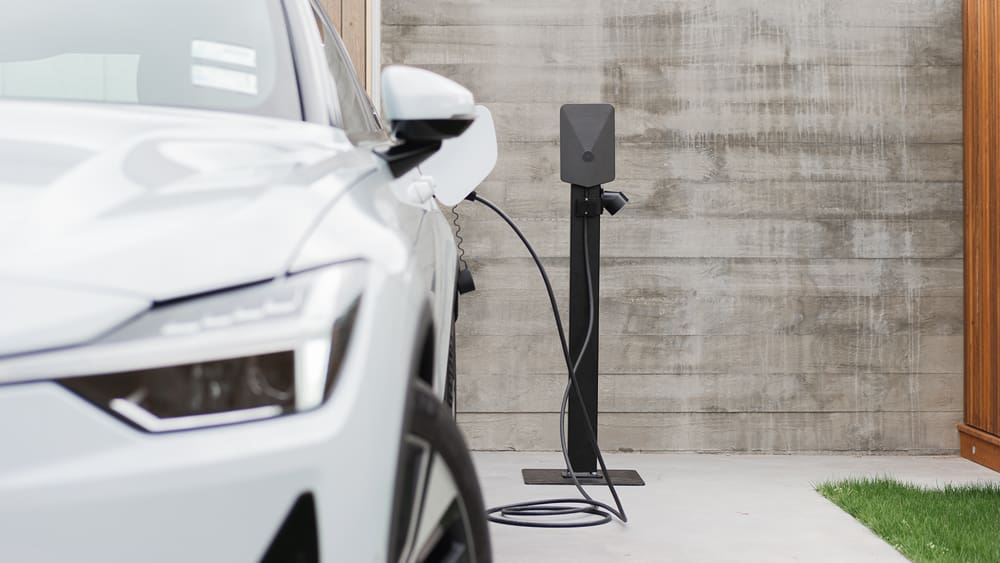
“We think a lot about what a charger looks like on your wall,” Ed says. “It’s going to live there for years. It should be something you’re happy to show off, not something you hide in the garage. When someone pulls up in a new EV, the charger is part of that experience and it should match the ambition of the car.”
The E2 Plus, Evnex’s flagship residential unit, charges at up to 7.4 kilowatts on single phase power — fast enough to add roughly 50 kilometres of range per hour. It features cellular connectivity, Tesla integration, local load balancing, and an app that lets you schedule charging for off-peak hours or divert excess solar energy straight into your car. The E2 Flex, launched as a more accessible entry point at just under $850, delivers the same core smart-charging technology at a price designed to remove one of the biggest barriers to EV adoption: the upfront cost of getting a charger in the home.
Both are designed, engineered and manufactured in Christchurch. Every charger that leaves the facility has been individually tested, the packaging is recycled cardboard, and an end-of-life charger can be returned to Evnex for recycling. There is also no single-use plastic in the box. For a product that’s fundamentally about sustainability, the supply chain has been thought through with the same precision as the electronics.
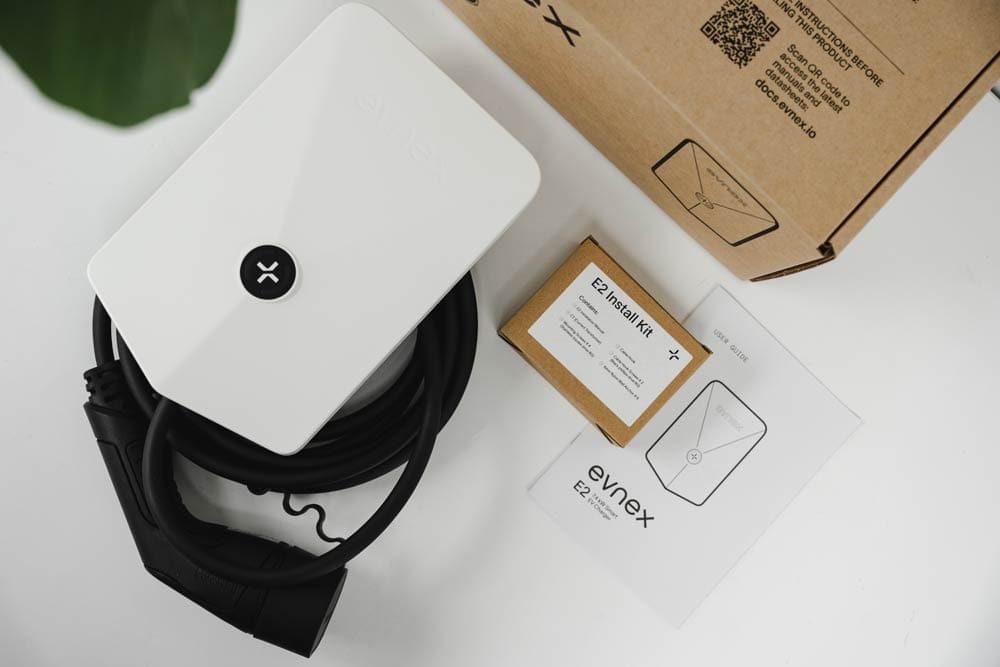
This is the part of the Evnex story that deserves more attention than it typically gets. In an age when most consumer electronics arrive in New Zealand from overseas, Evnex builds everything in Christchurch. The circuit boards. The software. The cloud platform. The app. The hardware.
Ed founded the company in 2014 after converting a 1997 Honda Accord to electric as a university project. Since then Evnex has sold more than 15,000 chargers across Australasia. It has partnerships with Volvo, Polestar, Volkswagen, Skoda, Subaru, Cupra and LDV. It secured investment from Adamantem Capital’s Environmental Opportunities Fund. It has an Australian office in Sydney’s Greenhouse Climate Tech Hub. And it still makes everything in Christchurch. Not bad going for a company that Ed founded at his parents’ farm in Marlborough.

“We’re passionate about New Zealand manufacturing,” Ed says. “It’s challenging. Finding the right talent in Christchurch is harder than it’s been in the ten years since I started Evnex. The brain drain is real, but we’re committed to building here. Being able to build this technology in New Zealand, using local manufacturing expertise, is incredibly rewarding.”
It’s also, quietly, a competitive advantage. When supply chains buckled during Covid, locally manufactured products with locally developed software proved more resilient than imported alternatives.
Across the Tasman, the opportunity is enormous. Australia has more than 454,000 registered plug-in electric vehicles, with EV sales up 38 percent year-on-year in 2025 and accounting for 13.1 percent of new car sales. The country is also in the middle of a massive energy transition — phasing out coal and gas, scaling up rooftop solar, and chasing an 82 percent renewable electricity target by 2030.
Evnex launched in Australia in 2023 and has already installed more than 5,000 chargers across the country. Its data from Australian homes shows the average EV driver saves around $3,620 a year in fuel costs — more than $41,600 over the average life of a vehicle. With petrol averaging $2.50 a litre amid the Middle East crisis, the economics are even more stark than in New Zealand.
“Australia is a huge market and we’re proud to be taking the best of New Zealand manufacturing across the ditch,” Ed says. “Australian consumers are responding really well to our technology. The combination of smart charging, solar integration and a locally supported product resonates.”
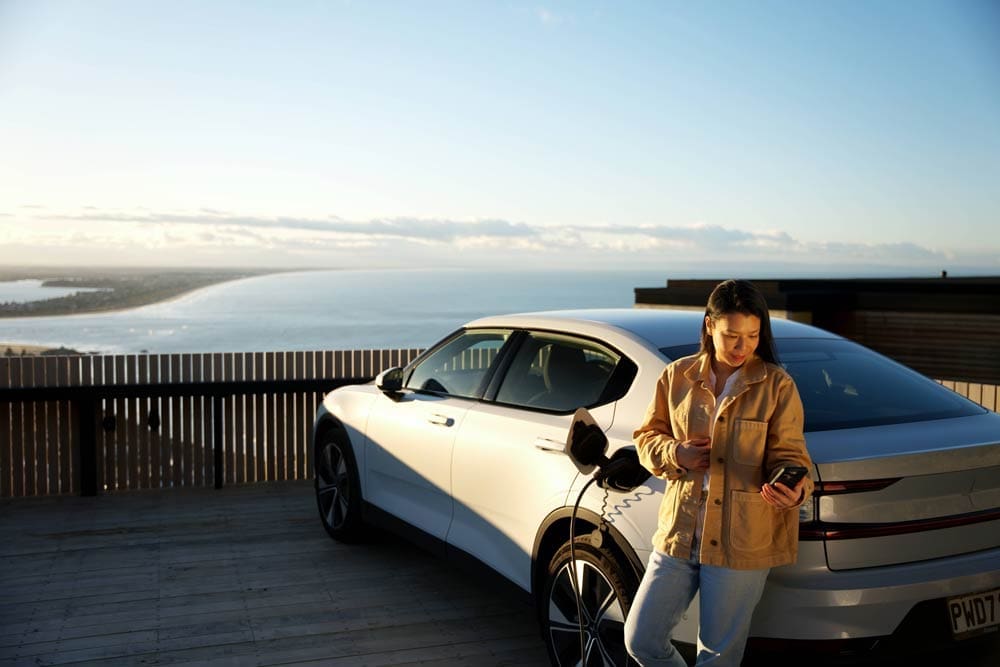
The chargers are engineered for Australasian conditions. UV-resistant, waterproof and tested for the kind of temperature extremes you’d find from snowy Queenstown to sunny Queensland. Ed’s team has built a nationwide network of certified installers across both countries, meaning a customer in Perth gets the same installation quality and ongoing support as one in Christchurch.
But Ed sees the charger as the beginning of something bigger, not the end. Evnex is making what he describes as “quiet moves” toward home energy management — the idea that your EV charger becomes the central intelligence for how your household consumes and stores energy, allowing you to optimise usage and save money.
“People are adding solar, batteries and EV chargers to their homes, and then wondering how on earth they all work together. Our chargers already talk to all of these systems, so we’re focused on making it simpler for homeowners to manage the lot from one place,” Ed says.
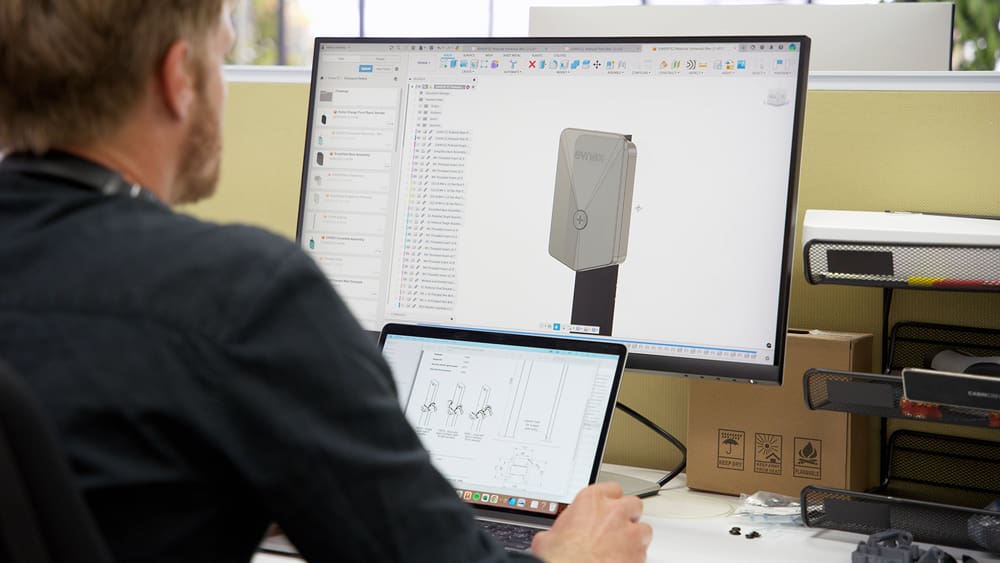
“Your EV battery is the single largest energy asset most households will ever own. The technology to use it intelligently already exists so we’re working on bringing that to New Zealand.”
It’s a vision shared by electricity retailers and network operators, who see smart home charging as a tool for managing grid demand rather than adding to it. Evnex already has relationships with lines companies across New Zealand and has run trials with Vector in Auckland, using its software to let the network dynamically manage when chargers draw power. The result: EV charging that’s invisible to the grid, seamless for the homeowner, and cheaper for everyone.
“There’s real benefit for electricity retailers if they can shift EV charging to times when the wholesale price is lower,” Ed says. “Smart charging is one of the puzzle pieces that makes electrification work, not just for the individual household, but for the whole system.”
Standing in the Evnex facility, surrounded by the quiet hum of a manufacturing line that exists because one engineer wanted a better way to charge his converted Honda, it’s hard not to feel that the world is finally arriving at the conclusion Ed reached a long time ago.
The numbers are now impossible to argue with. The geopolitics are impossible to ignore. The cars are better, faster and more desirable than they have ever been — from the $50,000 BYD that’s emptying New Zealand car yards to the $877,000 Ferrari Luce being designed with the same man who designed the iPhone.
“We’ve been saying this for years,” Ed says. “Electrification isn’t just a climate policy. It’s a cost-of-living policy. An energy security policy. A national resilience policy. People are finally hearing it — not because the argument changed, but because the petrol price did. Better late than never.”