
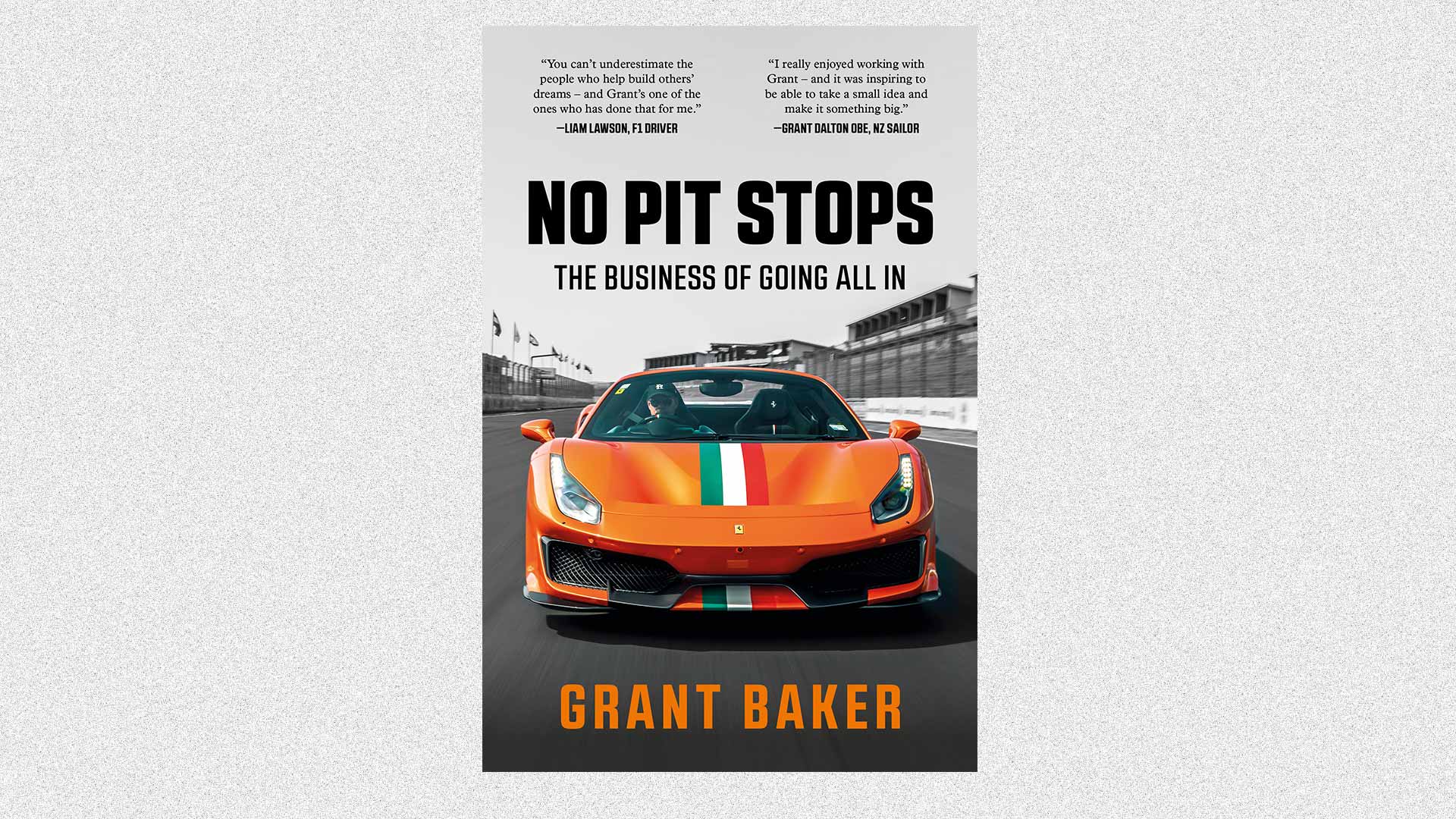
Book Review – No Pit Stops: The Business of Going All In
42 Below founder Geoff Ross kicks off this fun read with a no-holds-barred commentary on Grant. Raw and real, it traces a hard-working Kiwi’s journey through sales, travel, local businesses, the rise of 42 Below and more.
Grant was a child of the ’60s. His parents taught him the value of hard work and, especially, money, which set them apart from many New Zealand families. Their work ethic brought upward mobility and improved their standing. Grant took note.
Through different schools, all a young Grant knew was that he’d be moving soon, so books became his friends and fed his imagination. While he freely admits that he didn’t enjoy working hard, he understood that hard work enabled access to good things. Things like cars, which his parents taught him to appreciate. Cars correlate with success and he weaves cars through his story. They’re bookmarks in a life of measured risk-taking that yielded results.
Perhaps because of his mind-expanding reading, he was always comfortable dreaming big and doing ‘hard’ things. That’s almost a paradox when you meet him: he’s a calm, considered and retiring Kiwi. Yet here he is, having mastered everything he’s touched.
Things start to get real for Grant when he buys into Bluestar with other partners. He says it involved plenty of learning, but little fun: the company was permanently in financial trouble, always on the edge of the precipice. There were many days when he thought it would be his last. At one stage, the bank was actively in the office, supervising everything they did. Then, out of the blue, after a chance meeting on a golf course, the business was sold and Grant went from living in a grotty duplex to being a multimillionaire. It was at this time he first moved into a CEO role. Unlike many autobiographies, he doesn’t describe how he was made for it. Instead, he describes how difficult it is and how little support you have. Every problem becomes yours. Even when he reaches the top of the corporate ladder, he is still fighting, yet eight-figure amounts can be a conversation on a golf course away.
After selling Bluestar, he seems to be back in no time, this time founding a business. Netco is hard work, and he soon realises that you can’t just work in the business or on the business. You have to do both. He wades in and success follows.
By the middle of the book, Grant marks progress with his first Ferrari. He’s bought and sold companies. He’s founded and sold companies. He seems to be having more fun by this stage. The car tells the tale.
Following this series of stressful yet successful business outcomes, Grant turns to motor racing. It is fun, but there are plenty of lessons along the way. Starting in the slowest car, he gets the racing bug and has the funds to get properly into motorsport. He ultimately co-drives with established and up-and-coming drivers long enough to realise that, while he is good, he is not great, and that he may need another purpose. It is clear by this stage that he quietly thrives on competition, but rather than competing with the field, he is really competing with himself to see what he is capable of. Unlike a lot of people, he understands his limits and knows when to move on to the next thing.
After real hard graft in his early roles, Grant begins to become known, and before long 42 Below approaches him to invest. But if he’s going to do it, he’s going to be hands-on, because that’s where he adds value. He is in a unique position: not only can he work hands-on, but he can also see the view from above. He gets the company to set audacious goals, which it nails by doing things differently. Consumer products are very different from anything he has done before. I get the impression he was a little uncomfortable at times, yet equally prepared to trust Geoff to make it happen.
Not everything goes his way. Health rears its head aggressively, and a more tender few chapters recount his brush with mortality.
Maybe he has mental resilience. Maybe he’s pig-headed. But he has been defiant and persistent, prepared to think that he’s right and back himself until he is. There’s a saying that common sense isn’t common. And I think maybe Grant has worked this out. He often says that he will zig when everyone else is zagging, but I think there’s more to it than that. I don’t think he’s a contrarian so much as a believer in his ability. He didn’t mind being called wrong, because that meant he’d found something other people weren’t going to try. Maybe they were afraid to. He wasn’t. He didn’t seem afraid of much. There’s a circularity at play, with business success fuelled by his love of cars. Business bought him a car, then he sold cars to get back into business, and he used the profit to buy a better car. Ultimately, he’s ended up in the very business of cars itself.
It’s not a personal guide. It’s not a business guide. It’s a personal business story. Grant’s ultimate act was to buy into and eventually buy out Turners Car Auctions, bringing together the two threads of his life: business and cars. It all makes sense. It isn’t a book of ‘Top 10 Ways to Make $1,000,000’, and it’s the opposite of a get-rich-quick instruction manual; it’s a get-rich-slow story.
What comes across is a driving ambition, a determination to do whatever he’s doing well, even if that means being uncomfortable or learning a whole new thing, such as the fragrance industry or how to run a deregulated power company.
Humble to the extent of self-deprecation, I imagine that if you talked to his business partners, you’d probably find there were other impressive Grant moments that didn’t make it into this book.
The title is a play on words that isn’t quite right from where I sit. I think Grant did take pit stops. He stopped to enjoy himself, especially through cars, and used the brakes strategically rather than staying at 100% throttle. But one thing is certain: a pit stop used as part of a strategy isn’t really a stop. It’s a pause. Overall, it’s a great read.
It feels like a holiday book you could smash out on a rainy day or drip-feed over a couple of weeks.
The writing is even and consistent, never off-putting, academic or boastful.
Grant’s an interesting Kiwi to learn from. He has been successful while maintaining a fairly low profile, all while owning some of the highest-profile cars you can imagine. At the top of his game, he isn’t too proud to park a limited-edition Ferrari outside a McDonald’s for a snapshot. The book ends in a way that leaves you feeling Grant is unfinished and there is more to come. I’m hoping that means another book, or at least another few chapters. I just can’t wait to see the matching cars!