
Driving Growth with AI Agents
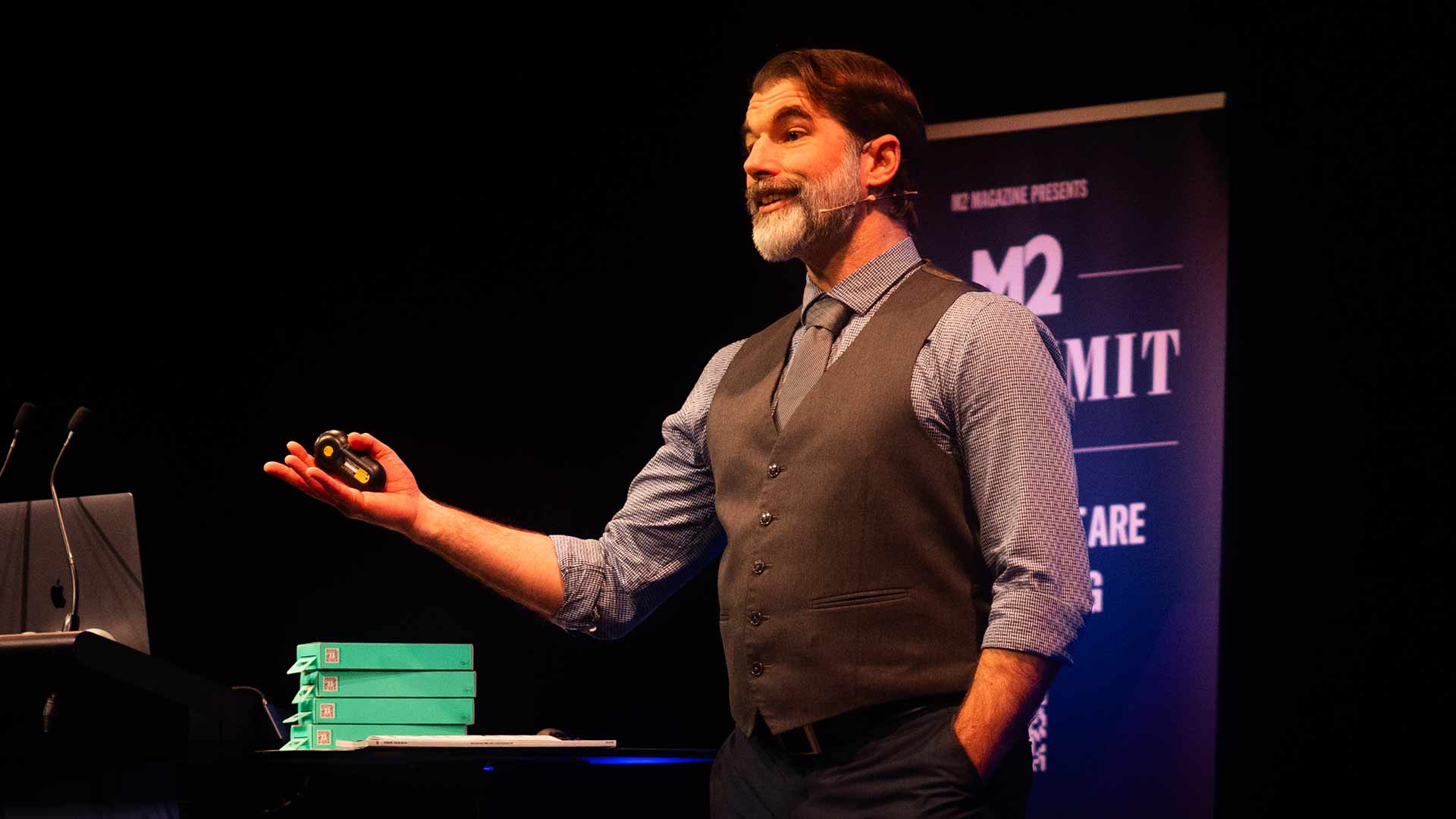
After lunch, AI educator Caelan Huntress, a fast-talking Portland transplant with a circus background, set out to make agents tangible, demonstrating the leap from AI that suggests things to AI that actually goes and does them.
Caelan Huntress warned the room he talks fast (“I get really enthusiastic about this topic”) and then proved it, opening with a game. Everyone with an AI app on their phone typed in a prompt: “My favourite movie is X, what other movies should I watch?” The list that came back, he explained, is generative AI. “Agentic AI would make the reservation for you. It would add the movie to your Netflix queue. It would order the book from Whitcoulls and have it shipped to your door.” That, in one breath, is the shift the whole talk was about.
The mechanics are a loop. Where generative AI takes a prompt and hands back an answer, an agent starts from a trigger, “makes a plan, it reasons, and then it executes actions using tools”, and, if you build it well, reflects on the result and goes round again “until the exit conditions are met”. The tools, he said, are the agent’s hands: fetching email, processing a photo, turning a stage selfie into anime (“everybody, say cheese”). Quoting Fei-Fei Li that AI is “a tool to amplify human creativity”, he was firm that a human stays in the loop, and that making an agent means getting four things right: “pick the right model, teach it the right process, provide the right context, and establish the right guardrails”.
Then he simply let it rip on stage, parallel-prompting ChatGPT, Gemini, Claude and a couple of open-source agents to spin up a fictional cafe, generating menus, a logo and, with a final prompt, a working website. “I’ve got five websites cooking,” he said, leaving them to bake while he talked. Claude handed back actual HTML he could push live to a URL in a few more clicks, which was the point: “that’s what agents can do”.
He was refreshingly practical about the plumbing. Frontier models from OpenAI, Google and Anthropic are the ones you pay for because they sit on the cutting edge; open-source models you can download and run locally as a free fallback. The smart pattern, he said, is a frontier model as your “orchestrator” handing grunt work to cheaper local sub-agents, “because if your orchestrator agent is doing all the reasoning, you don’t want to use your highest-level model” for the donkey work. He even flagged the bill: an all-you-can-eat subscription throttles you, while pay-as-you-go never does, “but you can get a really good bill if your agent gets stuck in a loop”.
To keep it manageable, he reached for a four-step framework, SAGE: scope the project, automate the pieces, generate the skills, evaluate the effectiveness. “Projects fail when they aim too wide,” he warned, and the best way to judge an agent’s output is with another model, “because AI is a lot better at evaluating content than a human’s ever going to be”. Decompose the task, he added, quoting Google’s agentic-design researchers, because breaking it into steps makes each one easier to understand and debug. Running agents, he said, “is a lot like spinning plates”.
His closing pitch was about the human, not the machine. The genuinely valuable skill now is being a generalist, “able to take information from very disparate bodies of knowledge and combine them in new and interesting ways”, or as he preferred it, “I’m not a generalist, I’m a polymath”. An LLM will happily spit out a thousand ideas, but organising them into something executable “is your work, and it happens outside the LLM window”. Borrowing E.O. Wilson, he said the future belongs to the synthesisers who can “put together the right information at the right time, think critically about it, and make important choices wisely”. Anyone can get the easy eighty per cent out of AI, he said. The job is finding the extra twenty that takes it to something worth keeping.
5 Takeaways
- Know the difference between generative and agentic. Generative suggests; agentic acts. The leap from a list of restaurants to a booked table is the leap that changes what AI can do for your business.
- An agent needs four things to work. The right model, the right process, the right context and the right guardrails. Miss one and the loop falls over, so a human stays in it.
- Match the model to the job. Use an expensive frontier model as the orchestrator and hand the grunt work to cheaper local sub-agents. Watch the meter, because a looping agent on pay-as-you-go racks up a real bill.
- Scope tight and let AI grade AI. Projects fail when they aim too wide. Scope small, automate the pieces, and evaluate the output with another model, which is better at judging content than we are.
- Be the synthesiser. AI gives you a thousand ideas; turning them into something executable is human work that happens outside the chat window. The advantage is in the last twenty per cent only you can add.