
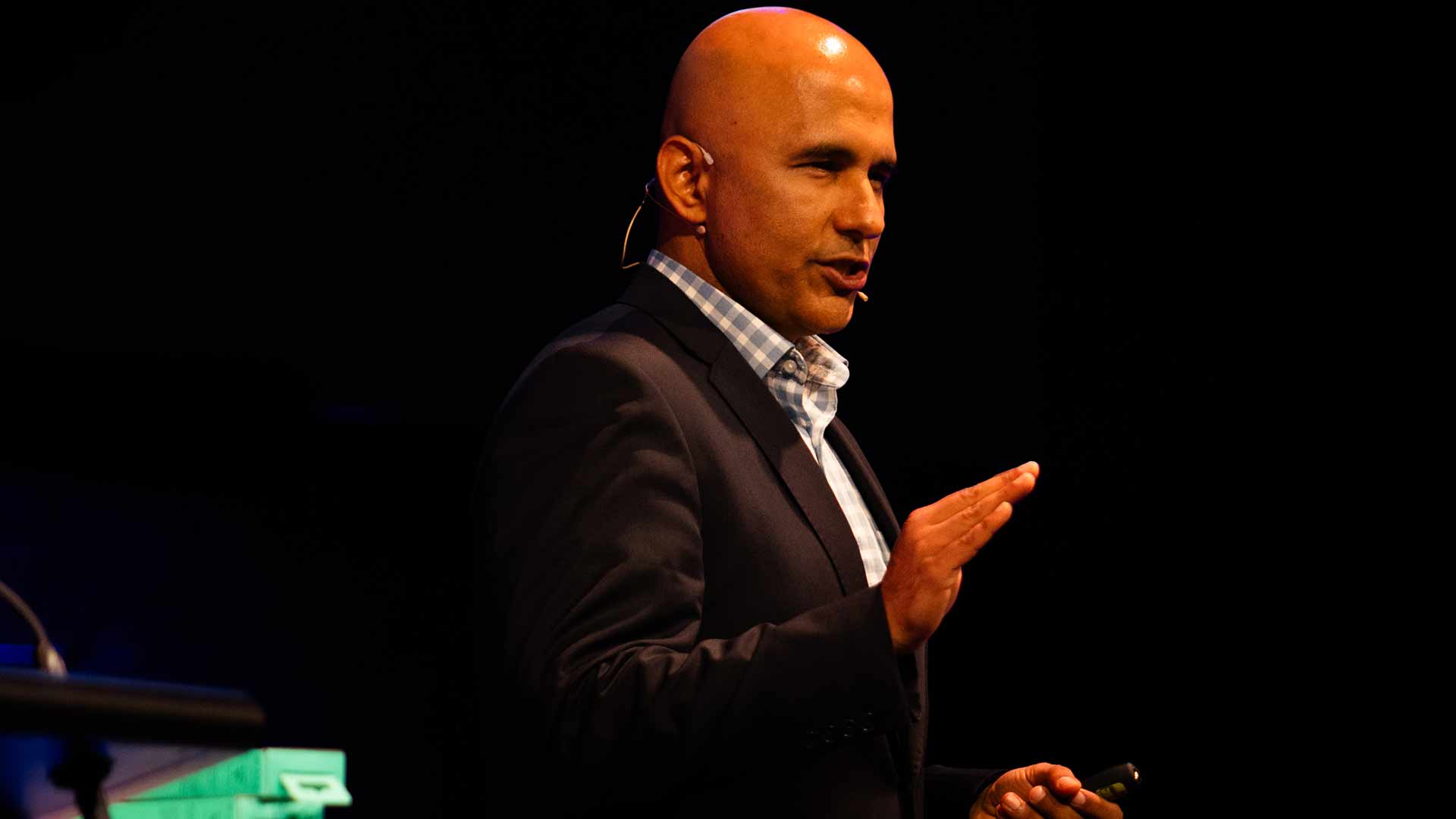
How to Use AI to Rethink Business
Atratus founding partner Amit Choudhary wrapped up the morning with the idea that most businesses were built to manage scarcity, and as AI quietly dismantles the old constraints, the winners will be the ones who rethink the model rather than just automate the one they’re stuck with.
Amit Choudhary opened with physics and a self-deprecating aside. Newton’s first law says “a body at rest continues to be at rest until there is an external force which is applied”, and AI, he said, is that force (though sadly not enough of one to get him doing the dishes). His subject was the post-constraint enterprise, and he got there via a line he pinned on Einstein: “An expert is a person who knows more and more about less and less till they know everything about nothing.”
Organisations, he argued, are basically piles of experts. You start a business because you’re good at something a customer will pay for, and as you grow you hire more experts: lawyers, HR, procurement, finance. But “expertise is scarce”, so “organisations exist to manage one thing, which is called scarcity”. Departments, layers of management and eventually ticketing systems all exist to ration that scarce expertise. “Ticketing came about,” he said, nodding to Jared Langguth’s earlier point, “because those experts were not available all the time to everyone.”
So could AI just replace the experts? Not really, and he was relieved. The big models “don’t know everything, and thank God for that”, because “if these language models were the experts, then competition would disappear” and every bank would feel like the same bank. A model “cannot have your memories”, he said, the experiences built up over a lifetime, “and that’s what truly expertise is. It is not just what you know, it’s what you have gained over a period of time.”
The real point was that organisations were designed around constraints AI is now quietly knocking down: time, distance, language, availability, capacity and expertise. Tickets, forms, help desks, even your accounting software exist because of them. “Why did Xero come about?” he asked. “Because it was helping you with the constraint of dealing with finance.” His challenge was to flip the logic: “Look at where a constraint can disappear, because then you can make a business model available which didn’t exist previously.”
He made it real with an example of someone who works in a retirement village and once dropped everything to hunt down an elderly couple’s lost engagement ring on their fiftieth anniversary. In the old world, recognising that means a colleague wrestling with an award form, and if their English is patchy, or they speak another language, the story barely makes it onto the page. Knock out the language constraint with a conversational agent and the whole thing changes: a staffer just tells the agent “This employee did a good job”, the agent says “tell me more”, teases out the story, and even ranks it against the brand’s values of care. Recognition happens “directly where the requester is, through voice, through interactive channels”, not lost in a ticket queue.
That, he said, is the gap between automating the old world and actually rethinking it. He held up today’s silos, where a colleague’s question feels like a mugging to be fended off with “have you raised a ticket?”, against a bank his dad worked at thirty years ago, all in-tray, out-tray and actual conversation. Too many firms, he warned, just use AI to do the same old things a bit faster, ignoring the constraints it could wipe out entirely. The winners will use it to get closer to the customer, maybe shoving HR out of head office and into the village itself, backed by AI rather than buried under it.
His parting image was another line he handed to Einstein: “Life is like a bicycle. If you want to balance, you need to keep pedalling.” AI is that bicycle, all forward motion and steering. But ambition is the thing. If everyone can write a tidy prompt, “where will the differentiation be?” Sameness is the danger, every bank and call centre blurring into one. “Don’t think 1x better,” he said, “don’t think 2x better, think eight times better.”
Asked how legacy businesses break free, he reached for the beehive: bees explore and exploit at the same time, and “if they do not explore something else, that hive is going to die”. So protect the exploring, roughly eighty per cent exploiting what already works and twenty per cent chasing what might, and don’t sack the people who go looking and come back empty-handed. “Find two lazy people in your organisation,” he grinned, “and give them the agenda to explore.”