
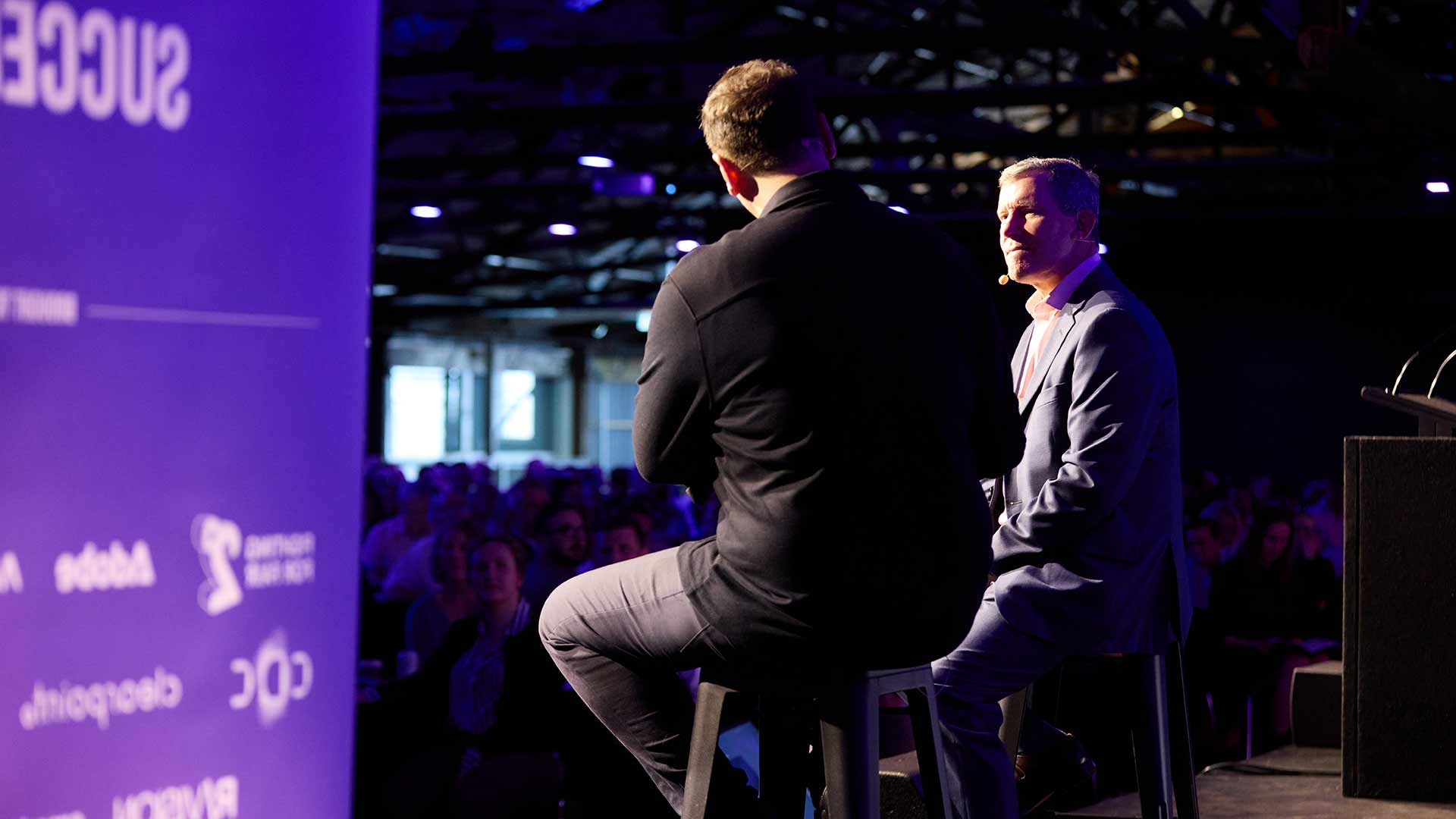
How to Future-Proof Your Organisation Amid Accelerating Change
In a wide-ranging fireside discussion, Mark Bregman explored the growing tension between the accelerating pace of technological change and the organisational structures that struggle to adapt to it. Drawing on decades of executive leadership at companies like IBM, Symantec, and Veritas, Bregman brought a systems-level view of innovation, offering insight into how business leaders can create resilience in an era defined by AI, platform shifts, and exponential disruption.
He opened by challenging the myth that technological change is purely about tools or features. Instead, he framed innovation as a cultural process, where organisations either make space for experimentation or slowly become obsolete. “The issue is not whether the technology works,” Bregman said. “The issue is whether the organisation is structured to take advantage of it.”
Bregman stressed the importance of feedback loops—between employees and leadership, customers and product, strategy and execution—as the mechanism by which organisations can stay relevant. He encouraged leaders to build deliberate tension between long-term vision and short-term delivery, arguing that innovation happens when organisations hold both perspectives without collapsing into one.
He also discussed how leadership styles must evolve. In traditional structures, hierarchy drives decision-making. In more adaptive environments, distributed authority, psychological safety, and a tolerance for ambiguity are essential. “Leadership is not about knowing the answer. It’s about being willing to make bets in the face of uncertainty and supporting your team through that.”
Finally, Bregman urged organisations to move beyond incrementalism. He argued that in a world of exponential change, optimising current models isn’t enough. Leaders must be willing to “bet against the status quo” and set up new structures within the business that can grow independently of legacy systems.
Takeaways
Organisational inertia is the biggest barrier to innovation.
Even the best technology will fail if the internal culture, incentive systems, and decision-making processes are not aligned. Bregman challenged leaders to ask not just “what can this new tool do?” but “what needs to change inside our business to benefit from this?”
Create tension between horizon one and horizon three.
Bregman referenced the three-horizon model to describe the need for balancing today’s business demands with longer-term innovation bets. Rather than choosing one, organisations must create space for both and accept that they will often conflict.
Build internal feedback loops that shorten response time.
Companies that adapt quickly have built-in mechanisms for gathering and responding to real-time data. This could be customer signals, employee insights, or product telemetry. What matters is that feedback is translated into action without friction.
Psychological safety enables risk-taking.
When people are afraid to fail, they won’t try new things. Bregman urged leaders to foster environments where intelligent risk is encouraged and where failure leads to learning rather than punishment.
Leadership is about decision-making under uncertainty.
Bregman described leadership as the willingness to make directional bets, support experimentation, and be transparent about what is not known. This is especially important in areas like AI, where the outcomes are emergent and hard to predict.
Experimentation must be protected from business-as-usual.
To future-proof an organisation, leaders need to set up autonomous teams that can experiment without being crushed by the expectations and constraints of the core business. These “edge units” often hold the seeds of the company’s next major capability.
Bet against the status quo.
In a stable world, it makes sense to double down on what’s working. But in a dynamic environment, success requires challenging assumptions. Bregman said leaders should ask, “What if we’re wrong about how this industry works?” and then explore alternatives before competitors do.