
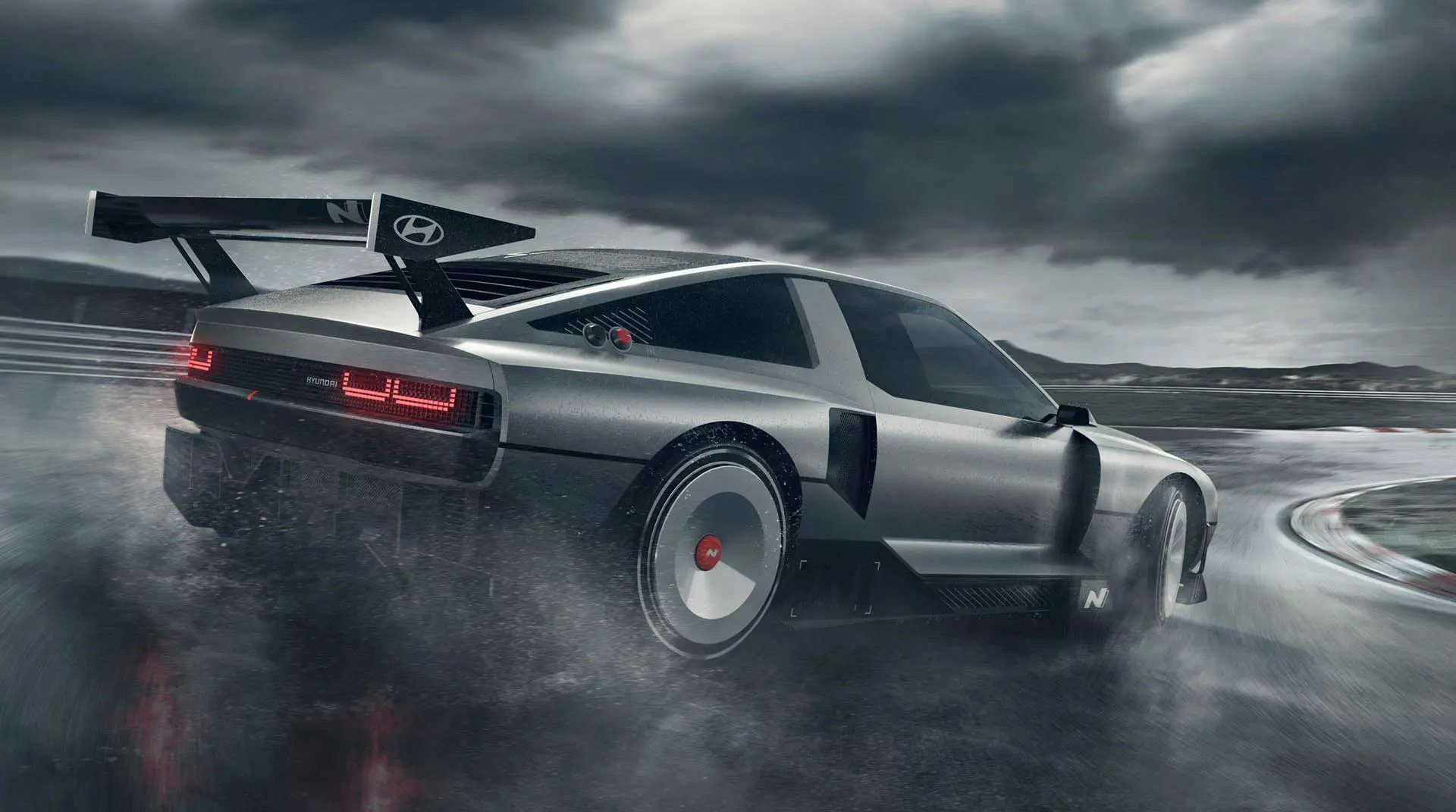
The Cyberpunk Coupe
Cyberpunk is the gristly bit of science fiction that stopped waiting politely for a clean utopian future and instead dragged it into a rain-soaked alley behind a neon-lit convenience store. The term is generally traced back to Bruce Bethke’s short story titled “Cyberpunk,” published in Amazing in November 1983, and the genre’s rulebook was effectively written when William Gibson’s Neuromancer hit shelves in 1984, hardwiring “high tech, low life” into popular imagination; Ridley Scott’s Blade Runner (1982) did the same job visually, with rain, glare, and megacorp mood lighting doing as much storytelling as dialogue.
Hyundai’s N Vision 74 looks like the design team has those references bookmarked. Officially, it’s a high-performance hydrogen fuel cell hybrid “rolling lab” from Hyundai Motor’s high-performance N sub-brand: a test-bed intended to validate technology that could later filter into production models. It’s also Hyundai N’s first hydrogen hybrid rolling lab, pairing EV technology with an advanced hydrogen fuel cell system to explore “driving fun” in an electrified era, which is corporate language for “we’re trying to make zero-emissions performance feel like something you’d choose, not something you’d tolerate.”
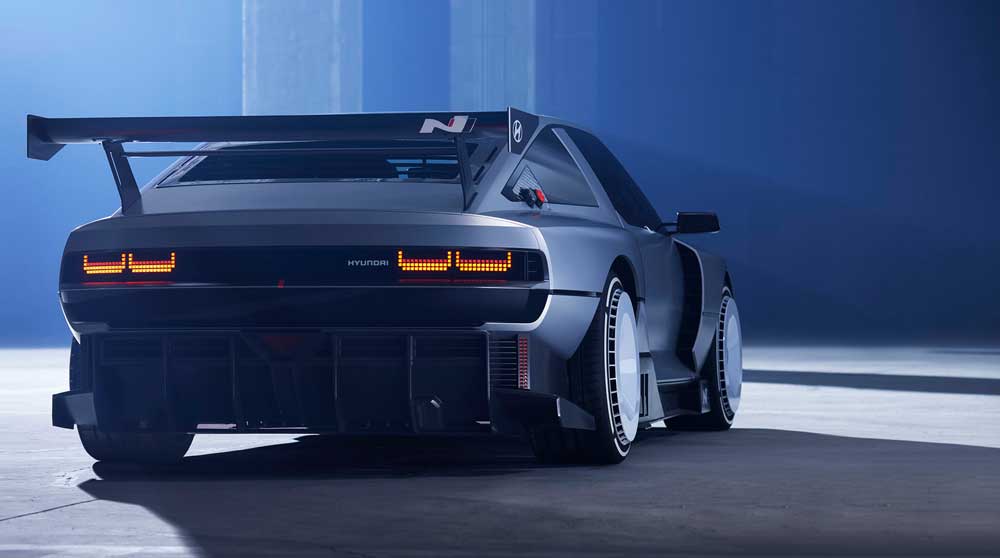
As well as mainlining Blade Runner, N Vision 74 is explicitly inspired by Hyundai’s Pony Coupe concept from 1974, developed by legendary designer Giorgetto Giugiaro. Hyundai says that concept was built into prototypes for what would have been Hyundai’s first production sports car, but it never made production, leaving behind exactly the sort of unresolved “lost future” that cyberpunk loves to resurrect. N Vision 74 inherits the Pony Coupe’s clean surfacing, its dramatic proportions, and its distinctive B-pillar, then drags that 1970s wedge into the electrification era with an unapologetically digital signature: Parametric Pixel lighting. Very futuristic in a kind of 80s sort of way.
Inside, Hyundai keeps the same “retro-future” logic: a driver-centric cockpit that mixes heritage cues with modern interfaces, specifically a digital cluster alongside analogue buttons. Actual buttons feel oddly rebellious in 2026.
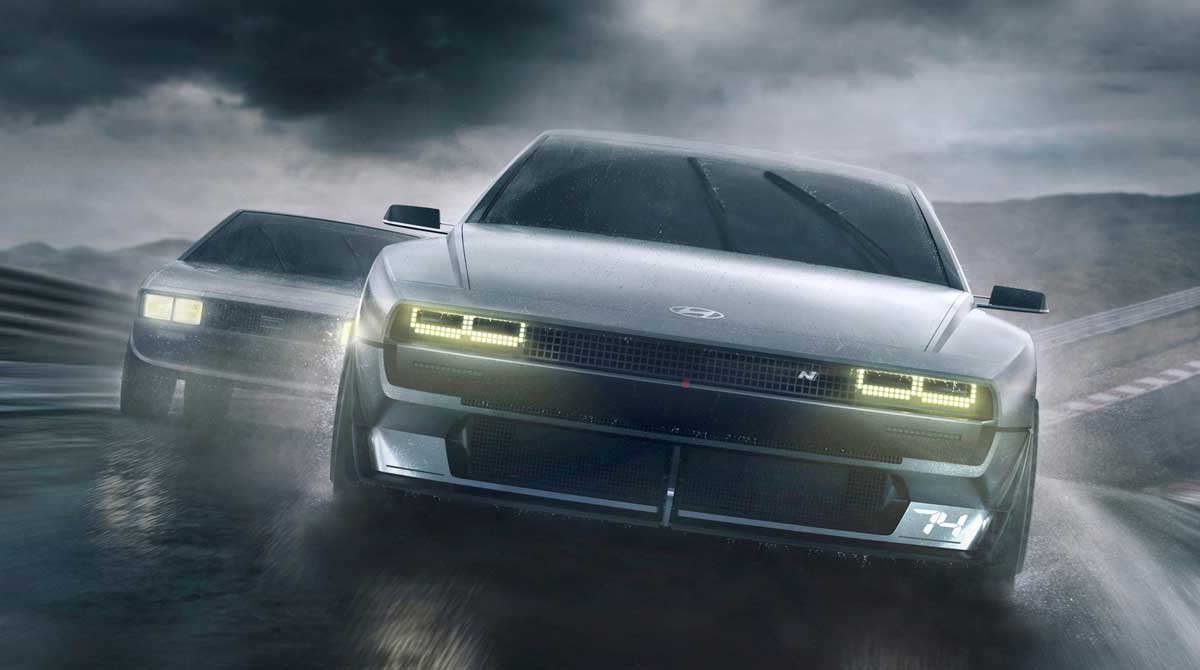
It’s not just the designers having fun either, Hyundai’s engineers get properly ambitious with this concept. Hyundai describes N Vision 74 as a hybrid structure combining a battery-electric system with an FCEV system in an all-new layout, with both power sources working together. The claimed upside is improved cooling efficiency and the ability to call on different power sources depending on driving conditions. Hyundai goes further and says this “fine-tuned logic system” enables better torque vectoring via twin motors on the rear, aiming for precise, responsive cornering.
Cooling is so central that Hyundai calls out a three-channel cooling system, and says the high-performance technology is integrated into the design to fulfil the fuel cell EV’s heat-management requirements. So the styling isn’t just there to look futuristic; it’s utilitarian, very cyberpunk still.
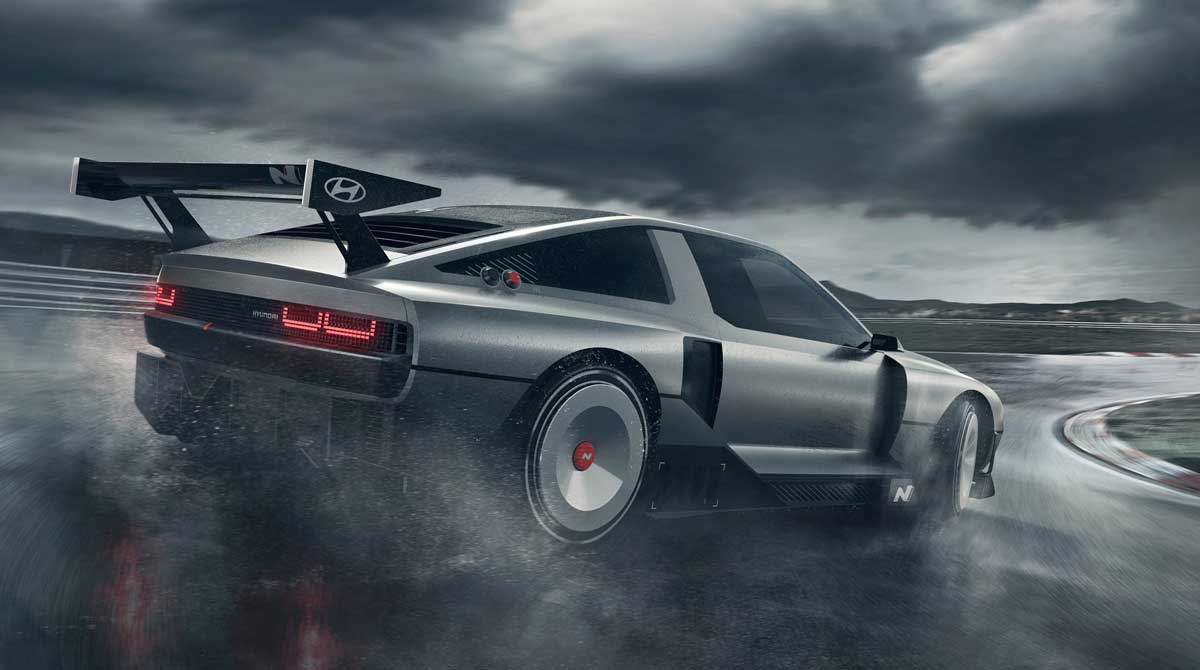
N Vision 74 is also a continuation of Hyundai’s longer hydrogen-performance curiosity. Hyundai links it back to the Hyundai N 2025 Vision Gran Turismo concept, unveiled in 2015 to imagine hydrogen-based high performance, and notes this is not N’s first engagement with fuel cell tech, just the most advanced system the N rolling lab programme has yet put into a high-performance concept. Hyundai also positions N Vision 74 around long-range and fast refuelling capability, promoting hydrogen’s core promise compared to battery-only life.
What they miss in the press release is that this makes it a lot easier to hunt and retire replicants without having to stop for recharging.