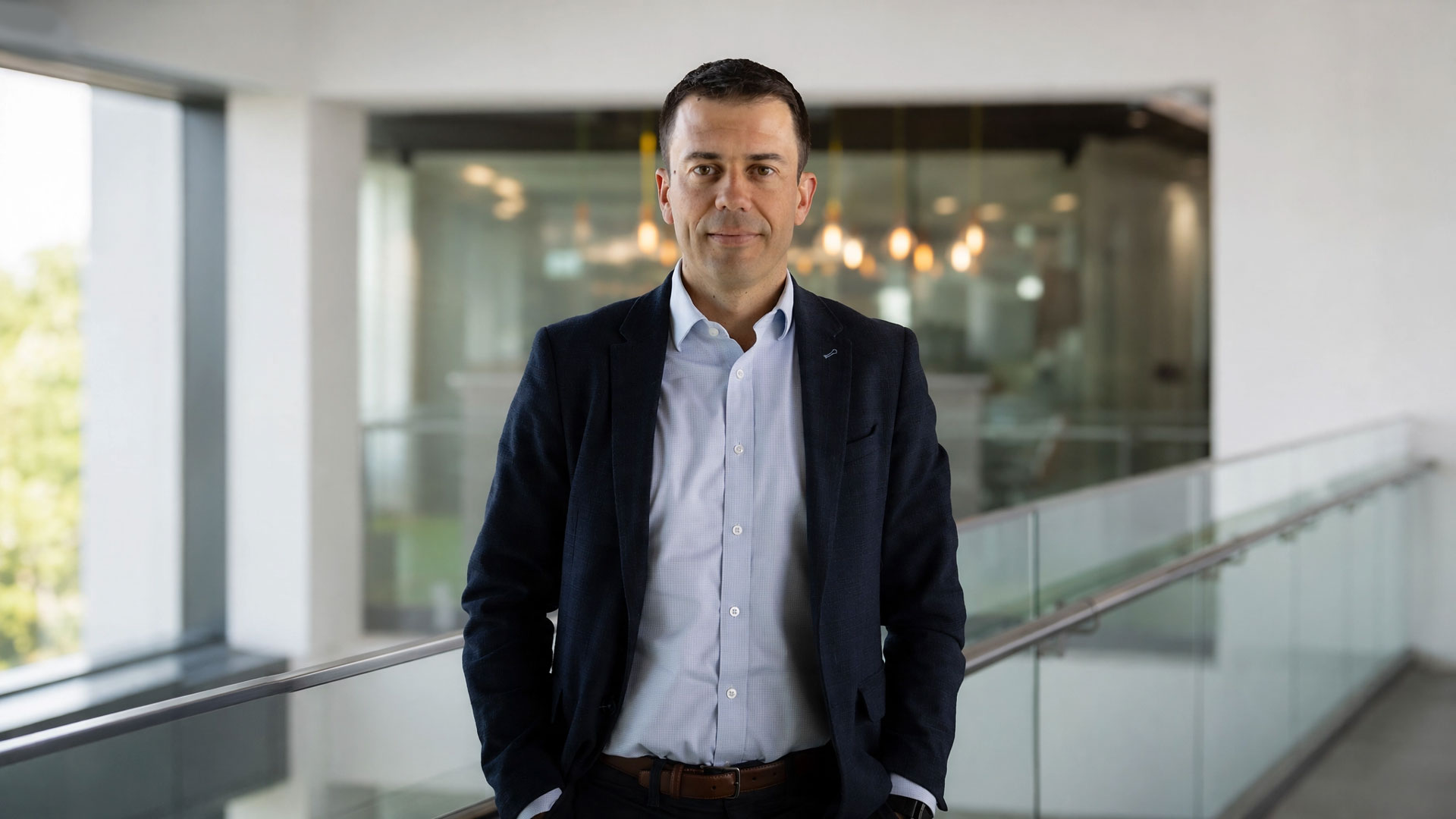
Kieran Byrne likes a difficult problem
Before each big move in his career, Kieran Byrne says, he has been “genuinely nervous” about what comes next. His path has taken him from power systems engineering to an MBA in London, management consulting, and a succession of roles at One NZ. He is now the company’s Chief Financial Officer.
“You step into the new position and you take it on and you learn very quickly,” he says. A few months later, he says, you can look back and wonder why you were so worried.
Byrne also likes the moments when the work is difficult and the outcome matters. “I love the days where we solve something really meaty,” he says. “It might be one or two decisions you make during a day which actually moves the dial and makes a difference. And I love that. I love the challenge.”
He began as an engineer, working in power systems and the physical infrastructure that keeps electricity moving: power lines, substations and major projects. For a few years after graduating, he worked in technical roles and project management in New Zealand and overseas.
“I really enjoy working in infrastructure and real physical assets,” he says. “I can drive around near my home and see things that I helped design and build.”
At 25, Byrne took on one of his first major stretches, moving to Doha, Qatar, to manage projects on a much larger scale than he had handled in New Zealand. He found himself working with seasoned contractors in a fiercely competitive environment.
“It was a huge learning curve for me,” he says. The work taught him about dealing with people and finding his way in an unfamiliar setting, as well as managing the infrastructure itself. The experience also gave him an early taste of what would become a recurring part of his career: walking into a role that felt bigger than his experience, then learning quickly once he was there.
Byrne doesn’t claim to enjoy feeling uncomfortable. “I don’t know if it’s thriving on being uncomfortable,” he says. “But it’s a satisfaction of doing complex things.” He likes the point where a tricky situation becomes clearer and the decisions start to make a difference.
“I love the days where we solve something really meaty. It might be one or two decisions you make during a day which actually moves the dial and makes a difference. And I love that. I love the challenge.”
That ability to stay calm when things get difficult is something others have noticed. One executive described his “superpower” as being able to “keep cool when the world’s burning around you”. Byrne says it helps to put a problem in perspective. “In the heat of the moment, things can seem bad,” he says. “But there’s going to be a point in the future where whatever happens, you’ve resolved this issue.”
After several years in engineering, Byrne started asking how he could broaden his career. “I wondered, what’s my path out of being an engineer and moving wider?” he says. He went to London to study for an MBA, looking for more breadth and the chance to work in different industries.
The experience opened up his view of what might be possible. “400 people in a course from 80 different countries,” he says. “That opened my eyes to, you know, from little old New Zealand, what’s possible in the world.”
After the MBA, Byrne joined Bain & Company. Consulting gave him a chance to work on a new business problem every few months, often in a different industry and with a different team. “You basically change your job every two or three months,” he says.
He found it a valuable education in how businesses work and the complexity of large organisations. But, after a number of years, he wanted to move closer to the work itself. “I loved it, but I also love being on the tools and having accountability,” he says. He wanted to be “riding the highs and lows of having to deliver outcomes, not just give advice”. Consulting had shown him how to analyse a business problem. He wanted to take responsibility for what happened next.
That opportunity came at One NZ. Byrne had worked with the company’s CFO while consulting in Australia and knew people in the management team and on the board. They asked if he would consider returning to New Zealand and invited him to talk about what he wanted to do.
He took a commercial role supporting the wholesale business, working on new opportunities that combined his infrastructure background with a wider business perspective. The work included developing the mobile virtual network operator market and major hyperscaler and government deals.
“It’s pretty unusual for a CTO to go into a CFO role,” he says. “But I think because my background’s not just technical, I’ve got commercial and strategic in there too, it’s sort of a natural place for me to go next.”
Byrne says he wasn’t completely qualified for the role when he started. That was part of the appeal. He was able to stretch into a new area while bringing skills he already had: problem-solving, technical understanding and a willingness to learn.
His roles at One NZ have continued to broaden. From commercial leadership, he moved into strategy and transformation, then became CTO, responsible for the network and IT. Now he is CFO. It is his fifth role at the company in five years.
“I don’t feel like I’ve been flip-flopping to different roles that require a completely different way of thinking,” he says. “It’s more just sort of a different lens to the same problem.”
The problem, as he sees it, is how One NZ can keep delivering reliable connectivity while finding ways to grow and adapt. “We’ve been pretty good here at One NZ over the past few years to be pretty clear in where we’re heading,” he says. The aim is to be “the best core connectivity provider in New Zealand” and give people network infrastructure they can rely on.
For Byrne, the move from CTO to CFO brings together the commercial, strategic and technical experience he has built along the way. He knows the technology, has worked on the strategy and understands the commercial pressures around investment. “It’s pretty unusual for a CTO to go into a CFO role,” he says. “But I think because my background’s not just technical, I’ve got commercial and strategic in there too, it’s sort of a natural place for me to go next.”
He also brings a broader view of how the organisation works. In a telco, network, IT, product and channels all need to connect for customers to get a good outcome. Byrne says the executive team has to work across those functions rather than simply focus on its own area.
“We talk a lot about our executive team as our number one team,” he says. The executive team may disagree on details, but, once it settles on a plan, it needs to commit and move forward together.
That same cross-business thinking shapes his view of career development. Since Byrne joined One NZ, the company has worked to create more movement between roles and give people opportunities to build new skills.
“We now have a good amount of mobility around the organisation where people are able to step into new roles to build new skill sets,” he says. People who have worked across different parts of the business, he believes, can better understand how the whole operation fits together.
Byrne has taken that approach to his own career, too. When the company was restructuring, he wanted to move from technology into strategy. He put his hand up and proposed a role he believed he could do.
“When I moved out of technology originally into the strategy role, that was me putting my hand up and saying, you know, we’re restructuring, I think I could do a role that looks like this,” he says. The move gave him more exposure to the executive team and board, and helped prepare him for the next step.
His advice is to take responsibility for your own development and talk to people about where you want to go. “You’ve got to go laterally,” he says. “You’ve got to have the conversations and drive your own career agenda.” People need to put their hand up for opportunities, he says, and be willing to move into roles that will stretch them.
“Don’t prescribe what you think you’re going to be doing next. Follow your gut, follow opportunities, and work with people you really enjoy working with.”
“You can’t always just expect the opportunity to come, you’ve got to make things for yourself,” he says. “You’ve got to create your own luck a little bit.”
When Byrne talks about leadership, he focuses on the aspect of bringing people together. “I like coordinating resources to achieve really difficult and complex things,” he says. He enjoys being accountable, growing a team and helping people do their best work.
“I ask a lot of questions. I’m curious. I want to use data. I want to understand the why.” His ideal team is made up of people who know more than he does about their areas, with his role being to coordinate their expertise and help them do good work.
That approach includes being disciplined about priorities. “I’m a ruthless prioritiser,” he says. “I always know what my two to three important things are that are going to move the needle today.” He tries to do the hardest things first and focus on what will move the business forward.
The discipline is particularly useful in the CFO role. Byrne says most of One NZ’s investment goes into its network and IT, and there are usually far more requests for capital than the company can fund.
“We will typically be oversubscribed in terms of asks by two times,” he says. The company has to choose between proposals that may improve customer outcomes, raise productivity or reduce risk. Some investments have a clear financial return. Others are harder to measure.
“There’s science to it, but there’s also art,” he says. He understands why technology spending can seem to finance leaders like “a bit of a dark art, a bit of a black box”. He has been on the technology side of those decisions and understands the risks and modernisation requirements involved.
“It’s very hard to say we’re going to invest in one cell site, what’s that going to return?” he says. “There’s no clear, tangible line of sight to a dollar.” Still, the site may be essential to keeping the network reliable and competitive. Having worked on that side of the business, Byrne can bring the technical context into the financial conversation.
Artificial intelligence is another area where his technical experience is useful. Byrne is bullish about the technology, but says the challenge is making it dependable inside a large organisation. “Although at the frontier of AI, the capabilities are absolutely mind-blowing, the ability to deploy that in corporate environments at the moment is really, really complicated,” he says.
“I’m a ruthless prioritiser. I always know what my two to three important things are that are going to move the needle today.”
One NZ is using AI in software development and exploring applications in network operations, customer service and process improvement. Byrne says the larger gains come when companies redesign how work gets done and build the data and automation needed to support it.
“To really get the benefit of AI, we actually have to really redesign how the work needs to get done,” he says. Without those foundations, he says, businesses risk “just plugging holes in existing processes”.
He is also experimenting with AI himself. His personal agent prepares a morning summary of global AI news, which he can listen to on his drive. It can even book golf tee times. Much of the work is handled by scripts, with a language model helping to build and improve them.
“The power of the LLM is to write you code which allows you to automate something,” he says. “So it’s turning everyone into a software developer.” His summary of the shift is simple: “AI has made automation cool again.”
For Byrne, that’s a useful example of his broader approach to technology. Start with the job that needs doing, understand how the system works and then use the right tools to make it better. His career has followed a similar pattern. He hasn’t needed to know exactly where each step would lead. He has needed to be willing to take it, learn quickly and keep moving.
“Don’t prescribe what you think you’re going to be doing next,” he says. “Follow your gut, follow opportunities, and work with people you really enjoy working with.”
When asked what advice he would give the new generation coming through, Byrne offers a combination of technical and human. “Get really good at working with AI, whatever that means, and be a good human being.”
“The world’s going to be powered by AI,” he says. “So you need to get interested in it and you need to understand it and know how to work with it.” The people best placed for that future, he says, will be “the decent human beings who understand how to work with technology”.