Best Of Watches and Wonders 2026: Rolex
Rolesium
COSMOGRAPH DAYTONA
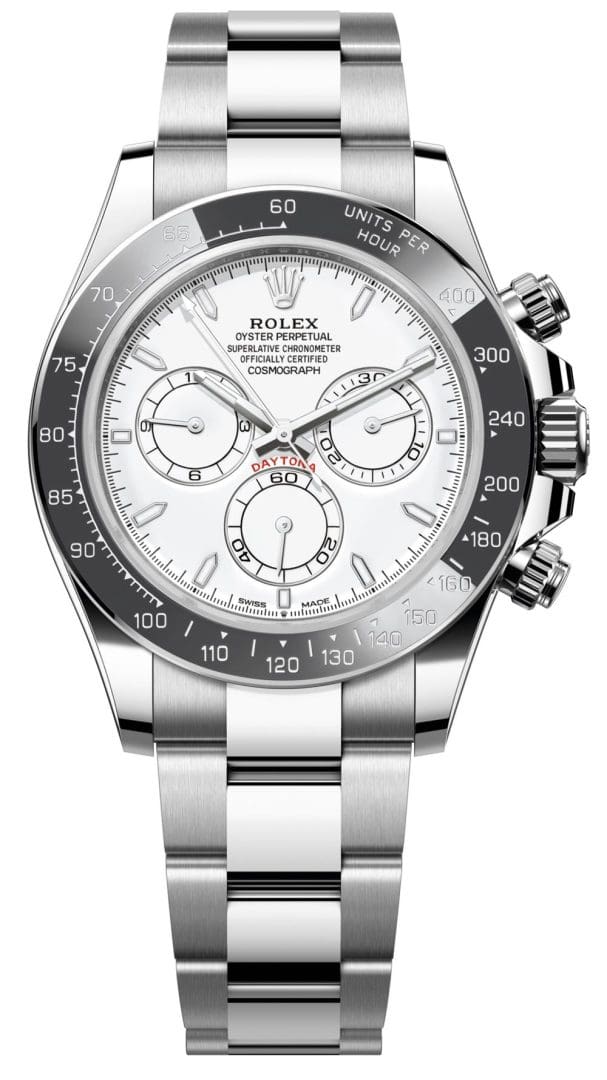
The new Daytona comes in Rolesium, combining Oystersteel with platinum, and it is noticeably cooler in tone than the gold-heavy references that have dominated the line in recent years. Whether that reflects a deliberate shift in direction or simply a gap in the release schedule is hard to say, but the result sits well.
The dial is white grand feu enamel, fired at around 800 degrees Celsius, which produces a surface hardness and colour consistency that lacquer cannot replicate. The Daytona was conceived as a tool watch for racing drivers, the tachymeter scale calibrated to calculate average speed over a known distance, and the enamel dial returns it to that instrument-grade register without making a point of doing so.
The bezel is new Cerachrom in anthracite ceramic enriched with tungsten carbide, a compound with a Vickers hardness of around 1600 HV compared to standard ceramic’s 1200 to 1400 HV, edged with a band of platinum. The tachymetric numerals are oriented horizontally, matching the layout of the original reference 6239 from the mid-1960s, rendered here in a contemporary typeface. The horizontal orientation improves legibility at speed, which is nominally the point.
The movement is now visible through a sapphire crystal case back secured by a platinum ring, a first for the production Daytona line. The calibre is the 4130, Rolex’s fully in-house column-wheel chronograph with a vertical clutch, developed to replace the modified Zenith El Primero used in earlier references. The vertical clutch eliminates the hand jump at chronograph start, and the 4130’s architecture integrates the chronograph mechanism directly into the base movement rather than layering it on top, keeping the overall height to 6.5mm. Power reserve is 72 hours. It has been in production since 2000 and looking at it through that new case back, the development time shows.
Yellow Rolesor
OYSTER PERPETUAL 41 CENTENARY
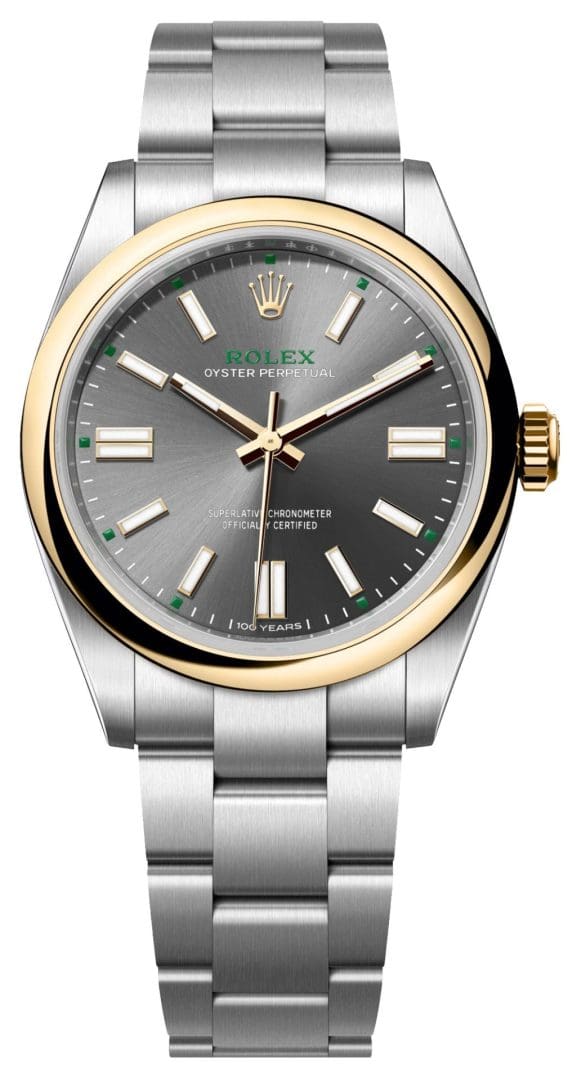
A hundred years ago, Rolex made a watch that could go underwater. That sounds unremarkable now, but in 1926 a waterproof wristwatch was a genuine engineering problem that nobody had convincingly solved. The Oyster’s screw-down case, screw-down crown and hermetically sealed architecture was the answer, and the following year Rolex proved it by sending one to the wrist of Mercedes Gleitze for her English Channel crossing. The watch survived. The marketing department has been dining on that moment ever since.
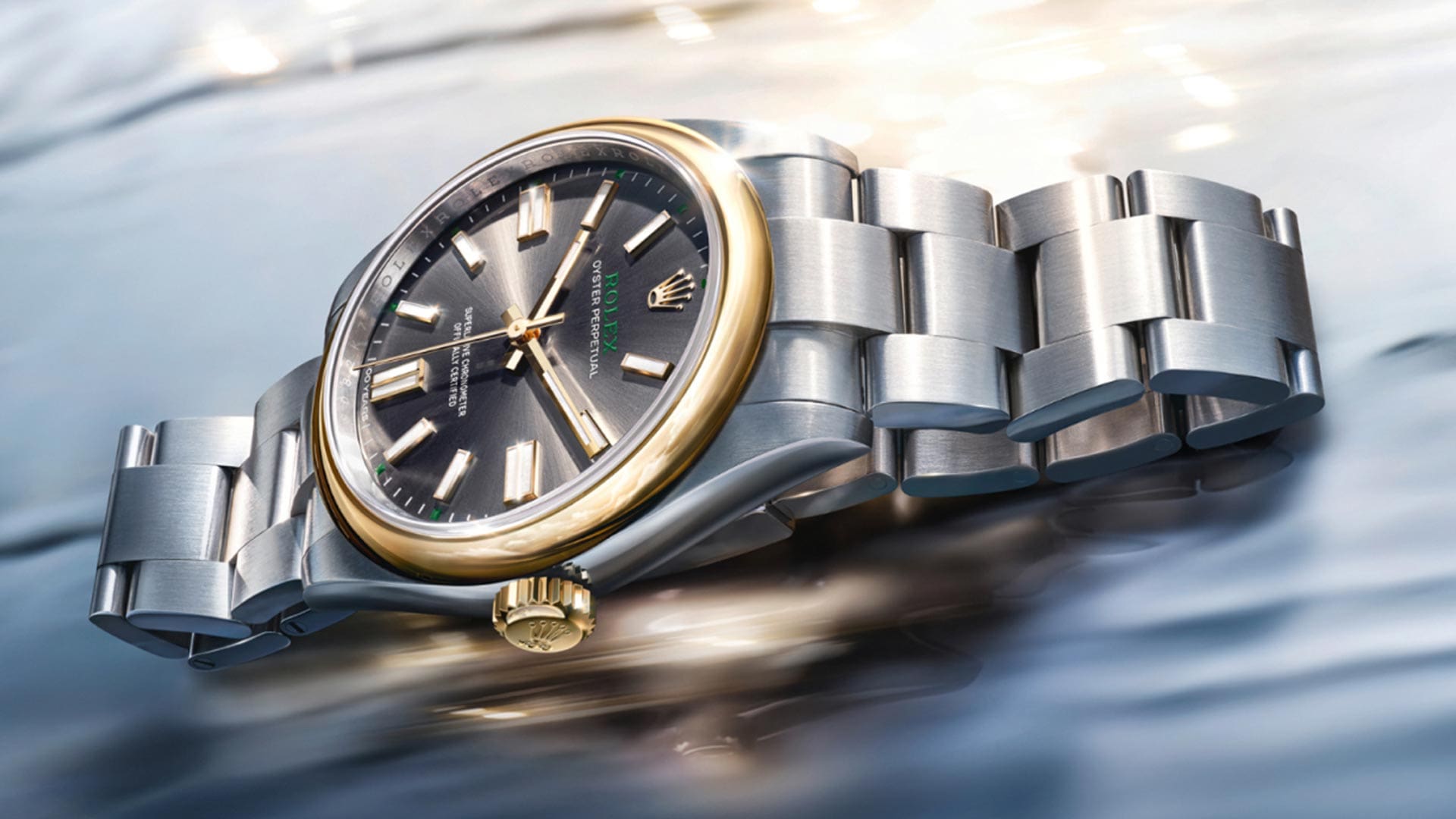
What Rolex chose to do with their centenary is, in retrospect, entirely fitting. Rather than a complicated piece or a limited edition, they made an Oyster Perpetual. Slate dial. Yellow gold bezel and crown on an Oystersteel case and bracelet, a configuration known as yellow Rolesor that has been in the catalogue since the 1930s. The archival reference is deliberate and fairly literal. Oystersteel is Rolex’s proprietary 904L alloy, which outperforms the 316L steel used by most of the industry in corrosion resistance and surface finish, though the people buying this watch are unlikely to be testing that in the field.
The centenary details reward patience. The winding crown is stamped with 100. At six o’clock, where Swiss Made normally appears, it reads “100 years.” Rolex green runs through the brand name and the minute track squares, pad-printed. That is the full extent of the commemoration, and the restraint communicates something more effectively than any amount of anniversary engraving would.
Under the dial is the calibre 3230, introduced in 2020, with Rolex’s in-house Chronergy escapement offering approximately 15 percent better energy efficiency than a conventional lever escapement and a 70-hour power reserve. It is among the first references to carry the upgraded 2026 Superlative Chronometer certification, which adds magnetic resistance, reliability and sustainability testing to the existing criteria around precision, waterproofness, self-winding and power reserve. Those tests are validated by independent Swiss entities, not internally, which matters in an industry where self-certification is the norm.
The watch that started it all gets the most technically rigorous movement Rolex has ever put in it, dressed in a material combination that maps directly to the archive.
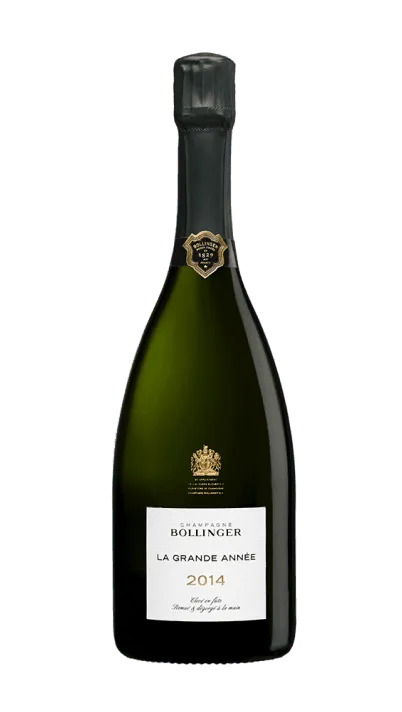
La Grande Année 2014
Vinification in barrels: expertise preserved by Champagne Bollinger
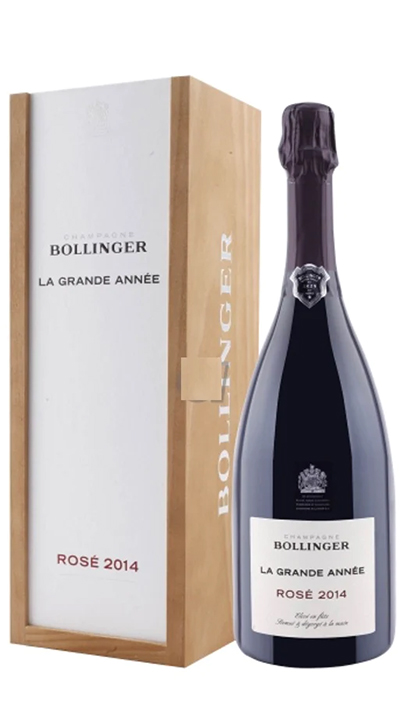
La Grande Année Rosé 2014
La Grande Année, a champagne craftmanship