Empathy In A Bottle
Stepping into the tiny nook of High Street’s Unity Books Auckland in early October this year, I was greeted with one of my favourite smells in the world. Books. Stacks of them. Glorious, beautiful, stunning books. Floor-to-ceiling cream-coloured shelves displaying thousands of these divine morsels—new releases, top-sellers, fiction, non-fiction, poetry—waiting to be devoured and consumed by hungry readers. The defined scent of them: a mixture of sweet almond, chocolate and woody vanilla. When I eventually shuffle off this mortal coil, I give whoever is burying me permission to bottle it up and smother me in it.
Due to the complex VOCs (volatile organic compounds) from the books glue, ink or aging paper, the scent evokes strong emotional connections of nostalgia, comfort and excitement. Living in a world of AI algorithms and online retailers, one highlight of my life is to go to a random bookshop, stand in the corner, and sniff. It makes people gravitate away from me too, fearing that I may be contagious with something.
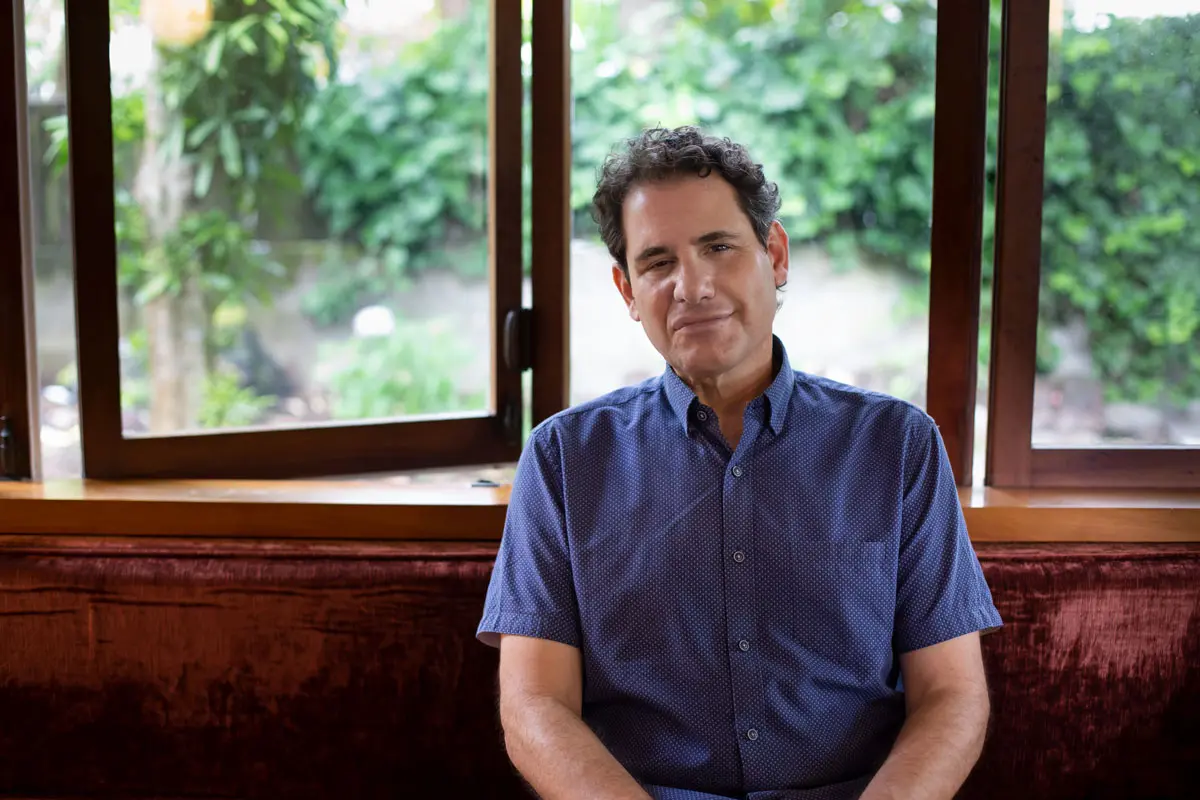
I had gone to Unity Books Auckland not simply to inhale book pages like a psychopath, but to attend the launch of my friend Bryan Walpert’s second novel, Empathy, published by the amazing team of Mākaro Press. Born in the United States and now based in Tāmaki Makaurau, Walpert’s body of work feels defined, matured and travelled, being published widely in multiple genres.
An award-winning author, poet, novelist, literary critic and academic, I have known Bryan for years and have always been smitten by his work. His last novel, Entanglement, published again by Mākaro Press, had been shortlisted for the highly-lauded Jann Medlicott Acorn Prize for Fiction in 2022. And his poetry collection (his fourth), Brass Band To Follow, published by Otago University Press in 2021, is a personal favourite. It featured too in the Listener’s 10 Best Books of Poetry. His writing has always been good. Real good.
Not surprisingly, the bookshop was buzzing when I arrived. Several familiar faces too. Lloyd Jones—award-winning author of Mister Pip, shortlisted for the Man Booker Prize in 2007 and adapted to film in 2012 starring Hugh Laurie—was there to launch Empathy. A book of his poetry, The Empty Grandstand, had been released last year, and I had flicked through it whilst waiting. My dear friend and publisher at Mākaro Press and The Cuba Press, Mary McCallum had apparently ushered me over to talk to her and Lloyd. She told me when we got to talking eventually. She said that she had spotted me as I was awkwardly cowering (my words, not hers) by the Spirituality & Religion section, sniffing at book pages like a clucking junkie (again, my words, not hers), and had waved me over. I had seen her indeed, but innocently had mistaken the usher for a wave, responded with a half-arsed grimace, a quick flap of my hand, most probably made a strange noise and shuffled away to the opposite corner and stared blankly at a wall. Nice one. Upon staring at that said wall however, I noticed Bryan next to me, in the midst of a conversation with someone. Bryan appeared cool, calm and collected. He always does. He gives off this scholarly-academic charm mixed with chill-dad energy. Whether it was Bryan or the person he was talking to (or even the books themselves), someone/something was wearing a lovely fragrance. Dolce & Gabbana’s The One, maybe? Or maybe Yves Saint Laurent? Or maybe it was those cheeky VOCs.
Not to give too much away, Empathy is all about smells too. Alison Morris, the marketing executive who tries to sell empathy in a fragrance bottle, or her husband, Jim, a game developer who has sunk his funds into EmPath, an online RPG where players progress by showing (you guessed it) empathy to strangers. The chemist who worked on the perfume, Edward, too, or his son, David—the only one looking for him. The book is a thrilling, deeply emotional read that will keep you hooked until the very last page.
A couple of days before the launch, I got to sit down with Bryan and talk to him about his next book, his inspirations and what next on his writing journey.
Give me a run-down of Empathy. What can readers expect?
The book is about a man—his name is David; a widower—whose father has disappeared. The book opens with that event, and then it is basically David trying to work out what happened to Edward, his dad, who is a chemist for a perfume company. When David (and the reader) eventually learn what the father was up to, the kidnapping all makes sense. The book mostly centres around the search for his father, but also David’s relationship with his two kids—a roughly-12-year-old son and roughly-17-year-old daughter. The book interweaves a perfume company marketing executive, Alison, and her husband (who is a game creator). Both the perfume she is working on and the game he’s working on have to do with empathy, which is where the title comes from.
As you said before: Empathy opens with a kidnapping and has a thriller-feel, I think. Your writing in general has a ‘blockbuster’ style that I felt too in your last novel, Entanglement. This book also has quite a slow-burn to it. How do you balance between thrilling suspense and a slow-burn exploration of character?
Well, I’ve always been a slow-born sorta person…so writing Empathy was a little different for me. I went back and forth between literary development and the thriller movement to try to grasp the best way to tell what happened with Edward (David’s father). I’d never written in the thriller vein before. It was fun to try to pursue that. I don’t know how thriller authors in general plot their novels. I tend not to do a lot of advanced plotting. I just start off with a few ideas and then pursue the plot as I go, trying to figure out what happens next. I’ve never been a big advanced plotter. It was fun to watch the story develop naturally. I’d sit down with the goal of getting to 1,000 words a day and I just saw what happened as it happened.
I believe Stephen King does that too…He sits down at his desk every day with the goal of getting to a thousand words…
He does! In his memoir, On Writing, he said: ‘I’ll never say I don’t plot, like how I say I never tell lies, I just try to do those things as little as possible’, or something like that. I agree with that. Every author has their own method. Some plot meticulously. When I started Empathy I knew that it was going to be a book about perfume and I had David in mind as a character. I knew that David’s father would be involved and then disappear. I just set up the schedule, and as things came to me I would take notes as I went. Toward the end I started to outline, sort’ve like a birdseye view of the book. I’d outline all the different chapters, or sections, to help me figure out what’s missing and what needs to be rearranged. The disadvantage of doing it this way is you go down some false plot alleyways, or some paths you don’t end up going down again. The consistency errors crop up (which is why you need a good editor).
Talking about good editors, the amazing Mary McCallum and Paul Stewart from The Cuba Press are your publishers! Love them both!
Oh yes, they’re fantastic. Mary’s a writer too (award-winning author and poet), and a great editor and person. Paul is a brilliant editor too and looks at every line meticulously. It’s really great working with them both.
Is getting 1,000 words down a day easy for you? Or is it sometimes a slog?
It’s challenging sometimes. Some days you get an idea and it comes quickly. Other days there’s nothing. I always take weekends off as a chance to regenerate and not get too burnt out. With Empathy I wrote five days a week, a thousand words a day (except for weekends, holidays and my birthday.) Also I took a day-off when Auckland was hit by Cyclone Gabrielle! I try to be disciplined. I know that if I stop it’ll take me a while to get back into it.
Who influences your creativity most?
Oh boy…Most probably [Kazuo] Ishiguro (Nobel Prize-winning author of Klara and the Sun) is my number one. How he deals with memory, and the dramatic irony, and how people fool themselves yet the truth gradually comes to the surface. He’s very influential.
Another really influential figure early-on was David Foster Wallace (who wrote Infinite Jest); he played with language. He would not spoon-feed you, but give you the things that you can put together yourself. The way he experimented with structure and voice! Marvellous. Those two are my biggest influences fiction wise.
I guess I’m forever getting influenced. I don’t know about you, but every time I read I’m simultaneously reading as a reader and reading as a writer. As a reader I get easily lost in the book. As a writer, I’m more analytical and ask more questions…How did they do this? Why did they do this? I didn’t know you could do that that way etcetera etcetera. I’m really interested in writers that do unusual things.
There’s a Scottish writer called Ali Smith. I don’t think anyone writes quite like her. She’s quite unique. I love the surprises she always has in store and she examines how a book moves and its voice and its numerous elements.
I really like the US writer, Richard Powers, who really draws in science into his work. I quite like to do that too, but not nearly as he does it. He writes quite expansively, except for one recent book that I loved and is more compact. It is about a father and son. I read as widely as possible and get influenced in many ways. I love books that do interesting things.
As well as a very good novelist, you’re also a very gifted poet. Whilst working on a novel, do you ever find that you slip back into a poetry mode?
The fiction that I started writing has and is heavily influenced by poetry. I came into fiction as a poet, very interested in the way words interlace one another. That’s particularly true of Entanglement. Numerous elements in it are grounded by poetry. I also think that that novel had a lyrical language and had a particular interest in metaphor. In Empathy there’s definitely some of that. There’s still an interest in structure and lyrical language. Given the thriller element there’s a little less of it, sure. But I was trying in this book to write something a little more profluent, which is to say: to be a bit more straight-forward, and not so circular. But poetry is always there in the background, and it always will be.
I don’t know about you, but I can’t write poetry and fiction at the same time. I sort’ve need to be focused on one or the other. If I’m reading a lot of poetry, I wanna write poetry…and the same with fiction. But poetry will always be there. In fact, I was working on some poems yesterday!
What surprised you the most when working on Empathy?
Alison Morris, who is the perfume executive in the novel…I wasn’t expecting her at all. That was surprising. And then her husband, the game developer, came up in the first chapter I wrote about Alison. I was not expecting to have an online game to be as central to the book as it was. At some point I realized that I would have to write from the perspective of playing this game. My previous agent, Fergus, is gamer. He gave me good feedback. He was like: ‘we could adjust this here and there.’ I was very surprised to find myself writing from the perspective from playing a game.
Fatherhood and the idea of family are large themes in the book. Care to expand on that?
For a large part I took my own experiences as a father in creating David. He feels a great responsibility because his wife, Molly, died a few years before. He’s left to raise the two kids by himself. His daughter is a challenge, and has her own social dynamics going on. He’s trying to maintain and keep a connection with her. Definitely there’s a playfulness between a father and his kids too.
You’re focusing, I guess, on the launch right now…But do you have your next book in mind? Will you go back to poetry? What does the (excuse the pun) next chapter look like?
Right now I’ve started working on another fiction novel. I also have another novel in mind (a few ideas). The thing about poetry is, if you’ve got a couple of poems that aren’t working…you can put them aside and write more. A novel, it either works or it doesn’t. You can fix a novel only at the end, seeing if it holds together. It surely is a speculative endeavor. It takes time. I’m hoping it works.
I also will take time to work on my poems. I’d really like to get another poetry book out. I have three projects ahead and will keep me busy for a few years I’d say.
You can pick up a copy of Bryan Walpert’s second novel, Empathy, at any good bookshop or online at: thecubapress.nz/shop/empathy/