
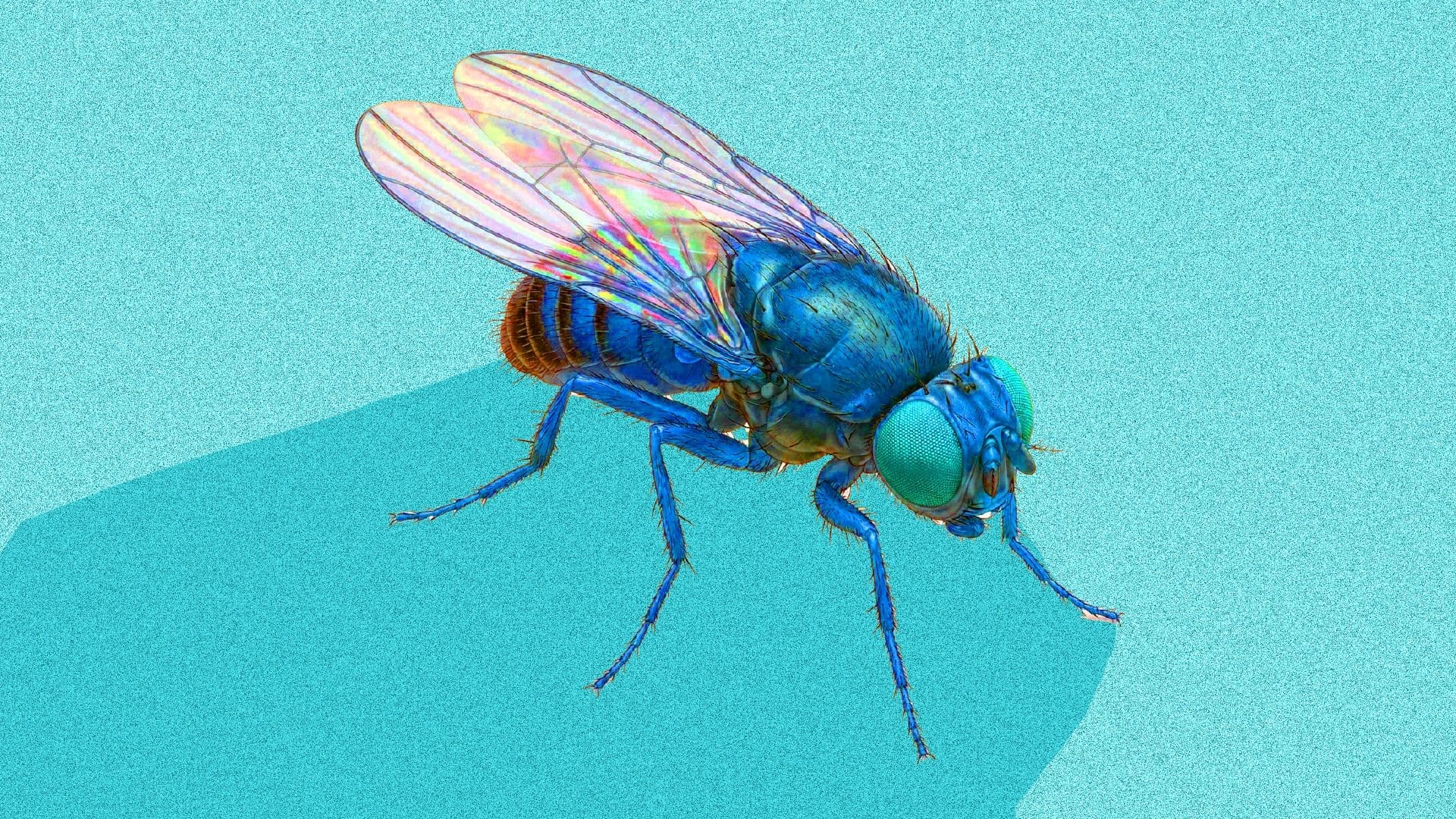
Flies In The Machine
Large Language Models are inherently flawed. They’ve pulled off a highly technical party trick but it’s not going to be the path forward toward true machine intelligence. When it comes to flexible creative thinking and learning nothing beats the human mind (when it isn’t vibe coding with Chat-GPT). But how do we put a human mind into a machine? Well science already has. For a fruit fly.
Eon Systems PBC has created what they believe to be the first embodiment of a whole-brain emulation of a fruit fly. In 2024 they published a paper in Nature on how they had digitally reconstructed 125,000 neurons and 50 million synaptic connections to emulate its brain. It could predict motor behavior with 95% accuracy but it had nowhere to send these instructions. A brain without a body. Cut to 2025 and they have created a physics-simulated fly body. It’s not a perfect emulation of the body however, but this might also come in the future.
“We can’t trace the actual motor neurons because the body was not scanned.” said CEO of Eon Michael Andregg. “However we do know what the brain does when it wants to move in certain ways and that’s what we connected to the NeuroMechFly. This is a real limitation of the FlyWire connectome, which is why we plan to scan both the brain and the body.”
The result is a fly with 91% behavior accuracy.
“This shows how much information is captured by the architecture itself, rather than the neuron model, which is great for the feasibility of full emulation.”
Their next step from here is to scale up.
“Eon’s mission is to produce the world’s largest connectome and highest-fidelity brain emulation, targeting a complete digital emulation of a mouse brain and laying the groundwork for eventual human-scale emulation. A mouse brain contains roughly 70 million neurons, 560 times the fly’s count, and the team is currently amassing the connectomic and functional recording data needed to attempt it” says Dr. Alex Wissner-Gross.
There are some limitations to the current model they’re running, it apparently has “Leaky Integrate-and-Fire” which means no brain plasticity rules, so it cannot form long-term memories. If that sentence strikes at your core a little bit you aren’t alone. Is this in some way a real creature? The Eon team certainly seem to be treating it that way.
“This is, in our view, a real uploaded animal.” says Andregg “We don’t know what its experience is — nobody does. But we take the possibility seriously, and we’re working to give it a rich environment, not just a test box.”
“If you’re going to build this technology, you have to care about the beings you create with it. That starts now, at the smallest scale.”
At this point it really is all about scaling up. The team has no idea quite how difficult this will be, but if they make it to their goal of recreating a mouse it’s only a matter of when, not if we do it with a human brain.
Apart from the creepy factor there are some massive positive implications of doing this sort of mapping and recreation. We could use these systems to understand and cure Alzheimer’s along with everything else that plagues us.
“A successful hi-fi upload should feel like you.” says Andregg “A you that is robust, free from illness and death; editable, can run faster than real time and keep up with AI (transistors are a billion times faster than neurons); and most importantly aligned, with your values, memories, relationships, and moral intuitions.”
I don’t particularly care to have a version of me like that. My consciousness will forever be trapped inside this rotting husk of a body no matter how many times you hit ctrl-c ctrl-v on it. A simulation of me would just be a problem. The only person I would have wanted a brain emulation of is someone like David Bowie so we can keep getting cool music.