Randy Feltface: A Gimmick From a Comic Genius
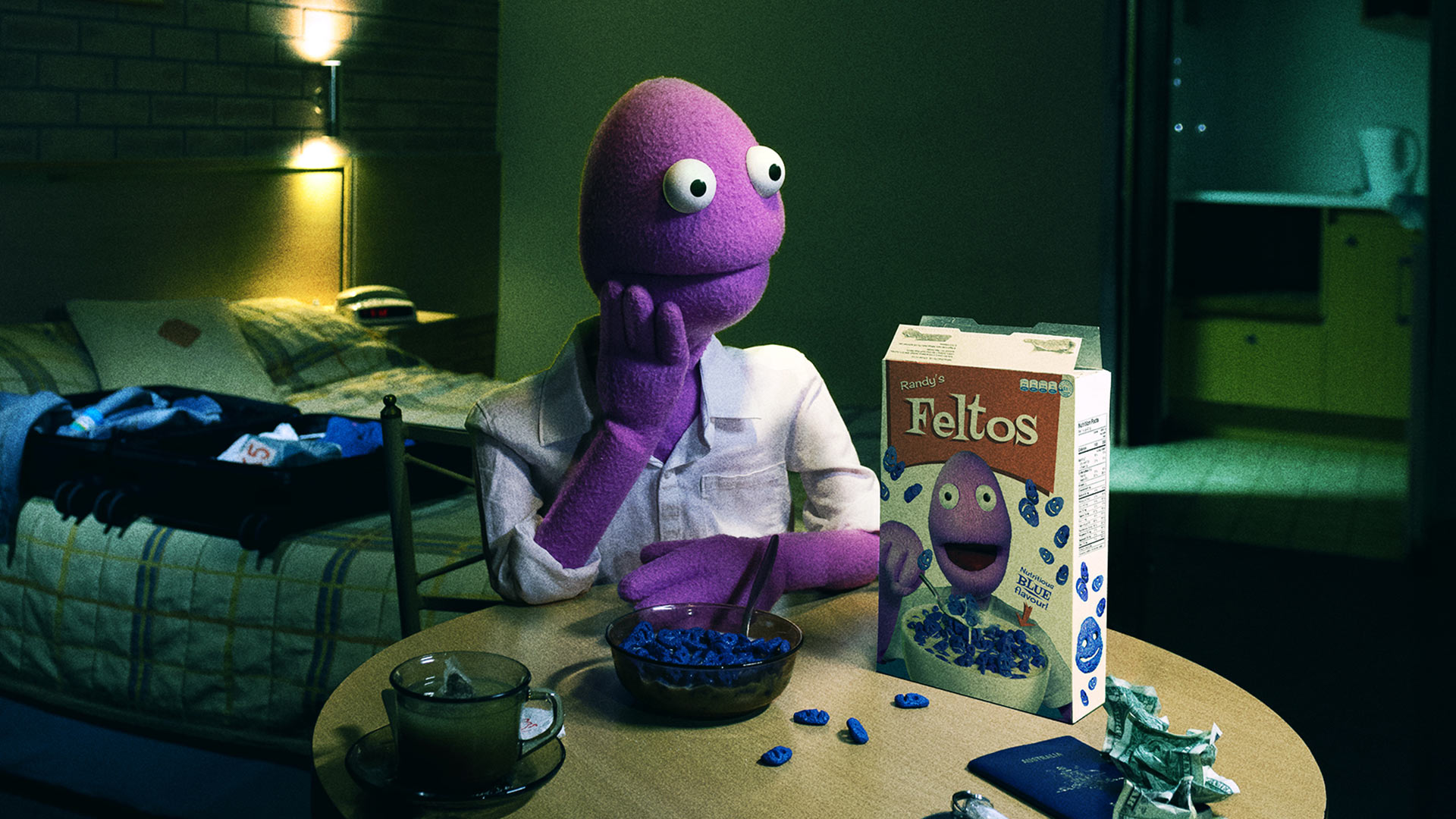
There’s something wonderfully absurdist, albeit refreshing, interviewing a puppet. For years in this job, this was my first time doing it. As the well-known Australian comedian and provocateur, Randy Feltface looked at me as we sat together, with his tiny, felty purple visage and big, bulging bug eyes, my usual work style and social awareness dissipated almost instantly. I suddenly had no idea where I was, how to do my job properly, or who I was ultimately talking to. Was it, in fact, Heath McIvor, the creator of Randy himself, that I needed to address? Should I even bring up McIvor—does he even exist in this space I am currently in? Or is it the puppet controlling the puppeteer here?
I knew from watching his stand-up routines online, and even seeing Randy Feltface live in Auckland last year, that he has the emotional stability of a collapsing soufflé and the philosophical instincts of a late-night existential crisis, so I was prepped for some pretty routious dialogue with him. And alas, there Feltface was, in the flesh (or felt), waiting for the interview to begin, and I was flabbergasted on how to start it, or who to address first.
As we started talking together on his upcoming tour back to New Zealand next year, I was stunned, almost, by the gloriously unhinged creation that is him. He spoke with such intelligent philosophical poignancy that it became clear that I wasn’t talking just to a puppet (a damn funny one at that), but I was talking to a social commentator at times, surprisingly thoughtful in the performance of simply being.
Over the many years Randy Feltface has graced stages around the globe and has become a comedy phenomenon. Starting all the way back in 2011 with his first solo tour, Randy Is Sober, he has written and performed 12 tours to date, has sold-out international tours, has an Edinburgh Fringe Best Comedy nomination and a USA television appearance on NBC’s Bring the Funny. His online following has propelled him further, garnering up to 350 million views on Youtube.
His latest tour, Gimmick, is bringing him back to these shores next year with plenty more tricks up his felty sleeves (if puppets even have proper sleeves.)
I came to your show in New Zealand last year, the First Banana tour! It was brilliant. Also, I gotta be honest, this is the first time I’ve interviewed, to put it lightly, a puppet…
Thanks! What a show! Guess what, it’s my first time I’ve been interviewed by a Jamie, so we’re even.
How excited are you to be bringing your newest show, Gimmick, to New Zealand next year?
I am overwhelmingly excited to be bringing Gimmick to New Zealand next year because, last time I toured your beautiful country, the audiences were phenomenal. I personally think this show is more fun and more joyous than the last one. I’ve managed to build a bit of an audience in New Zealand over the last few years, and I’m very proud of bringing them this absolute blinder of an hour and a bit of pure, unbridled shenanigans.
It’s been an amazing tour so far, and I’ve decided to start the Australia/New Zealand leg of it in little ol’ NZ, so you’re getting it fresh off the presses. I’m in Vancouver right now. I just arrived in Vancouver about seven minutes ago, so I walked into my little apartment I’m staying in, and bang, boom—we’re in, we’re on!
My god, you’re a machine!
I only came from Seattle. Let me caveat that by saying it was a three-hour drive, so it’s not like I got off a plane from the Southern Hemisphere!
You’ve performed for audiences all over the world. Do Australian or New Zealand audiences respond differently to you, or do you get the same reception all around the globe? Do you have to tweak your sets to accommodate different countries?
I don’t necessarily tweak to accommodate, but I tweak to put in some local references because it’s so much funnier for everybody if I’m referring to the country I’m in.
I love touring America, and I love touring Europe, but I feel that I get to relax a little more in Australia and New Zealand because I don’t have to work quite as hard to be understood.
I feel like I can drop into my natural accent a little more, I can be a little lazier, I can talk a little quicker. Australian and New Zealand audiences, we all kind of get the same sense of humour. We get the same stuff, so I get to just lock in and be myself.
I think the main difference with American audiences is that they’re very open, and they want you to succeed from the moment you walk on stage. Whereas I find Antipodean audiences, New Zealanders and Australians, are a little bit more reserved. They’re waiting for you to prove yourself, unless they’re super familiar with your work and know you’re going to come out with some gold. American audiences are all ‘star-spangled banner’, like A-meri-cah, ‘yeah, you got this!’ Then, if you ‘don’t got this’, they’re like, ‘Boo!’ Whereas Australian and New Zealand audiences are like, ‘Boo!’ until you got this. I find that, as far as the self-deprecation stuff goes, you do have to tone it down a bit. If you’re mean to yourself on stage in America, for example, a lot of audiences will be like, ‘Awww’, whereas if you do that in the UK, Australia or New Zealand, audiences are like, ‘Yes, I see it too, you are a d**khead!’ Or they at least know there’s humour behind it.
I write quite universally. I used to write very specifically in a certain way, but when you travel and the show has to work everywhere, you end up writing a little more broadly anyway.
I don’t really put myself down that much unless it’s super, super funny. I’m not sh**ting on myself too much these days. See, I respect cultures that are a lot more direct and just say, ‘This is how I feel. This is what I have to say.’ For example, I have American management now, and the email chains with the Americans compared to the email chains with the Australians and New Zealanders are completely different. Everything in the email is like a text chat with the Americans. It’s three-word answers. Australians and New Zealanders are far more waffly.
Over the years, and over your many, many shows, you’ve definitely created a personality for yourself with many opinions. How much of what audiences see on stage comes from the human behind you, basically, and how much have you, Randy, become a character in yourself?
I get what you mean, but we don’t really talk about that guy [Heath McIvor]. What I can say is that, just the same as with a lot of comedians, what happens in reality, what happens in real life, either directly translates to the stage or at least elements of it. You know, never let the truth get in the way of a good story, sort of thing.
I try not to talk on stage about things that I don’t at least have some sort of relationship with, or that I’m not curious about, or that I haven’t researched a little bit before I blunder on stage and speak with authority. A lot of what I talk about on stage is very accurate to my everyday life, and certainly it’s aligned with my belief systems. It’s fun, actually, being able to evolve personally and then talk about those things on stage. I’ve been doing this for 20-something years now, and your audience gets to witness your highs and lows, your moments of triumphant maturing, and your moments of humiliating mistake-making. It’s a ‘warts and all’ sorta thing, I think. But this show, again, this one, is just non-stop laughs. This is joyousness. The idea is that I’m really leaning into the idea of the gimmick that I am.
There is an incredible amount of skill involved in your act. How would you describe the relationship between your voice and your movements? What do you still find enriching and enlightening about discovering parts of yourself on stage?
What an amazing question. I use my physicality to accentuate the points. I am a very physical performer, so if I’m doing a lot of this sort of stuff, making huge gestures, I find the stillness really has an effect. I jump around a lot, and I’m very loud and vocal. But what that does is afford me the luxury of being able to bring it right down when I need to make a point. I love that.
I’m always trying to discover new things on stage, physically and vocally as well, because that keeps it fun for me. I rarely, unless there’s a really specific joke that has a very specific action that accompanies it, do the same thing twice on stage. I’m jumping around all over the place because it keeps it fresh for me. For want of a less w**ky term, it’s a flow-state sort of action.
I’m a big fan of silent comedies: Buster Keaton, Chaplin and Harold Lloyd and stuff. I grew up watching a lot of that stuff.
Then there were a lot of very esoteric, existential, very wordy comics as well. So my influences are a mix of cartoon violence and existential philosophising. If I can combine those two and make them fun, then I’m where I want to be.
Are you a comedian who needs a fully rounded idea for a joke, or do you just see something funny, write it down, and have it in the back of your head? Or do you need a plan for your comedy?
I start with a deadline. Usually, I put the show on sale before I’ve written it, just to have that air of pressure. Then I’ll have an idea about what the show is going to be like. For this one, the idea is old-school gimmicks versus new-school gimmicks, and the challenge to myself is that everything in the show has to be a gimmick. That was kind of where I set off with this one.
Then I research ideas. I come up with big, broad ideas that I want to have in the show, and then I funnel them down. I create a structure, and I sit down and write it.
I’m not one of those comics that necessarily goes out and works up stuff on the road. That being said, if something funny happens on the road, I will say it on stage. I do a lot of improvising on stage as well, and if something comes out of that, I’ll keep it in the show.
Some of my best bits have just come from me experiencing something in the world, talking about it on stage, and then honing it over a couple of weekends. Then you have a new bit.
But as far as my full narrative shows go, I have an idea, I have a theme, I have a deadline, and then what happens in the middle has to happen. Otherwise, I would never make anything.
Having a bunch of ticket holders going, ‘Oh, we can’t wait to see it, Randy!’ puts that sphincter-clenching pressure on you to come out with something gold.
It’s all playing. When I’m writing, I’m also trying to make myself laugh. I pace around the room, writing stuff that I find funny. Once it’s written, it just exists. The real key is that you put it on stage, and the audience will tell you whether or not it’s funny pretty quickly.
Sometimes it’s not the thing you thought was going to be the funny bit of the joke that they laugh at. Then the joke changes based on how audiences perceive it. I love that.
Over your career, what have been the highlights? Now, in doing Gimmick, do you sometimes reach back at lessons you learnt at the start of your career and take something from your younger self?
I think I do, but not consciously. You learn from everything you do. You’re constantly funnelling in or honing in on being better at what you do, unless you’re reinventing yourself with every single piece of art that you create. I think you’re constantly honing your style and stuff.
So I think unconsciously, young Randy definitely has a hand in everything I do because all of the mistakes I’ve made and all the discoveries I’ve made have led up to this point.
But as far as career highlights go, I feel like even just being here in Vancouver is an example. The first time I did Vancouver, I was in a tiny little room. Then you keep coming back and coming back and coming back.
I think that’s the thing I’ve enjoyed most: the fact that I’ve played to no one in small clubs, but then you just keep coming back to the same places around the world. You manage to build this audience through persistence. I’m very lucky that I get to tour and travel all the time, so I go to all these places. I just think watching my audience grow and evolve, and the audience I’ve managed to cultivate, is something I’m super proud of. They’re all really cool people. I think that’s a source of pride: that the audience has grown and that, for the most part, the people I meet are just really sweet, cool humans. Is that reflective? Look, look, everyone—watch me!—I’m just going to lean on the wall reflectively.
I wanna talk about the power of comedy as art, as using it to make a creative statement. Do you think the power of your art, your voice, has changed for you over the years?
I think what I’m trying to say changes with every show. Sometimes you manage to say something in the exact way you want to articulate it. When you want to articulate a concept, sometimes you nail it, and then people receive it the way you intended. If that happens, to me, that’s the diamond in the artistic pursuit of it all. We’re talking about comedy as an art form, so if you have the concept, clarity, execution and reception, and everyone is on the same page, then you’ve nailed it. Over the years, that changes. Sometimes my shows have the exact right mix of punchline and pathos, and people take it exactly how I wanted to put it out there. Sometimes it doesn’t work, and you have to keep working on it.
Sometimes you put something out there that you think is going to be received a certain way, and it’s received a different way. That becomes more powerful as a result. I think my job is to make people laugh and have a nice time doing it. For me, there has to be a looseness to it. My art, as far as it goes, is an imprecise art form. It’s got to be a bit messy, a little bit loose around the edges, so that it has room to breathe. You’re trying to make people laugh and put an entire room of people at ease. If there’s an artistic message behind it, you kind of want to sneak it in there. You don’t want to be beating people over the head with it, you know what I mean?
It’s a bit of a smiling assassin, as far as the artistic side goes. With this show, anyway, it’s a little bit more buried, whereas a lot of my other shows are a little bit like whacking you over the head with an idea until you get it, and then just jamming some jokes in to justify the ticket price.
Whereas this one is the other way around. This one is wall-to-wall jokes, and then there are some sneaky little bits of philosophy in there.
Sounds very nuanced! I like to ask this next question in many of my M2 Magazine interviews…
Is it about cars or watches?
Unfortunately not!
Fashion?! Business?!
Not this time, mate…
AI?! Holy s**t, are you going to ask about stocks and crypto?!
Not quite! What is your definition of success?
Ah, f**k, okay then. Great question, though. I’ve been thinking about this a lot because I’m leaning into taking some time off the road next year. I think my pursuit of success, or success itself, has been a by-product of my inability to stop working and stop creating, because I’m driven by a desire to evolve and make new stuff. Success has become a by-product of that. Then, at some point, instead of chasing the next artistic pursuit, you find yourself chasing success instead.
At this point in my life, I’m back to just pursuing the artistic joy of it, the silliness and the creative shenaniganry of it. So, to me, at this point in my life, success is effortless joy in the pursuit of artistic satisfaction.
(If I can tag that answer with a *fart*, I would, just to take the edge off the seriousness of that statement.)
What’s the one-sentence hook for Gimmick next year that’s going to bring in the New Zealand audiences?
This is me at my most unhinged and most joyous.
New Zealand audiences will have three opportunities to catch Randy live February the 1st to February the 3rd next year in Auckland, Wellington and Christchurch.
For tickets and tour information: Visit TEG Dainty or Ticketmaster New Zealand.