
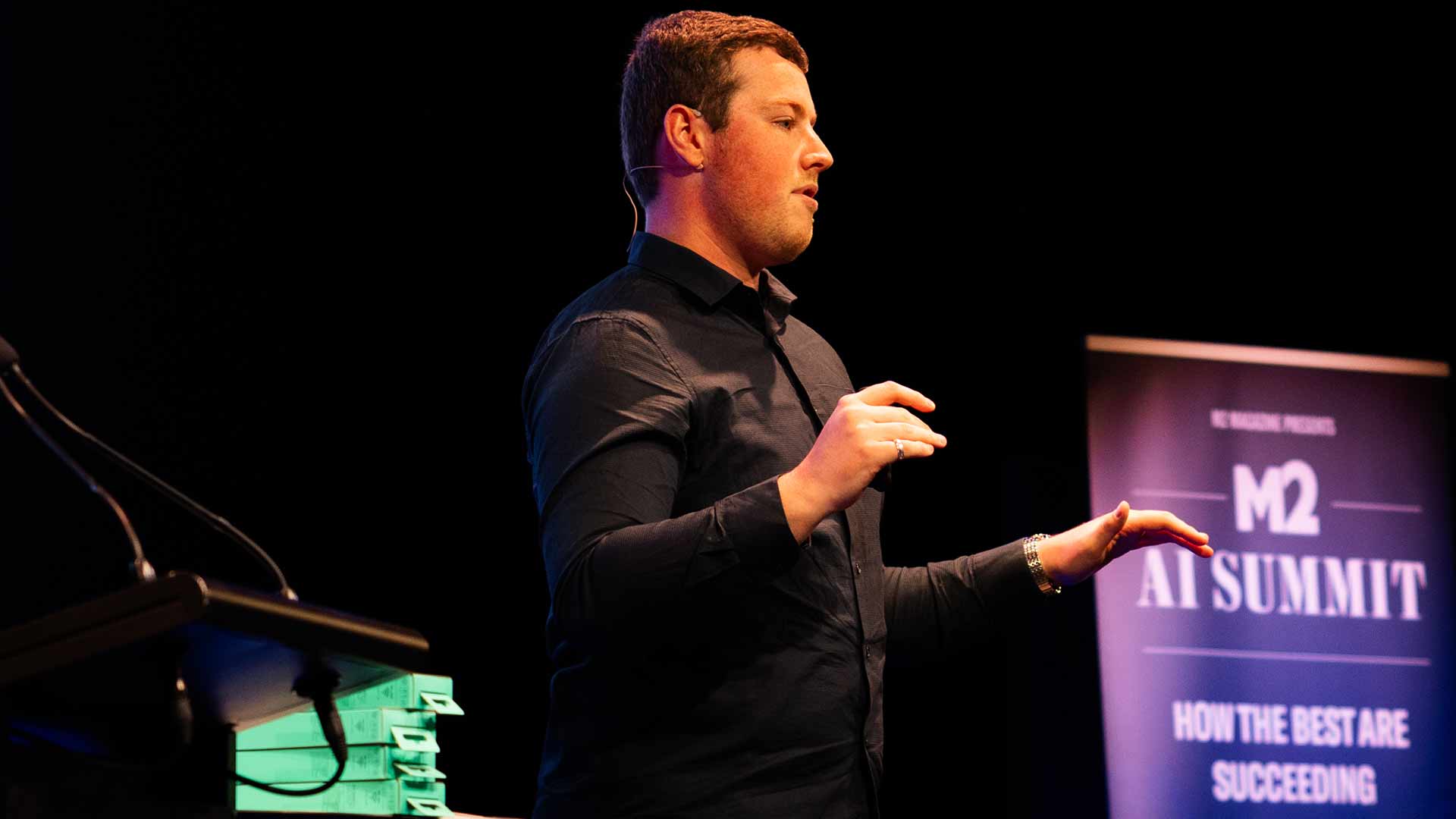
Using AI to Make Your Team Great
Blake Harkness suggested that, in an AI world, “the newest person might be your most valuable”, and the talent everyone’s chasing may already be sitting in the building.
Blake Harkness opened by flipping a familiar assumption on its head. Normally, he said, a fresh graduate knows “nothing about your clients, your relationships, the standard operating procedures”, so “they don’t actually provide you value for a year or two”. With AI, “I think this is completely flipped”, and he’d know, because he lived it. When ChatGPT landed in 2022 he did what every student did: “I can cheat on everything.” But a nastier thought followed. “If AI can already do this now,” he wondered, “by the end of my degree am I actually going to be able to find a job?” So he went all in, took a graduate job at MainPower off the back of one bullet point about helping with AI, and ran with it. A side project that scanned his partner’s makeup for cheaper dupes pulled in enquiries, and Harkness AI was born; it’s since helped more than twenty New Zealand businesses, “focusing really on practical use cases rather than all the fluff”.
He boiled it down to two ideas. First: “AI is an amplifier, it’s a garbage in, garbage out system.” It’s trained on the open internet, so the job is to feed it good information about your business and amplify what makes you you. The second follows on. “Your people are your superpower,” he said. “Everybody has a Claude licence, everybody can get a ChatGPT licence. But people don’t know your business, they don’t know your clients, they don’t know your process. Who does? Your staff.” They hold the real process, “compared to what the standard operating document actually says”, and that, not the tool, is the edge that lasts.
Which brought him to what he called New Zealand’s talent paradox. Back in 2023, he noted, around sixty per cent of tech roles went unfilled for lack of talent, while youth unemployment sits near sixteen and a half per cent, “almost three times the national average”. Yet businesses tell him in one breath they need AI skills and in the next that they won’t hire graduates “because AI is replacing that work”. His response was blunt: “You are literally blocking your AI-literate talent.” Universities banning AI just pushes students to use it anyway, often to solve real problems in their own lives, “and those are the kinds of people you actually want in your organisation”. Hence Young Kiwis in AI, his community for bridging the two. And because the field is barely four years old, the playing field’s surprisingly flat: “If I go into a business alongside someone that’s been there for twenty-five years, we’re starting at the same point about learning about AI.”
The answer, he argued, is to pair them up. The grunt work usually dumped on graduates, the reviewing and collating, is “all prime for automation”, but automating a process you don’t understand falls over every time. “I’ve made the mistake plenty of times of trying to automate a process that I don’t understand,” he said. “You can’t do it.” Pair a graduate with a grizzled colleague and both gaps close: the junior brings the AI fluency, the senior brings the domain knowledge and the judgement to check the output.
Doing it well “takes three things, and you can’t max all three”: training and education, tools and access, and time to explore. Handing everyone a Copilot licence and telling them to “go ham” achieves very little without training tied to real tasks, the right tools per role, and protected time to tinker, which is exactly why pairing helps. “It’s a balancing act.”
Throughout, he was firm about keeping a human in the loop. His own automations draft proposals and chase-ups but “never send it away” without a check. Hallucinations are rare but real, “I have to own that output”, and judgement, decisions and anything client-facing always get eyeballed. His first step is deliberately small: every fortnight, ask “what is the most tedious thing I did last week?”, map it out, and get AI to help fix it. Then take a proper look at your own team for the champions already there. “The people who hold the other half are already in your building,” he said. “Empower them.”
5 Takeaways
- The newest person might be your most valuable. AI-native graduates turn up useful in a way they never used to. The talent you’re chasing may already be in the building, or one hire away.
- AI is an amplifier, not a cost-cutter. Garbage in, garbage out. Feed it your real context and it multiplies a good team; treat it as a way to shed people and you bin the very knowledge that makes it work.
- Your staff are your superpower. Anyone can buy a Claude or Copilot licence, but no model knows your clients, your process or your unwritten know-how. That’s the advantage that sticks.
- Pair juniors with seniors. Graduates bring the AI fluency, seniors bring the domain smarts and the judgement to verify. Together they cover each other’s blind spots, and you can never automate a process nobody understands.
- Balance the three levers, and keep a human in the loop. Training, tool access and time to explore all matter, and you can’t max all three at once. Whatever you automate, own the output and check anything that leaves the building.