
Best of Watches & Wonders 2026: Patek Philippe
Ref. 610G-001
Celestial
Patek Philippe has been mapping the sky in mechanical form since 1927, when the manufacture first produced an astronomical pocket watch displaying sunrise and sunset times for a private client. That piece, made to order for James Ward Packard, was followed six years later by another for Henry Graves Jr., a commission that would eventually become the most complicated watch ever privately made. The through-line from those extraordinary objects to the reference 6105G-001 presented at Watches and Wonders 2026 is unbroken. Patek has simply been working on the problem for a very long time, and now, for the first time in the manufacture’s history, the solution fits on your wrist.
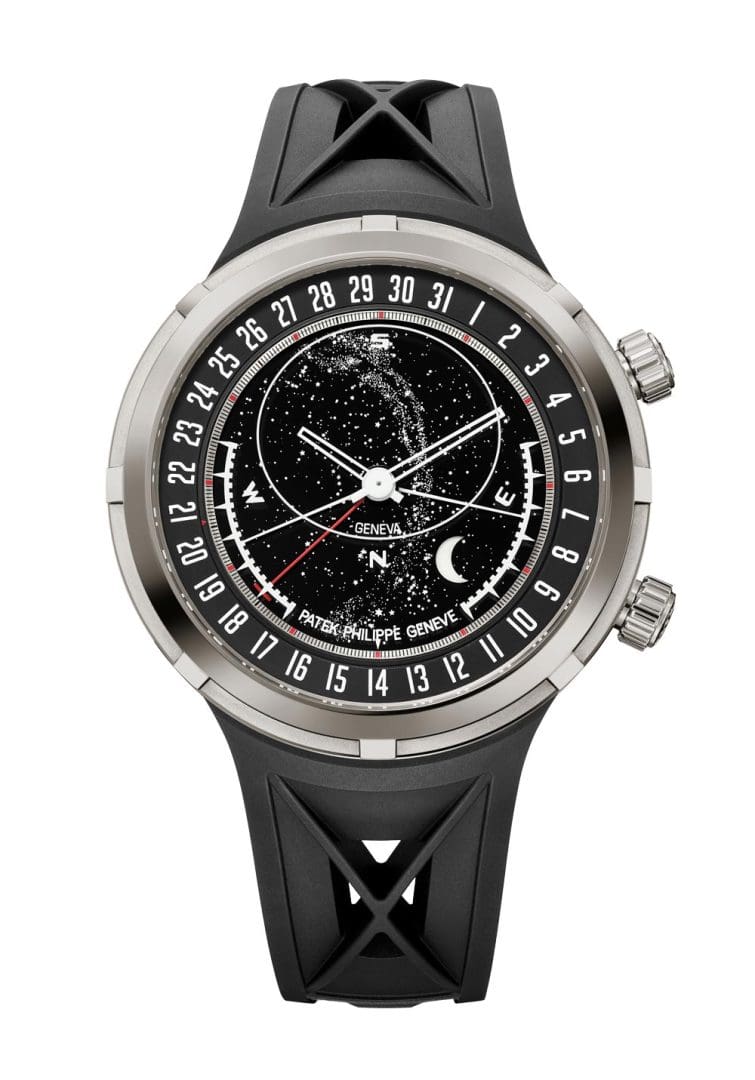
The new Celestial is Patek Philippe’s first wristwatch to display the times of sunrise and sunset. Five years of development and six patent applications later, the result is a 47mm white gold case housing the new calibre 240 C LU CL LCSO, a 426-part movement measuring 38mm in diameter and 7.93mm in height, which is remarkably contained given that the base calibre 240 measures only 3.43mm tall and the new sunrise/sunset mechanism adds just 1.12mm to that figure. The self-winding system uses an off-center mini-rotor in 22K gold, characteristic of the 240 family, whose density compensates for its small size. Power reserve runs between 38 and 48 hours. The Gyromax balance runs on a Spiromax balance spring in Silinvar at 21,600 vph, and the movement meets the Patek Philippe Seal’s rate accuracy standard of -1/+2 seconds per 24 hours.
The display architecture is genuinely complex. Three superposed transparent disks rotate at different speeds corresponding to astronomical cycles: the celestial vault disk completes one rotation per sidereal day, which is 23 hours, 56 minutes and 4.09892 seconds, not 24 hours, because a sidereal day measures rotation relative to distant stars rather than the sun. The lunar disk rotates over 24 hours and 50 minutes. The moon phase mechanism requires a correction of just one day every 3,000 years. To this existing Celestial display, Patek has now added the sunrise and sunset indication, driven by two ovoid cams whose geometry reflects the tilt of the Earth’s axis across the year. A double feeler-spindle just 0.48mm thick reads the cams via flexible arms, transmitting the information through a gear train to the relevant hands. The date scale on the periphery does double duty, serving simultaneously as the scale for sunrise and sunset times, which is an elegant piece of engineering economy.
The daylight saving problem, which has historically rendered sunrise/sunset watches temporarily incorrect twice a year, is solved here by a patented synchronised corrector system. Two push-pieces at 9 and 10 o’clock advance or retard the time by one hour while simultaneously rotating the date disk by 1/31st of a turn, keeping the sunrise and sunset indications in step without any manual recalculation. It is the kind of solution that sounds obvious once explained and is anything but.
The case carries Patek’s X-shaped motif worked directly into the caseband in contrasting polished and satin-brushed finishes, a design that continues onto the solid gold case back. It is a departure in scale and architectural language from the collection’s more classical pieces, and it demonstrates something that Patek does so well: the ability to hold a century and a half of heritage in one hand while reaching for something genuinely new with the other. The 6105G-001 is the result of that reach, and it is a remarkable thing.
Ref. 5249R-001
THE CROW AND THE FOX
There is a pocket watch in the Patek Philippe Museum in Geneva that has never been sold. Made between 1956 and 1958 by Louis Cottier, the Genevan watchmaker who invented the world time mechanism, it was a prototype that never went into production. For nearly seventy years it has sat in the collection as a testament to what the manufacture considered worth preserving: not just the functional achievements of watchmaking, but its capacity for poetry.
The reference 5249R-001 is that pocket watch, reimagined as a wristwatch and presented at Watches and Wonders 2026 as the first automaton in Patek Philippe’s modern history. That it has taken this long is not a reflection of technical inability. It is a reflection of the standard Patek applies before bringing something to market. The result, when it finally arrives, tends to be definitive.
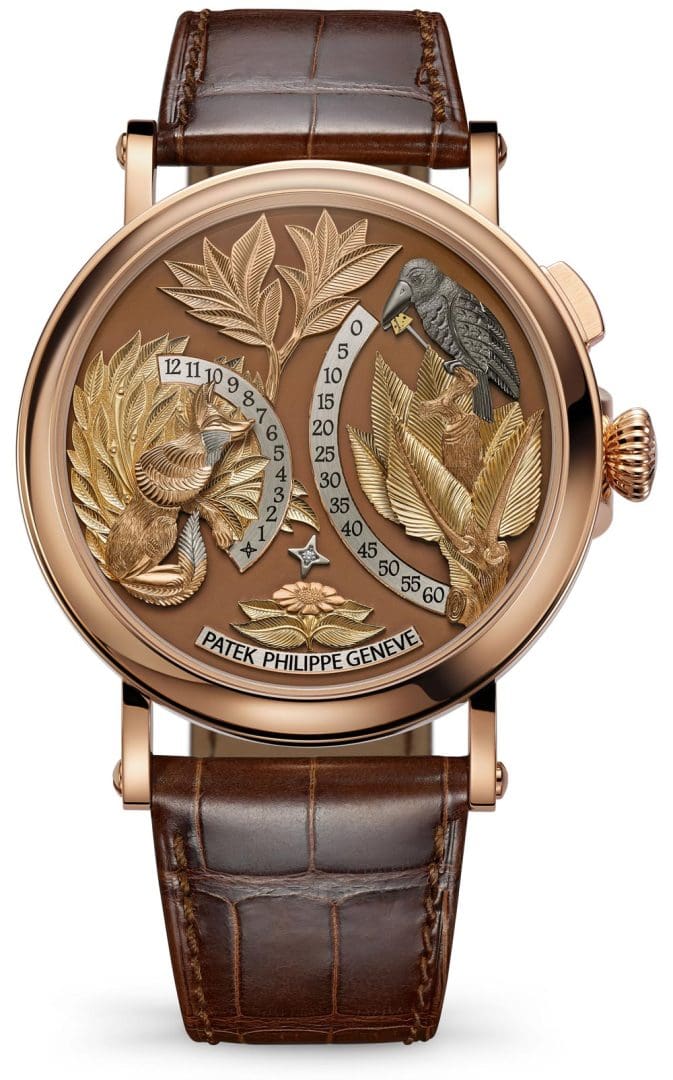
The concept is drawn from Jean de La Fontaine’s seventeenth-century fable in which a crow, flattered by a fox into opening its beak, drops its cheese. Here, that narrative is the display mechanism. Press the push-button at two o’clock and the fox indicates the hours with its paw for the first six hours, then with its muzzle from seven to twelve. Maintain the pressure and the minute hand, shaped as a wedge of cheese and made from titanium for the lightness needed to return cleanly to the crow’s beak, drops to indicate the minutes on a graduated arc. Release the pusher and both indicators snap back to their resting positions. The only permanently moving element is a small seconds display in the form of a diamond-set star at six o’clock, a quiet reminder that the watch is always alive even when the theatre is at rest.
The movement behind this is the calibre 31-260 PS HMD AU, a 267-part self-winding movement with a platinum mini-rotor, measuring 33.8mm in diameter and 4mm in height. It runs at 28,800 vph on a Gyromax balance with a Spiromax spring in Silinvar. Power reserve is 38 to 48 hours. The retrograde display mechanism uses snail-shaped cams, which means time setting requires turning the crown clockwise rather than anti-clockwise, with a patented coupling system protecting the movement against incorrect use.
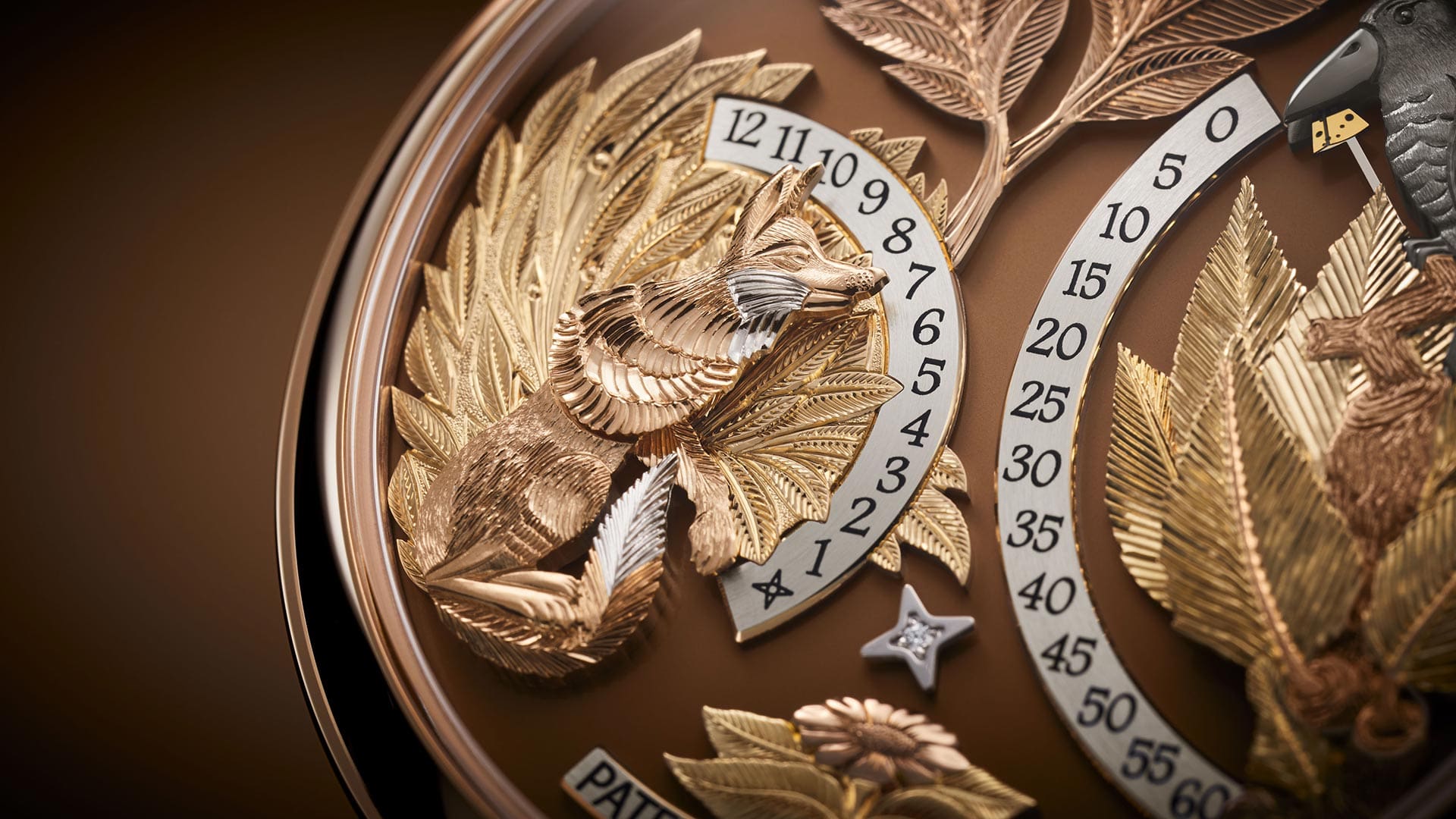
The dial is where the true measure of this watch becomes clear. The 18K rose gold plate in Matara brown opaline carries ten appliques in rose, yellow and white gold, all hand-engraved. At their thinnest these appliques measure 0.2mm. The fox’s head and paws are functional components as well as decorative ones, meaning any deformation during engraving risks putting the movement out of order. The engraver must calibrate every stroke with the movement’s tolerances in mind, a constraint that would paralyse most artisans and that Patek’s craftspeople treat as simply part of the work. Each watch requires around 150 hours of hand engraving. The minute hand’s cheese tip is hand-engraved and yellow gold-plated titanium. Total dial thickness is 2.5mm.
The 43mm rose gold case follows Patek’s Officer-style architecture, with a hinged dust cover protecting the sapphire case back and a view of the movement architecture beneath. It is worn on a shiny chocolate brown alligator strap with a triple-blade rose gold folding clasp. Production will naturally remain very limited, a consequence not of artificial scarcity but of the honest arithmetic of making something this difficult by hand. The reference 5249R-001 is, in the fullest sense of the phrase, a Patek Philippe: an object that takes the long view of what watchmaking is capable of, and then quietly exceeds it.