
How to Gain a Competitive Edge in an AI World
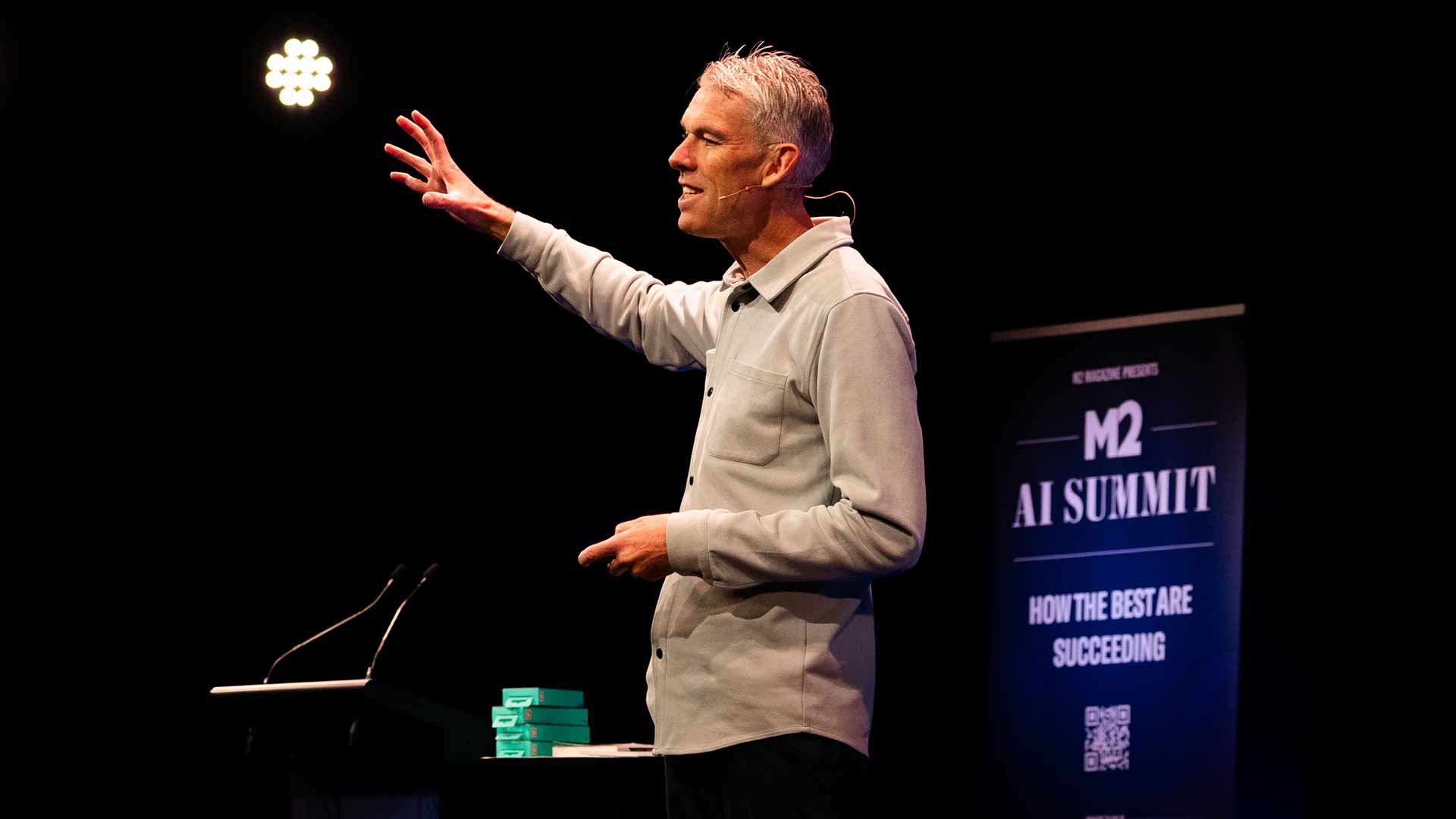
Leadership researcher Nick Petrie kicked off the M2 AI Summit with a bit of bad news: AI is not going to hand you your time back.
Nick Petrie opened with a question, asking the audience to place their own outfits on the technology adoption curve. Ahead of the pack? Behind it? About the same? Easier to work out than you would think, he reckoned, because new technology always arrives in the same order. First come the innovators, who grab a tool “before it’s really even ready” and start messing about with it. Then come the early adopters, the cautious thought leaders who want proof it works before they touch it. Everyone in the room sits somewhere on it.
Petrie, whose research has landed him in front of Google, NASA, Walmart and the White House, has spent five years watching the companies out front. He came bearing three things: what those early movers do well and you could copy, the traps they keep falling into, and the lessons the rest of us can take from them.
He started with the world before AI, and it was grimly familiar. A Microsoft study of 31,000 workers had captured a workplace of non-stop interruptions, back-to-back meetings and so little quiet that people did their real thinking after dark. AI was meant to rescue us. “The hope is it’s going to free us up,” he said, “give us space, give us time.” And has it? He asked the room to picture a full bucket of water, then pull a hand out of it and watch the gap close. “That’s what has happened with time savings,” he said. “It has collapsed in.”
What rushed into the gap is what he calls work intensification. “Things are speeding up, not slowing down for people,” he said, and “quite a few early adopters are starting to burn out faster than they were before”. The shape of work is shifting too. Layoffs grab the headlines, but probably the more insidious move is simply not replacing the people who leave: “We’re not going to hire someone, get AI to cover that.” How exactly AI is meant to do that, nobody’s quite sure, and the boundaries between jobs are “collapsing and merging” as expertise that used to belong to specialists seeps into the tools.
So what about all that saved time? A Glean study clocked it at roughly eleven hours a week, but Petrie warned about where it goes. More than half of it, he said, vanishes into “bot sitting” the AIs: feeding them, watching them and mopping up after them. Worse is the habit he cheerfully calls “bot shitting”, where frazzled staff shovel unverified output onto the next person, often unable to explain what they have just passed along. No wonder the sharper firms are suddenly obsessed with governance and guardrails.
The low achievers cram the saved time with more output and try to keep pace with machines that never sleep, and they pay for it. The high achievers play it differently, guarding what Petrie calls “grow mode” against the comfortable “perform mode” most of us default to. “If you don’t like learning, it’s going to get tricky over the next few years,” he said. “If you do, it’s probably going to get quite fun.”
Their big lesson is deep work. Once the boring, repetitive stuff is handed off, what’s left is the cognitively demanding, high-value thinking, done in uninterrupted ninety-minute blocks, and that is where people and AI together produce the most. There is also a line you shouldn’t cross. “Don’t outsource the core of your craft to AI,” he warned. “If you don’t use it, you lose it.” The same logic runs across the generations: seniors have the judgement, juniors have the AI fluency, so pair them.
He finished with an Amazon lifer who lasted a brutal decade only after a breakdown forced a rethink. The cure? “Argentine tango, to be precise.” On the dance floor “you must be in your heart and you must be in your body. Two places I never am during my workday.” Everyone he studied who thrived under pressure had one of these “opposite worlds”, a fully absorbing offline escape.
5 Takeaways
- Don’t expect AI to give you your time back. Whatever you save collapses straight back into more work. Treat reclaimed time as a deliberate choice, not a gift, or intensification will swallow it whole.
- Mind what you pass on. “Bot sitting” and shovelling unchecked output down the line are now common habits. If you can’t explain it, don’t send it. Guardrails are a leadership job now, not an IT afterthought.
- Protect grow mode. Low achievers pile on more work; high achievers ringfence time to learn. Build that habit now, because it is what separates the teams that keep up from the ones that don’t.
- Deep work is the premium, so don’t outsource your craft. When the easy stuff goes to AI, the hard, judgement-heavy thinking is what’s left, and it is where the value sits. The strategy, the storytelling, the mentoring: keep doing those yourself. Use it or lose it.
- Find your opposite world. The people who last pulse hard between screen and not-screen, head and heart. An absorbing offline thing that switches your work brain off isn’t a treat, it is how you avoid burning out as the pace climbs.