
How to go from Operator to Business Leader
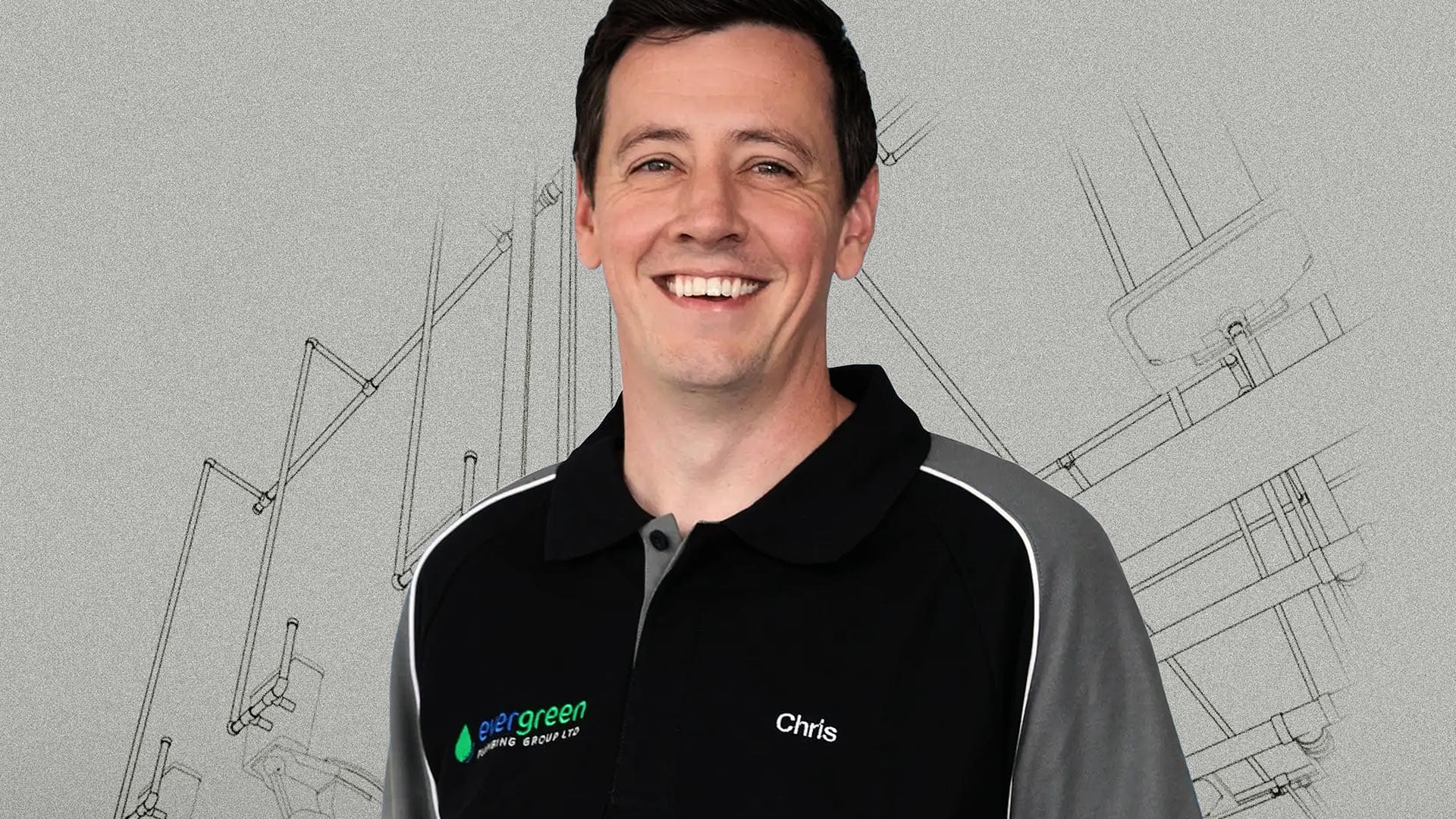
In any industry, being good at the work does not mean you are good at the business. Going to market, pricing properly, building systems, maintaining standards, hiring and developing people, and keeping enough work in front of them without sacrificing quality, these are just some of the plates that need to BE kept spinning. That is the shift Chris Baylis has had to make at Evergreen Plumbing in Hāwera.
There is also a wider community responsibility that many business leaders will recognise, particularly in regions like Taranaki, where primary industries account for a large share of GDP. At a time when construction and manufacturing have been under pressure, businesses like Evergreen are part of the service base that helps keep the regional economy working.
Baylis entered the trade through the local Hawera High School gateways programme, followed by an apprenticeship. One advantage of learning in a regional market was the variety of work. “We did maintenance, new installs, new builds, commercial work and industrial work,” he says. “You get a real taste of everything.” That variety built a strong technical foundation, but it also highlighted the demands of the trade. “Plumbing requires a lot of math. You need to be strong in English and communication. You have to be well-rounded.” Baylis is also pushing back on outdated perceptions. He doesn’t see plumbing as a fallback option, but as a profession that is becoming more technical and more demanding. “It shouldn’t be seen as a backup if you’re no good at school. If anything, it’s becoming more professional over time.”
He’s clear that the qualification is only the starting point. “There’s a plumber, and then there’s a plumber,” he says. Everyone may hold the same qualification, but capability isn’t equal. The difference comes down to how well someone understands the systems they’re working on, not just how to install them, but how they perform over time, how to diagnose issues properly, and how to deliver work customers can trust. Technical skill matters but so do communication, judgement, and professionalism.
“Construction goes through cycles. When things tighten, more businesses compete on price and when it becomes a race to the bottom, quality is often what gives.” For Baylis, that’s where the business side matters. A professional trade requires professional systems, clear pricing, and a service model customers can trust. One shift Evergreen Plumbing is currently in the process of, is their pricing and presenting system. Instead of a single quote, customers are given structured options. “You’ve got multiple options for everything,” he says. A “good, better, best” model allows clients to choose between a basic fix, a full replacement, or a premium option with added warranty and peace of mind. The goal is to put the decision in the client’s hands, not the technician’s assumptions. When customers are given clear options, many choose to invest more for better outcomes, whether that’s improved reliability, added benefits, or longer-term peace of mind.
Fixed pricing is another part of that shift. “It’s like booking an Uber versus a taxi,” he says. “With Uber, you know the number upfront. With a taxi, you’re watching the meter climb.” Hourly rates create uncertainty. Fixed pricing removes it. Customers can accept, decline, or choose another option but they’re not left feeling like the number has run away from them.
Becoming a business owner meant learning an entirely new profession.
“Plumbing is one job. Running a plumbing company is another,” Baylis says. “It’s a beast on its own.” In 2018, after several years in the trade, he and a colleague decided to go out on their own. They approached another company about subcontracting but were instead offered the opportunity to buy into Evergreen. “It was a big call. A lot of money, more than I’d ever had,” he says. But his view on risk is straightforward: “There’s risk in everything. There’s risk in staying where you are if you don’t move.” Buying into an established business gave them a head start, existing customers and existing work but it didn’t change the core lesson. “Running a business is not being a plumber. It’s its own profession.” One of the biggest learning curves has been systems. “If you don’t have proper systems and follow them, it falls over.” That applies to pricing, scheduling, workflow, team management, and customer communication. Growth doesn’t happen by simply taking on more work. It requires structure, clarity, and consistency. And systems aren’t static. “It’s constant. It’s not set and forget.” They need to be refined, reinforced, and sometimes rebuilt entirely. Without that, standards slip, especially as the team grows.
Baylis also highlights the difference between regional and city markets. “In a small town, it’s personal. You run into your customers all the time.” That changes the stakes. Reputation carries more weight. Service matters more. Word spreads faster. Evergreen’s expansion into New Plymouth has added another layer of learning. Unlike Hāwera, where the business was already established, this required building demand from scratch. “Work doesn’t just appear,” he says. “You build it through relationships and marketing.” That experience has given him a clearer understanding of how growth actually happens at the front end.
Staffing remains one of the biggest challenges, particularly in regional areas. “Hiring does have its challenges. If people don’t have ties to the area, they’re less likely to move.” That’s why Evergreen invests heavily in apprenticeships, working alongside Skills Trades Training, who support plumbing apprentices with NZQA and industry-recognised certified training and development.
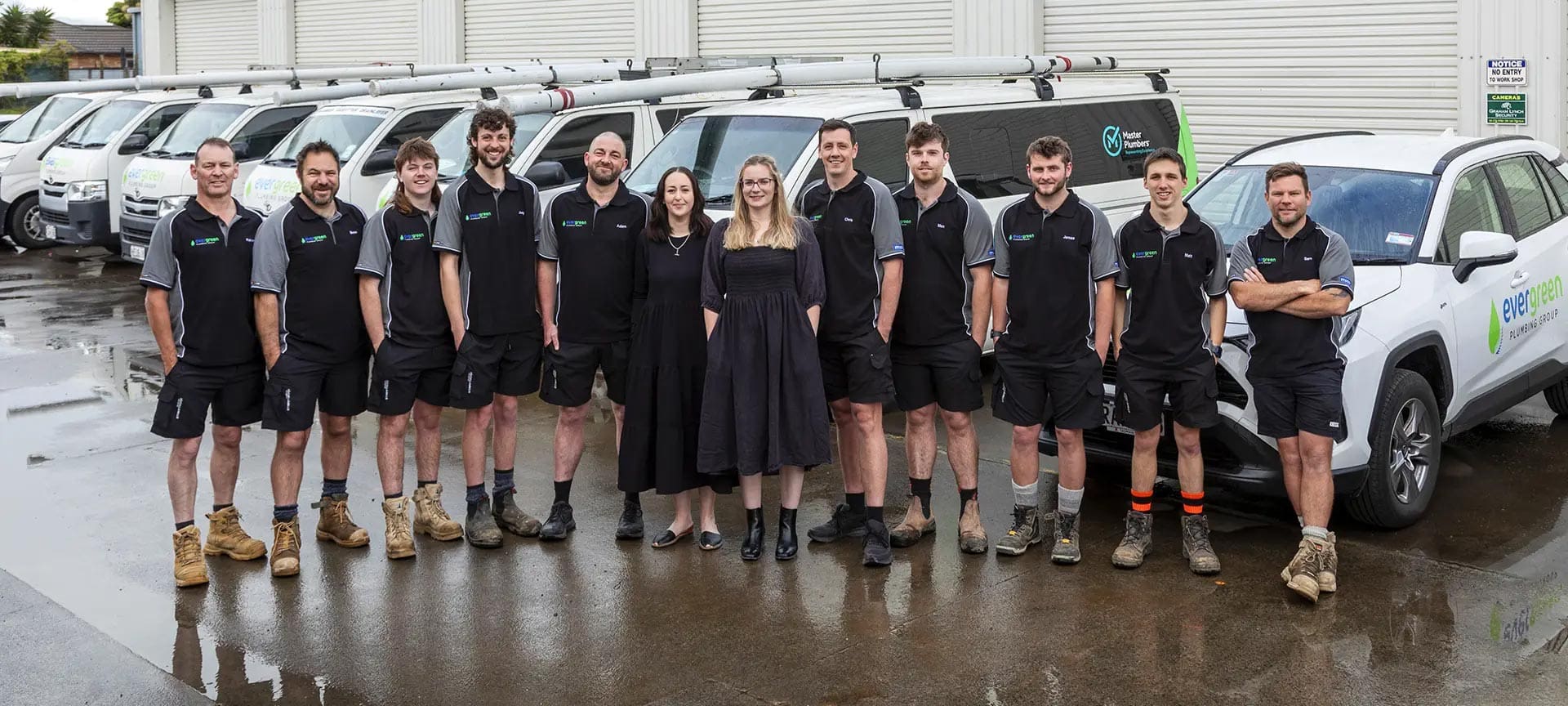
Apprentices are employed directly by Evergreen, while Skills Trades Training (which was formerly known as Industry Connection for Excellence or ICE for plumbing training) manages the formal training framework along with apprentice pastoral care. But the issue runs deeper than recruitment. It’s structural. Apprentices represent a significant investment for any business, but the industry’s boom and bust cycles disrupt consistent hiring, leading to the skill shortages that emerge in the years that follow. For Baylis, that cycle is one of the industry’s biggest problems. You can’t solve skill shortages without retaining people through the downturns.
In a regional market, the solution isn’t hiring ready-made talent, it’s building it. That means training people, supporting them, and giving them a clear pathway. Baylis also sees strong opportunity in the regions: lower living costs, less congestion, and a faster path to getting established. For younger tradespeople, it can be a strategic advantage, if they’re willing to take it. One of the less visible pressures of running the business is managing workflow. Too much work creates strain. Too little creates uncertainty. “It’s surprising how stressful low or no work can be, sometimes more than having too much. Fortunately, we haven’t experienced many of those periods.” That balance sits at the core of the business. Customers expect fast turnaround, especially for maintenance work. At the same time, the business needs consistent volume to keep good people employed and operations stable. That tension doesn’t go away.
At a national level, Skills Trades Training’s plumbing division supported over 1,000 plumbing, gasfitting and drainlaying apprentices in 2024/2025 period – around 20 percent of the country’s total. That scale reflects a broader reality: the sector depends on a steady, supported pipeline of apprentices if it is going to meet ongoing demand.
That local relationship sits inside a much bigger national training effort. Skills Group’s 2024 annual report says its specialist trades business or Skills Trades Training as its now known supported 1,037 plumbing, gasfitting and drainlaying apprentices. The wider group says it supports more than 7,000 trainees and 5,500 apprentices, and employs 600 apprentices through its group employment scheme. Its public training material positions plumbing, gasfitting and drainlaying as essential work that keeps New Zealand infrastructure running. For Evergreen, Skills Trades Training is not just a paperwork partner. It provides the formal apprenticeship structure, supports trainees through the on-job and off-job training framework, and helps create a pathway from entry-level apprentice to qualified tradesperson in a market where talent cannot simply be hired off the shelf.
It is a model that extends well beyond the tools of any one trade. Skills Group is one of New Zealand’s largest vocational training providers, working across industries including trades, healthcare, hospitality, IT, business, culinary and more, on the same principle that underpins Evergreen’s approach to apprenticeships. Because building people is how you build an industry.