Sculpting into a Storm
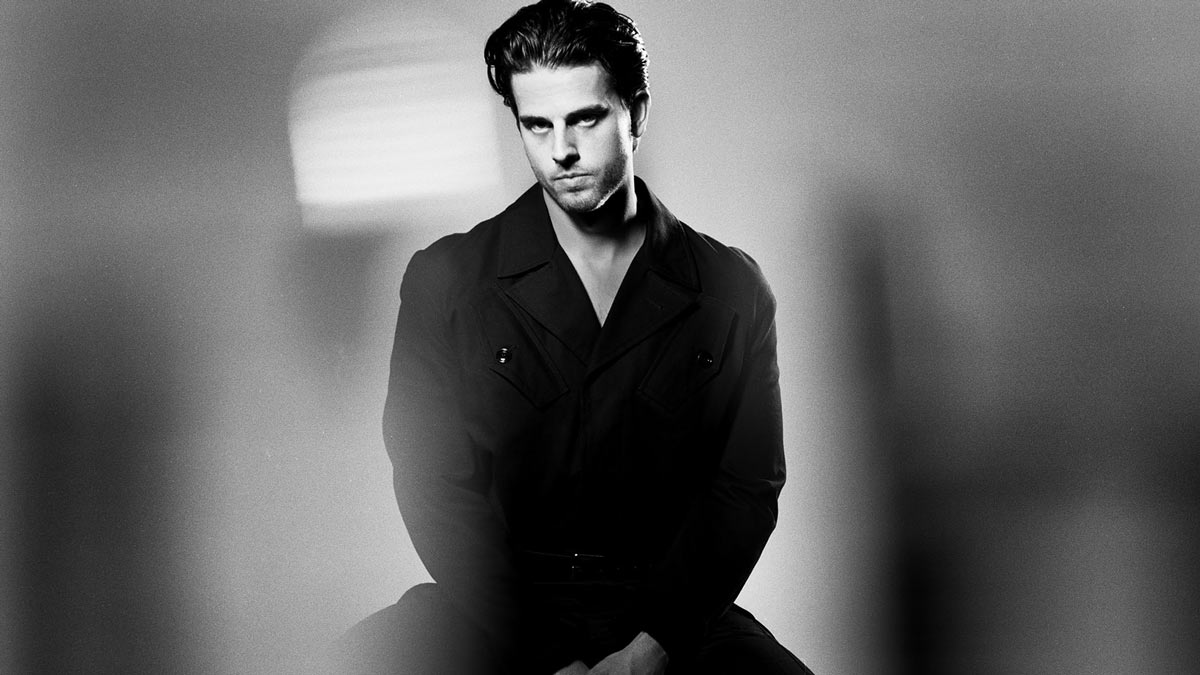
Imagine, if you would, a mighty great storm being sculpted – the rolling clouds thundering towards you. Or a vast blue ocean choreographed with its towering waves crashing down. Or invisible forces of nature transformed into something you could stand inside. For New Zealand multimedia artist and composer Jesse Woolston, his imagination is only the beginning as he invites you to step inside these natural occurrences.
His canvas and easel are the laws of physics; his medium is an extraordinary fusion of technology, sound and movement. Born in Lower Hutt and raised between his birthplace and Auckland, Woolston developed an early connection with Aotearoa’s landscapes, an influence that continues to underpin his stunning art. Now internationally lauded for his craft, he has spent more than a decade building a creative career overseas, immersing himself in big installations that blur the boundaries between visual art, sculpture, music and scientific simulation. His work has attracted international attention, with projects and collaborations spanning prestigious art institutions, like The Institute of Contemporary Arts in London, high-profile celebrity heavyweights like Leonardo DiCaprio, and global brands like Dior.
Yet, for all the global recognition, there is something wonderfully full-circle about Woolston’s latest art project. From 12 to 15 November, he returns home to feature in Art in the Park at Auckland’s Eden Park, presenting The Infinite Constant Front, the largest work of his career. Combining monumental weather systems, original music and technology, the installation that will amaze guests at Art in the Park transforms the stadium into an immersive encounter with nature’s raw power. It is a homecoming on an extraordinary scale, bringing an internationally celebrated Kiwi artist back to the landscapes that first inspired him – and welcoming audiences to experience the natural world as something not merely observed, but felt.
How did you first find art?
Art found me. When I was younger, I had this pull and this compulsion to go towards art. I wanted to build these experiences and these moments. I remember looking around at society to search for where I could do this. I looked at engineering and technology. Art is a bizarre space in society where people can do what they can. Artists are just weird and do weird things, you know. You don’t have to have a PhD in art to be an artist. Art was in this arena where I had the best shot at creating the things that I felt I had to make. I’ve really just followed that compulsion and that desire to do it. It’s kind of strange that I don’t come from the art world. I’m amongst it, but my interest, my passions and my direction come from somewhere else.
The use of nature – like water or light or weather – feels less like the subject in your art pieces and more of a collaborator. How, as an artist, can you explore that with technology?
As Kiwis we all have this connection with nature that’s a bit different than maybe other places around the world. It’s really intertwined in us and we all have a respect for it because it’s literally one of the biggest parts of the country. It’s this language between you and your surroundings. It’s a bit more intimate. It’s me and nature and how it talks and how it is just by itself in its beautiful ways.
I’m trying to use the tools to speak. To expose that quality; who and what that is. I want someone to stand in front of a work I build and think wow and consider the environment more. There’s this language between all of us as human beings and our environment in New Zealand. It’s been the dominant topic in my entire life. The natural phenomena and the universal laws around us. The entire goal with my work is to one day get to a place where it’s so precise. What I’m trying to do is create the conditions for nature to exist, which is beautifully terrifying. It’s a way to ask: what’s it like being a human being in this vast earth. Humanity itself has been built on 200,000 years of evolution. I like to think that that’s enough information and framework. So I feel like I’m not doing anything new. We are nature as well. We are the exact thing that’s around us, not in a philosophical way but in a literal way. It’s the most ‘human art’.
Your multimedia work also deals with soundscapes as a component. How closely are those two worlds connected to your creative process?
Sound and music very much provide the emotional context over a linear period of time. You can see this in film. You can have a soundtrack that feels positive and uplifting, and then you match it to a horror film and suddenly it sounds creepy and really uncomfortable. Using distance and how you frame things emotionally is important. With my framing, when I was younger, and I was looking at the art world, I thought, ‘Okay, this is the place where I can do what I’m aiming at.’ Part of that aim was to build the tools and skill-set to be able to execute how I feel connected to nature.
When you’re experiencing nature, whether it’s a beautiful beach, a mountain or anything like that, it’s just different mixes of emotions. I looked at that and thought, ‘We have these senses where the visual is obviously the immediate sensory experience, or something that can be a framework for the visual.’
I wanted to use music specifically as an emotional context for the viewer. If I’m going to ask, ‘What does that mean?’, well, I try to convey and speak the language of nature. I’m trying to hit that point in your chest where you feel something profound or powerful, or maybe a little bit scary.
Then I looked at what I could use as a mechanism to reinforce that. With music, I thought that Western music in general is largely diatonic, with tonal harmony. To get a starting point, I looked at that and saw an emotional scale. Something can feel alluring or biblical, then sad and depressing, or tense, and everything in between.
It’s almost a framework of senses. If I’m going to build a simulation that feels intimidating or intense, then I know that I will need to rebalance those emotional qualities. The music might be a bit softer, which kind of evens it up, because that’s more precise to the experience I’m trying to convey.
I’m not trying to be all in one camp. If someone experiences my work, I want them to hopefully feel the full range of what nature speaks to: something uncomfortable in the music, with some tension maybe, but also beauty, with some consonance and things like that.
I look at it as: how can I reinforce what I’m already doing by using music and sound? Then it also extends into physical materials and how I work with sculpture, painting and every medium. Everything is supposed to be there just to facilitate a stronger voice for the work I’m trying to produce that speaks to nature.
You’ve worked with some big international brands, and you do have a very impressive CV. How do you maintain your personal and experimental qualities within the practice when working in a more commercial setting?
It’s honestly such a great question, because this is also something that, in the day and age of art, is a reality. If you want to survive and do well, you kind of have to do a lot of different things. Until you’re 40 years into your career, you have to do anything.
For me, though, I actually really enjoy working in these arenas with brands. The reason I say that is because there’s actually a way to do it where it works out to be really, really interesting and really quite cool. When I’ve worked with brands in the past, they’ve actually just treated me as the artist. They’ve given me no guidance. They’re just like, ‘Whatever you want to do, we’ll do it.’ And that’s crazy. But here’s the kicker. This is the whole game: when I’ve rolled up to these projects, whoever else I’ve rolled up with, I’ve said, ‘This is the whole artwork I want to build. This is why I’m inspired by it.’ I treat it like an art project.
Then everyone across the table goes, ‘Oh, our job’s done. We don’t have to guide this person. They already know what they’re doing.’ So what’s interesting is that, by treating everything like an art project, no matter the context, it actually becomes something I’m really interested in exploring. I love working with brands, like Dior, because I love fashion, but I also wanted to jump into a whole other industry and just see what happens and what my artwork would look like in that arena. Or film, for example.
It’s also about diving into these different arenas and thinking, ‘How can I actually make this an artwork?’ Instead of thinking that art has to just be a canvas on a wall, or on an LED wall, or a sculpture, to me, art is pretty much everything. That’s where it’s actually been really, really fun. I get to be in an environment where I do something new, like a little bit of a different type of clay, but there’s no ‘Hey, you have to do this. We don’t like this. Do this instead.’ I try to arrive with everything figured out already, so I have freedom. That’s been the goal.
Let’s say when you went in with Dior, one can only assume that you had been looking at past Dior campaigns, to get inspired. Who would you say are your biggest inspirations? Who inspires you the most?
The cool thing about the Dior project was that when I talked to them, I was actually inspired by Dior himself, at his childhood home. When he was drawing dresses in his garden, there’s a pond there, and I was looking at the English Channel by him and kind of looking at the environment.
That was what inspired the work, which was great because I got to get a bunch of archival stuff and use that as inspiration in the work.
But in terms of a large inspirational set, I have different dimensions that I look at in other artists and people who have been around contemporary art. The first thing is that nature is obviously the most direct inspirational source. To me, that’s the one. But then I look at artists like Olafur Eliasson, if you’ve heard of him, where he looks at light and more large-scale effects of phenomena and architecture. Then there’s Anish Kapoor, who looks at more sublime ideas, voids and that kind of element. That kind of larger scale and material is inspiring.
I’m also a big fan of Hermann Nitsch, if you’ve heard of him. I love him because his whole arena with Actionism and things like that is so graphic and intense. That’s a marker of that quality of nature that’s quite violent, but it’s there. So I look at these different pockets and different artists.
Then my own inspirational sources – growing up, where I have been, the environments and my experiences – create this cocktail of direction where I’m like, ‘Okay, I have to go in this direction, and it has to feel like this, like this, like this.’ That’s how I am when I make something.
So, Art in the Park…
Hell yeah, I love these people. They’re stars. If you think about it, where in the world would you get a bunch of lunatics and be like, ‘Let’s build something in a stadium?’ It’s so good. Dude, I have to be there.
It’s like you and your art pieces are returning home, in a sense.
Dude, I left home when I was young, and I’ve been really fortunate enough to build international projects. It’s been a joy. But the whole time I’m like, ‘I want to build something at home. This is where it comes from.’ I haven’t been able to have an opportunity, and then all of a sudden you get some ambitious Art in the Park curators and they’re like, ‘Why don’t we just do this?’
I can come home and it can be built at Eden Park, which is where we’ve all grown up watching the All Blacks play, the cricket, everything. It is the place. The country gets to come together and be like, ‘This is what New Zealand can do.’ Here’s the thing that I’ve thought about too. I’ve been very fortunate to get into rooms in the art world, which is really very sweet and amazing. I’m really honoured to do that. But I never find any New Zealanders. It’s always, at most, maybe an Australian. They’re great, but I’m kind of like, there isn’t enough New Zealand representation in these arenas, and especially not in the art world as much as I’d love.
So I see this also as a moment where a bunch of New Zealanders, a bunch of artists, can come together and actually build something to a scale that the rest of the world will see.
We get to break the door down a little bit and be like, ‘Hey, look what we’re doing. Nobody’s doing a stadium with art everywhere. Nobody else is doing it. Of course we’re doing it, because we’re great!’
I love it. I’m just so stoked that New Zealand has more moments where we can show off the country.
It’s a cool collaboration, right?
Yeah. I honestly also hope there’s an element of spectacle. Take my work, right? There’s an element of spectacle. You can look at it and be like, ‘Okay, dude, you’re definitely leaning on the senses and large scale, and it’s intense.’
But I want it to serve as, at least, something that helps encourage what you said. If the New Zealand Government saw this and they were like, ‘You know what? Maybe we should get more involved,’ I’d be like, ‘Yes! That’s exactly what it should be.’
How do we pull New Zealand together as a country and start doing more? Because there’s so much room for us to do so many things. I’d love it, man. I’m hoping it can be loud enough that it starts to create momentum. I would love to see Art in the Park really turn into a location that New Zealanders get to build at large scale inside a stadium. But what I also love is the idea of some of the biggest artists in the world being like, ‘Well, why don’t we build inside a stadium?’
Then it becomes this international destination to build nutty installations in the corner of the world.
That’d be great, you know? Why not?
If you strip away the screens and the software and the technology behind your art, what do you think would be the central idea that remains? What is the feeling you’re ultimately trying to communicate?
Bro, this sounds bizarre – I’ve been building simulations for more than a decade and it’s been my paintbrush for a very long time, but it is not my focus. It is only a tool for me to achieve what I am trying to aim at, and it’s the best tool I can use right now. So that means that if you strip all that away, it doesn’t change anything. It still focuses on the exact same premise, which is that anything that I create, any artwork I create, is only an object for someone to have a moment with themselves. It should be a mirror. That’s all. It only exists to be a mirror. People should not think about me. They should think about what this object is in front of them and how it makes them feel. How does it make them think? At the end of the day, what I want is to create these moments for people to have this connection with their environment, with themselves, with how they feel. As we talked about earlier, when it comes to the evolutionary arcs and how we’re built, how we feel – I just want people to really have that connection. My life has been completely changed because of my experiences with nature and the environment, and that has given me the confidence to chase after what I want in life.
If there is a moment where someone can be affected by what’s really in themselves, I feel like that’s my job done.
But I also will say that nobody should – you can dislike it, you can like it, it does not matter. Don’t even have an opinion. It’s fine. So there’s kind of the initial answer when it comes to the artwork: don’t ever think about it. Feel it. And then the second answer is, if you want to dive deeper into maybe how I think about it, then that would be the longer answer. I like the body first, instead of the intellectual quality of technology and that kind of programming aspect.